Oregon Rural Practice-based Research Network, Portland, Oregon.
Department of Family Medicine, Oregon Health and Science University, 3181 SW Sam Jackson Park Rd, Mail Code L222, Portland, OR 97239. Email:
Prev Chronic Dis. 2019 Aug 15;16:E107. doi: 10.5888/pcd16.180395.
Accountable Care Organizations (ACOs) are implementing interventions to achieve triple-aim objectives of improved quality and experience of care while maintaining costs. Partnering across organizational boundaries is perceived as critical to ACO success.
We conducted a comparative case study of 14 Medicaid ACOs in Oregon and their contracted primary care clinics using public performance data, key informant interviews, and consultation field notes. We focused on how ACOs work with clinics to improve colorectal cancer (CRC) screening - one incentivized performance metric.
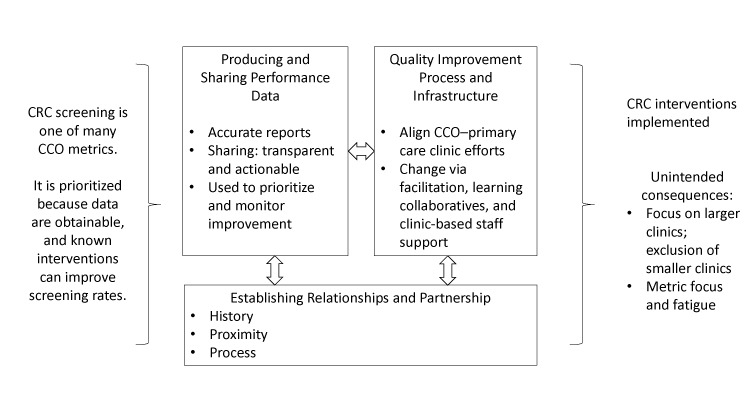
ACOs implemented a broad spectrum of multi-component interventions designed to increase CRC screening. The most common interventions focused on reducing structural barriers (n = 12 ACOs), delivering provider assessment and feedback (n = 11), and providing patient reminders (n = 7). ACOs developed their processes and infrastructure for working with clinics over time. Facilitators of successful collaboration included a history of and commitment to collaboration (partnership); the ability to provide accurate data to prioritize action and monitor improvement (performance data), and supporting clinics' reflective learning through facilitation, learning collaboratives; and support of ACO as well as clinic-based staffing (quality improvement infrastructure). Two unintended consequences of ACO-clinic partnership emerged: potential exclusion of smaller clinics and metric focus and fatigue.
Our findings identified partnership, performance data, and quality improvement infrastructure as critical dimensions when Medicaid ACOs work with primary care to improve CRC screening. Findings may extend to other metric targets.
责任医疗组织(ACO)正在实施干预措施,以实现改善医疗质量和体验,同时控制成本的三重目标。跨组织边界合作被认为是 ACO 成功的关键。
我们对俄勒冈州的 14 个 Medicaid ACO 及其签约的初级保健诊所进行了比较案例研究,使用公共绩效数据、关键知情人访谈和咨询现场记录。我们专注于 ACO 如何与诊所合作提高结直肠癌(CRC)筛查的效果-这是一个有激励作用的绩效指标。
ACO 实施了广泛的多组件干预措施,旨在提高 CRC 筛查率。最常见的干预措施侧重于减少结构性障碍(12 个 ACO)、提供提供者评估和反馈(11 个 ACO)以及提供患者提醒(7 个 ACO)。ACO 随着时间的推移发展了与诊所合作的流程和基础设施。成功合作的促进因素包括合作的历史和承诺(伙伴关系)、提供准确数据以确定优先行动和监测改进的能力(绩效数据),以及通过促进、学习合作、支持 ACO 和诊所内部人员配置来支持诊所的反思性学习(质量改进基础设施)。ACO-诊所合作出现了两个意外后果:潜在排除较小的诊所和指标关注和疲劳。
我们的研究结果确定了伙伴关系、绩效数据和质量改进基础设施,当 Medicaid ACO 与初级保健合作以提高 CRC 筛查效果时,这些是关键维度。研究结果可能适用于其他指标目标。