Li Zhongjun, Huang Lishan, Wei Li, Hou Zhiyong, Ye Weibiao, Huang Suran
Department of Obstetrics and Gynecology, Dongguan Affiliated Hospital of Southern Medical University, Dongguan, Guangdong 523059, P.R. China.
Department of Pathology, Dongguan Affiliated Hospital of Southern Medical University, Dongguan, Guangdong 523059, P.R. China.
Oncol Lett. 2019 Aug;18(2):1915-1921. doi: 10.3892/ol.2019.10507. Epub 2019 Jun 21.
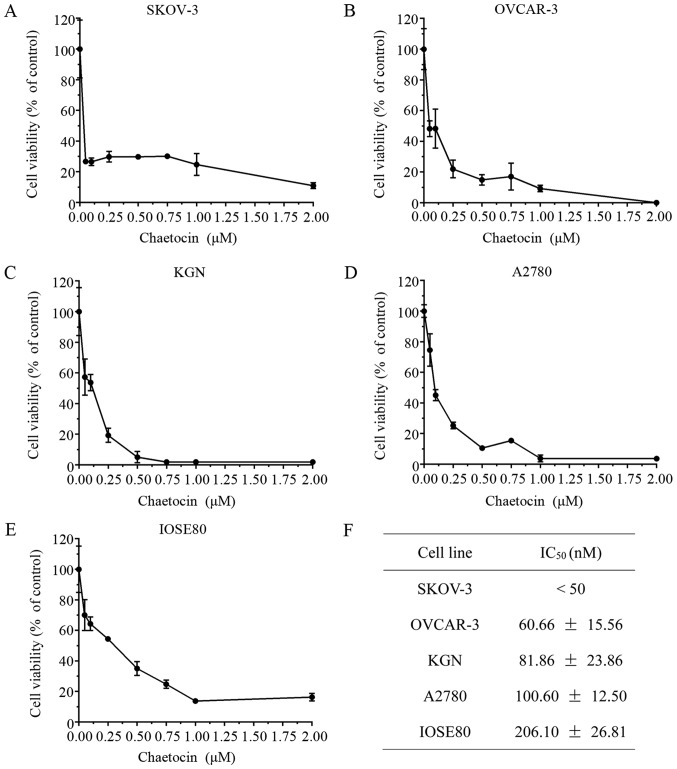
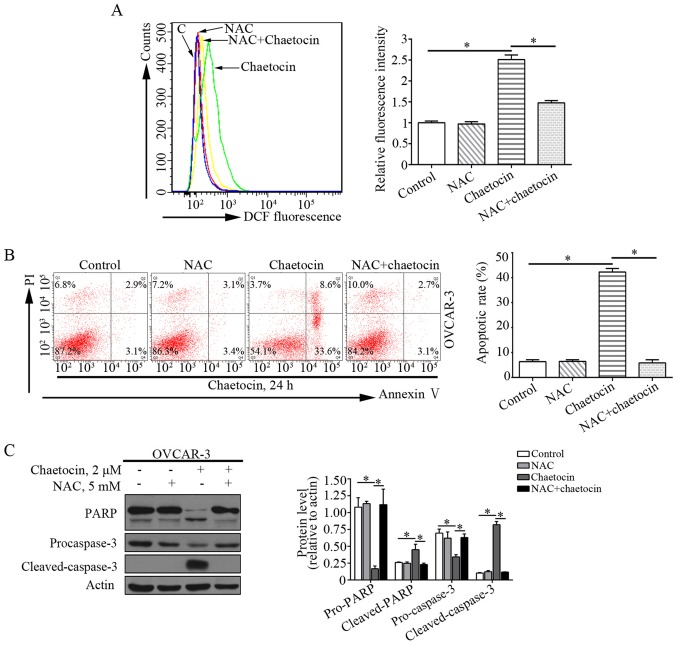
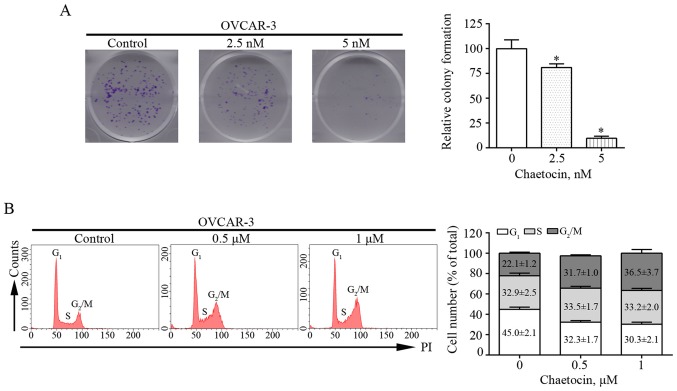
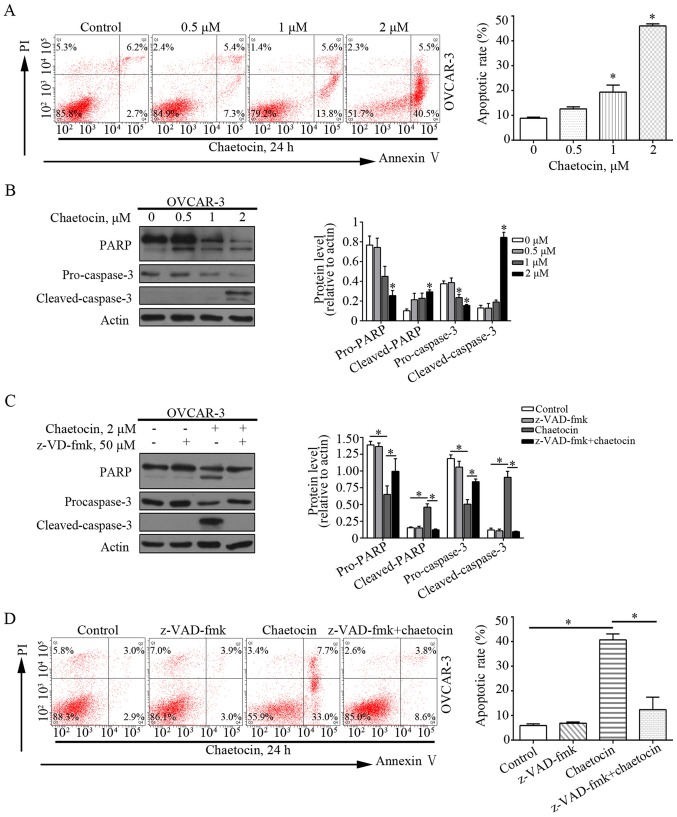
Ovarian cancer (OC) is one of the most common types of cancer among women worldwide. The majority of patients with OC respond to current chemotherapy approaches initially; however, patients are likely to experience cancer recurrence and become resistant to the chemotherapy. Therefore, novel agents for the treatment of OC are urgently required. Chaetocin, a natural product isolated from fungi, has been reported to exhibit anticancer activity against various types of cancer; however, the pharmacological action and detailed mechanism underlying the effects of chaetocin on OC cells remain unclear. Therefore, the present study investigated the cytotoxic effects of chaetocin on OC cells. A Cell Counting kit-8 assay was used to study cell viability, a colony formation assay was used to assess cell proliferation, flow cytometry was used to detect apoptosis, cell cycle and reactive oxygen species (ROS) generation, and western blotting was used to determine the protein levels of poly (ADP-ribose) polymerase, caspase-3 and cleaved-caspase-3. The results demonstrated that chaetocin significantly decreased the viability of OC cells. Chaetocin inhibited the proliferation and induced G/M phase arrest of the OVCAR-3 OC cell line. Additionally, chaetocin induced apoptotic cell death in OVCAR-3 cells via the caspase pathway. It was observed that chaetocin induced the accumulation of ROS in OVCAR-3 cells. Treatment with the ROS scavenger N-acetyl-L-cysteine reversed the apoptotic effects and activation of the caspase pathway induced by chaetocin. Collectively, these results revealed that chaetocin suppressed the proliferation and promoted the caspase-dependent apoptosis of OC cells by increasing the levels of ROS. Therefore, chaetocin may serve as a potential therapeutic agent for the treatment of OC.
卵巢癌(OC)是全球女性中最常见的癌症类型之一。大多数OC患者最初对当前的化疗方法有反应;然而,患者很可能会经历癌症复发并对化疗产生耐药性。因此,迫切需要用于治疗OC的新型药物。Chaetocin是一种从真菌中分离出的天然产物,据报道对多种类型的癌症具有抗癌活性;然而,chaetocin对OC细胞作用的药理作用和详细机制仍不清楚。因此,本研究调查了chaetocin对OC细胞的细胞毒性作用。使用细胞计数试剂盒-8检测法研究细胞活力,使用集落形成检测法评估细胞增殖,使用流式细胞术检测细胞凋亡、细胞周期和活性氧(ROS)生成,使用蛋白质印迹法测定聚(ADP-核糖)聚合酶、半胱天冬酶-3和裂解的半胱天冬酶-3的蛋白质水平。结果表明,chaetocin显著降低了OC细胞的活力。Chaetocin抑制了OVCAR-3 OC细胞系的增殖并诱导其G/M期阻滞。此外,chaetocin通过半胱天冬酶途径诱导OVCAR-3细胞发生凋亡性细胞死亡。观察到chaetocin诱导OVCAR-3细胞中ROS的积累。用ROS清除剂N-乙酰-L-半胱氨酸处理可逆转chaetocin诱导的凋亡效应和半胱天冬酶途径的激活。总的来说,这些结果表明chaetocin通过增加ROS水平抑制了OC细胞的增殖并促进了其半胱天冬酶依赖性凋亡。因此,chaetocin可能作为治疗OC的潜在治疗剂。