Wang Huihui, Wen Chuangyu, Chen Siyu, Li Weiqian, Qin Qiyuan, He Lu, Wang Fang, Chen Junxiong, Ye Weibiao, Li Wende, Peng Junsheng, Yang Xiangling, Liu Huanliang
Department of Clinical Laboratory, The Sixth Affiliated Hospital, Sun Yat-sen University, Guangzhou, China.
Guangdong Provincial Key Laboratory of Colorectal and Pelvic Floor Diseases, Guangdong Institute of Gastroenterology, The Sixth Affiliated Hospital, Sun Yat-sen University, Guangzhou, China.
Front Pharmacol. 2021 Oct 27;12:729367. doi: 10.3389/fphar.2021.729367. eCollection 2021.
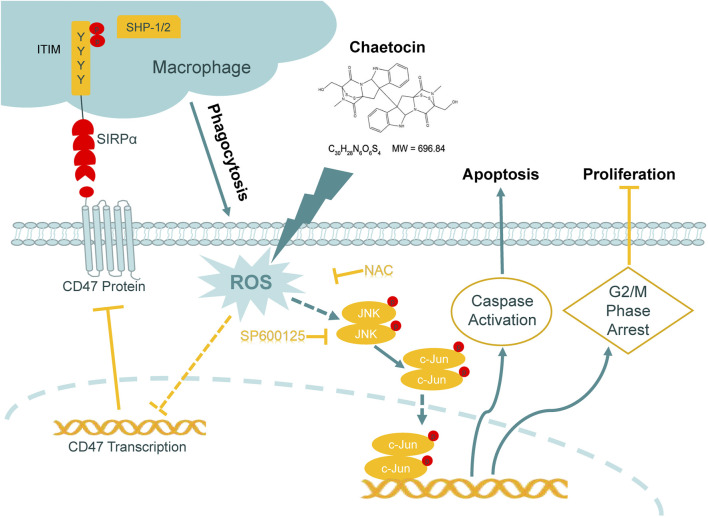
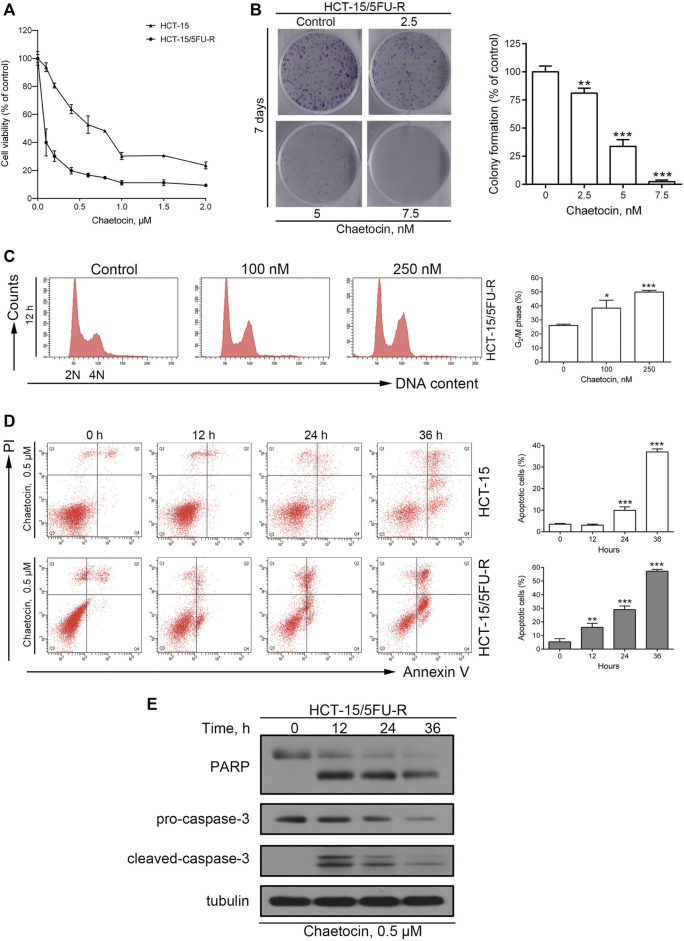
There is an urgent need for novel agents for colorectal cancer (CRC) due to the increasing number of cases and drug-resistance related to current treatments. In this study, we aim to uncover the potential of chaetocin, a natural product, as a chemotherapeutic for CRC treatment. We showed that, regardless of 5-FU-resistance, chaetocin induced proliferation inhibition by causing G2/M phase arrest and caspase-dependent apoptosis in CRC cells. Mechanically, our results indicated that chaetocin could induce reactive oxygen species (ROS) accumulation and activate c-Jun N-terminal kinase (JNK)/c-Jun pathway in CRC cells. This was confirmed by which the JNK inhibitor SP600125 partially rescued CRC cells from chaetocin induced apoptosis and the ROS scavenger N-acetyl-L-cysteine (NAC) reversed both the chaetocin induced apoptosis and the JNK/c-Jun pathway activation. Additionally, this study indicated that chaetocin could down-regulate the expression of CD47 at both mRNA and protein levels, and enhance macrophages phagocytosis of CRC cells. Chaetocin also inhibited tumor growth in CRC xenograft models. In all, our study reveals that chaetocin induces CRC cell apoptosis, irrelevant to 5-FU sensitivity, by causing ROS accumulation and activating JNK/c-Jun, and enhances macrophages phagocytosis, which suggests chaetocin as a candidate for CRC chemotherapy.
由于结直肠癌(CRC)病例数量不断增加以及当前治疗相关的耐药性问题,对新型治疗药物的需求迫在眉睫。在本研究中,我们旨在揭示天然产物茶褐素作为CRC治疗化疗药物的潜力。我们发现,无论对5-氟尿嘧啶是否耐药,茶褐素均可通过引起G2/M期阻滞和半胱天冬酶依赖性凋亡来抑制CRC细胞增殖。从机制上讲,我们的结果表明茶褐素可诱导活性氧(ROS)积累并激活CRC细胞中的c-Jun氨基末端激酶(JNK)/c-Jun通路。这一点通过JNK抑制剂SP600125部分挽救了茶褐素诱导的CRC细胞凋亡以及ROS清除剂N-乙酰-L-半胱氨酸(NAC)逆转了茶褐素诱导的凋亡和JNK/c-Jun通路激活得到证实。此外,本研究表明茶褐素可在mRNA和蛋白质水平下调CD47的表达,并增强巨噬细胞对CRC细胞的吞噬作用。茶褐素还抑制了CRC异种移植模型中的肿瘤生长。总之,我们的研究表明茶褐素通过引起ROS积累和激活JNK/c-Jun诱导CRC细胞凋亡,与5-氟尿嘧啶敏感性无关,并增强巨噬细胞吞噬作用,这表明茶褐素可作为CRC化疗的候选药物。