Pamminger Tobias, Becker Roland, Himmelreich Sophie, Schneider Christof W, Bergtold Matthias
Global Ecotoxicology, BASF SE, Limburgerhof, Germany.
PeerJ. 2019 Aug 12;7:e7394. doi: 10.7717/peerj.7394. eCollection 2019.
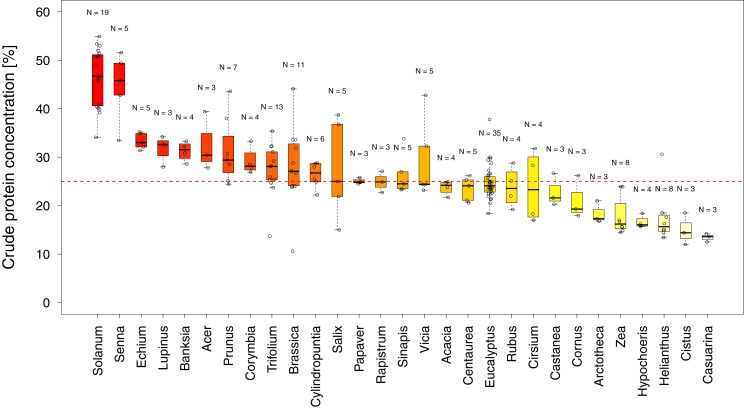
To ease nutritional stress on managed as well as native bee populations in agricultural habitats, agro-environmental protection schemes aim to provide alternative nutritional resources for bee populations during times of need. However, such efforts have so far focused on quantity (supply of flowering plants) and timing (flower-scarce periods) while ignoring the quality of the two main bee relevant flower-derived resources (pollen and nectar). As a first step to address this issue we have compiled one geographically explicit dataset focusing on pollen crude protein concentration, one measurement traditionally associated with pollen quality for bees. We attempt to provide a robust baseline for protein levels bees can collect in- (crop and weed species) and off-field (wild plants) in agricultural habitats around the globe. Using this dataset we identify crops which provide sub-optimal pollen resources in terms of crude protein concentration for bees and suggest potential plant genera that could serve as alternative resources for protein. This information could be used by scientists, regulators, bee keepers, NGOs and farmers to compare the pollen quality currently offered in alternative foraging habitats and identify opportunities to improve them. In the long run, we hope that additional markers of pollen quality will be added to the database in order to get a more complete picture of flower resources offered to bees and foster a data-informed discussion about pollinator conservation in modern agricultural landscapes.
为缓解农业栖息地中养殖蜜蜂和本地蜜蜂种群面临的营养压力,农业环境保护计划旨在在蜜蜂需要时为其提供替代营养资源。然而,迄今为止,这些努力主要集中在数量(开花植物的供应)和时间(花朵稀缺期)上,却忽视了与蜜蜂相关的两种主要花源资源(花粉和花蜜)的质量。作为解决这一问题的第一步,我们汇编了一个地理明确的数据集,重点关注花粉粗蛋白浓度,这是一种传统上与蜜蜂花粉质量相关的测量方法。我们试图为全球农业栖息地中蜜蜂可以在田间(作物和杂草物种)和田间外(野生植物)采集的蛋白质水平提供一个可靠的基线。利用这个数据集,我们识别出就蜜蜂粗蛋白浓度而言提供次优花粉资源的作物,并提出可以作为蛋白质替代资源的潜在植物属。科学家、监管机构、养蜂人、非政府组织和农民可以利用这些信息来比较替代觅食栖息地目前提供的花粉质量,并找出改善这些质量的机会。从长远来看,我们希望能在数据库中添加更多花粉质量指标,以便更全面地了解提供给蜜蜂的花卉资源,并促进关于现代农业景观中传粉者保护的基于数据的讨论。