Centre for Agri-Environmental Research, School of Agriculture, Policy and Development, University of Reading, Reading, RG6 6AR, UK.
Department of Biological Sciences, Royal Holloway University of London, Egham, UK.
Sci Rep. 2023 Oct 23;13(1):18099. doi: 10.1038/s41598-023-45279-w.
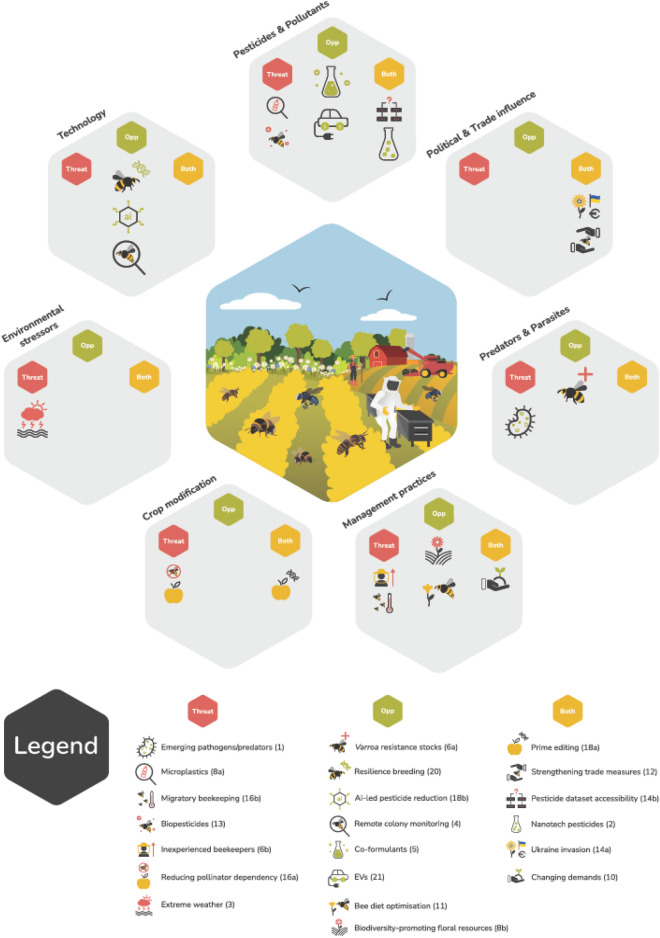
Managed bee species provide essential pollination services that contribute to food security worldwide. However, managed bees face a diverse array of threats and anticipating these, and potential opportunities to reduce risks, is essential for the sustainable management of pollination services. We conducted a horizon scanning exercise with 20 experts from across Europe to identify emerging threats and opportunities for managed bees in European agricultural systems. An initial 63 issues were identified, and this was shortlisted to 21 issues through the horizon scanning process. These ranged from local landscape-level management to geopolitical issues on a continental and global scale across seven broad themes-Pesticides & pollutants, Technology, Management practices, Predators & parasites, Environmental stressors, Crop modification, and Political & trade influences. While we conducted this horizon scan within a European context, the opportunities and threats identified will likely be relevant to other regions. A renewed research and policy focus, especially on the highest-ranking issues, is required to maximise the value of these opportunities and mitigate threats to maintain sustainable and healthy managed bee pollinators within agricultural systems.
管理的蜜蜂物种提供了至关重要的授粉服务,有助于全球的食品安全。然而,管理的蜜蜂面临着各种各样的威胁,预测这些威胁以及潜在的机会来降低风险,对于可持续管理授粉服务至关重要。我们与来自欧洲各地的 20 名专家进行了一次 horizon scanning 练习,以确定欧洲农业系统中管理的蜜蜂面临的新出现的威胁和机会。最初确定了 63 个问题,并通过 horizon scanning 过程将其缩小到 21 个问题。这些问题涵盖了从当地景观层面的管理到大陆和全球范围内的地缘政治问题,跨越了七个广泛的主题-杀虫剂和污染物、技术、管理实践、捕食者和寄生虫、环境胁迫、作物改良以及政治和贸易影响。虽然我们在欧洲范围内进行了这项 horizon 扫描,但识别出的机会和威胁可能与其他地区有关。需要重新关注研究和政策,特别是针对排名最高的问题,以最大限度地利用这些机会,并减轻对维持农业系统中可持续和健康的管理蜜蜂授粉者的威胁。