Putti Matilde, de Jong Simone M J, Stassen Oscar M J A, Sahlgren Cecilia M, Dankers Patricia Y W
Department of Biomedical Engineering, Laboratory of Chemical Biology, Eindhoven University of Technology, Eindhoven, The Netherlands.
Institute for Complex Molecular Systems, Eindhoven, The Netherlands.
ACS Appl Polym Mater. 2019 Aug 9;1(8):2044-2054. doi: 10.1021/acsapm.9b00334. Epub 2019 Jun 13.
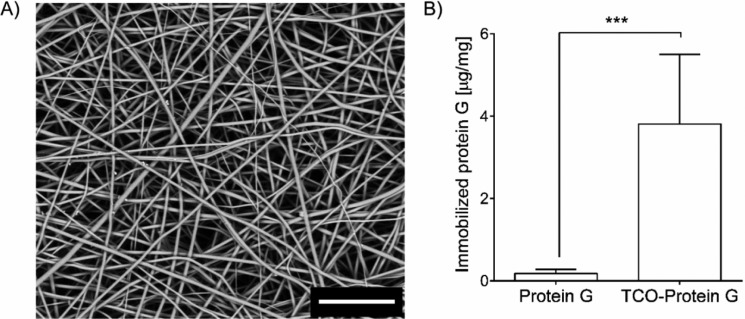
Bioorthogonal chemistry is an excellent method for functionalization of biomaterials with bioactive molecules, as it allows for decoupling of material processing and bioactivation. Here, we report on a modular system created by means of tetrazine/-cyclooctene (Tz/TCO) click chemistry undergoing an inverse electron demand Diels-Alder cycloaddition. A reactive supramolecular surface based on ureido-pyrimidinones (UPy) is generated via a UPy-Tz additive, in order to introduce a versatile TCO-protein G conjugate for immobilization of Fc-fusion proteins. As a model bioactive protein, we introduced Fc-Jagged1, a Notch ligand, to induce Notch signaling activity on the material. Interestingly, HEK293 FLN1 cells expressing the Notch1 receptor were repelled by films modified with TCO-protein G but adhered and spread on functionalized electrospun meshes. This indicates that the material processing method influences the biocompatibility of the postmodification. Notch signaling activity was upregulated 5.6-fold with respect to inactive controls on electrospun materials modified with TCO-protein G/Fc-Jagged1. Furthermore, downstream effects of Notch signaling were detected on the gene level in vascular smooth muscle cells expressing the Notch3 receptor. Taken together, our results demonstrate the successful use of a modular supramolecular system for the postprocessing modification of solid materials with functional proteins.
生物正交化学是一种用生物活性分子对生物材料进行功能化的优秀方法,因为它能使材料加工和生物活化解耦。在此,我们报道了一种通过四嗪/环辛烯(Tz/TCO)点击化学进行逆电子需求狄尔斯-阿尔德环加成反应构建的模块化系统。通过一种脲嘧啶酮(UPy)-Tz添加剂生成了基于脲嘧啶酮的反应性超分子表面,以便引入一种通用的TCO-蛋白G缀合物来固定Fc融合蛋白。作为一种模型生物活性蛋白,我们引入了Notch配体Fc-Jagged1,以在材料上诱导Notch信号活性。有趣的是,表达Notch1受体的HEK293 FLN1细胞被用TCO-蛋白G修饰的薄膜排斥,但在功能化的电纺网孔上黏附并铺展。这表明材料加工方法会影响后修饰的生物相容性。在用TCO-蛋白G/Fc-Jagged1修饰的电纺材料上,相对于无活性对照,Notch信号活性上调了5.6倍。此外,在表达Notch3受体的血管平滑肌细胞的基因水平上检测到了Notch信号的下游效应。综上所述,我们的结果证明了一种模块化超分子系统成功用于用功能蛋白对固体材料进行后处理修饰。