• 文献检索
  • 文档翻译
  • 深度研究
  • 学术资讯
  • Suppr Zotero 插件Zotero 插件
  • 邀请有礼
  • 套餐&价格
  • 历史记录
应用&插件
Suppr Zotero 插件Zotero 插件浏览器插件Mac 客户端Windows 客户端微信小程序
定价
高级版会员购买积分包购买API积分包
服务
文献检索文档翻译深度研究API 文档MCP 服务
关于我们
关于 Suppr公司介绍联系我们用户协议隐私条款
关注我们

Suppr 超能文献

核心技术专利:CN118964589B侵权必究
粤ICP备2023148730 号-1Suppr @ 2026

文献检索

告别复杂PubMed语法,用中文像聊天一样搜索,搜遍4000万医学文献。AI智能推荐,让科研检索更轻松。

立即免费搜索

文件翻译

保留排版,准确专业,支持PDF/Word/PPT等文件格式,支持 12+语言互译。

免费翻译文档

深度研究

AI帮你快速写综述,25分钟生成高质量综述,智能提取关键信息,辅助科研写作。

立即免费体验

可改变的风险因素解释了痴呆风险的社会经济不平等:来自基于人群的前瞻性队列研究的证据。

Modifiable Risk Factors Explain Socioeconomic Inequalities in Dementia Risk: Evidence from a Population-Based Prospective Cohort Study.

机构信息

Alzheimer Centrum Limburg, School for Mental Health and Neuroscience, Maastricht University, Maastricht, the Netherlands.

Department of Behavioural Science and Health, University College London, London, UK.

出版信息

J Alzheimers Dis. 2019;71(2):549-557. doi: 10.3233/JAD-190541.

DOI:10.3233/JAD-190541
PMID:31424404
原文链接:https://pmc.ncbi.nlm.nih.gov/articles/PMC6839472/
Abstract

BACKGROUND

Differences in dementia risk across the gradient of socioeconomic status (SES) exist, but their determinants are not well understood.

OBJECTIVE

This study investigates whether health conditions and lifestyle-related risk factors explain the SES inequalities in dementia risk.

METHODS

6,346 participants from the English Longitudinal Study of Ageing were followed up from 2008/2009 until 2014/2015. We used Cox regression adjusted for age, gender, wealth/education, and clustering at the household level to examine the association between SES markers (wealth, education) and time to dementia in a structural equation model including potential mediation or effect modification by a weighted compound score of twelve modifiable risk and protective factors for dementia ('LIfestyle for BRAin health' (LIBRA) score).

RESULTS

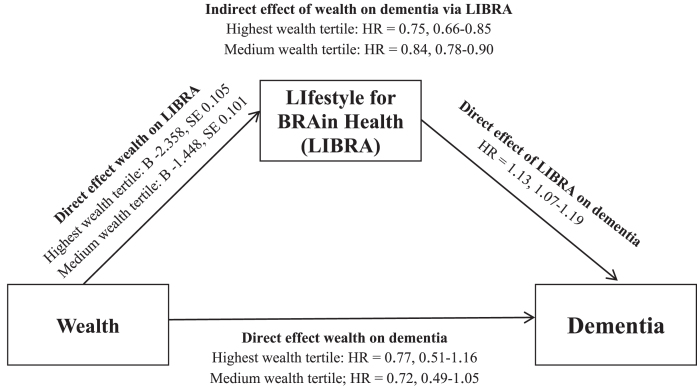
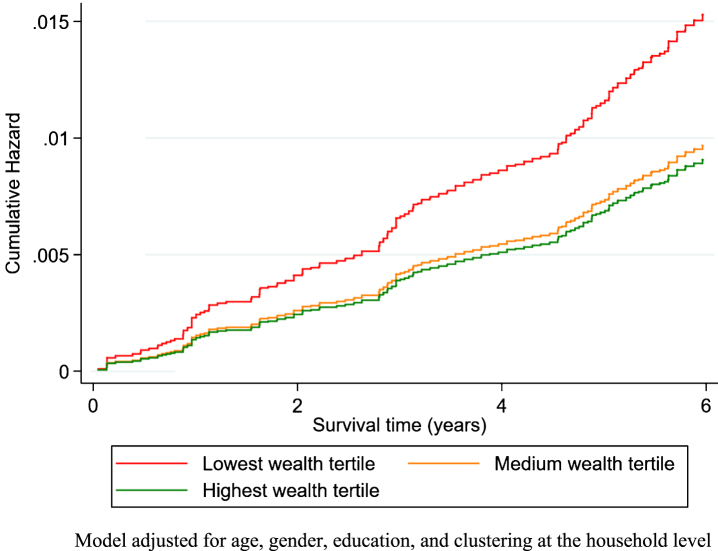
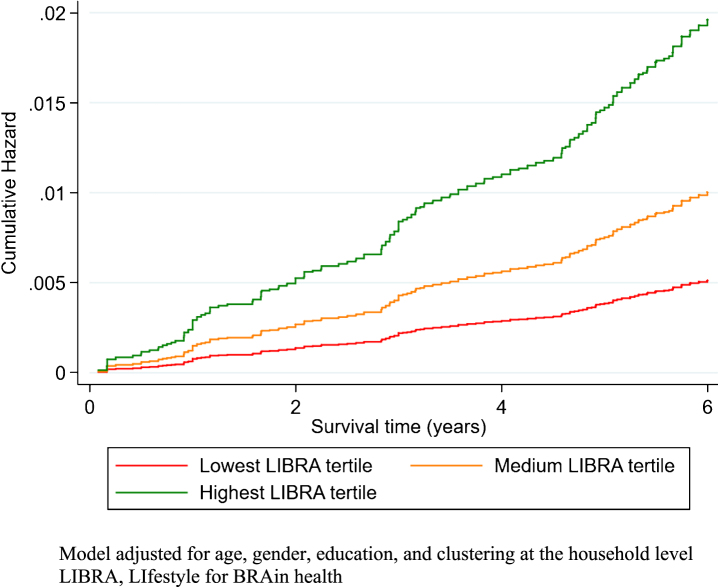
During a median follow-up of 6 years, 192 individuals (3.0%) developed dementia. LIBRA scores decreased with increasing wealth and higher educational level. A one-point increase in the LIBRA score was associated with a 13% increase in dementia risk (hazard ratio (HR) = 1.13, 95% confidence interval 1.07-1.19). Higher wealth was associated with a decreased dementia risk (HR = 0.58, 0.39-0.85). Mediation analysis showed that 52% of the risk difference between the highest and lowest wealth tertile was mediated by differences in LIBRA (indirect effect: HR = 0.75, 0.66-0.85). Education was not directly associated with dementia (HR = 1.05, 0.69-1.59), but was a distal risk factor for dementia by explaining differences in wealth and LIBRA scores (indirect effect high education: HR = 0.92, 0.88-0.95).

CONCLUSION

Socioeconomic differences in dementia risk can be partly explained by differences in modifiable health conditions and lifestyle factors.

摘要

背景

在社会经济地位(SES)梯度上,痴呆风险存在差异,但这些差异的决定因素尚不清楚。

目的

本研究旨在探讨健康状况和与生活方式相关的风险因素是否可以解释痴呆风险的 SES 不平等。

方法

6346 名来自英国老龄化纵向研究的参与者从 2008/2009 年开始随访,直至 2014/2015 年。我们使用 Cox 回归调整年龄、性别、财富/教育以及家庭层面的聚类,在包含 12 种可修改的痴呆风险和保护因素(“生活方式对大脑健康”(LIBRA)评分)的加权复合评分的结构方程模型中,研究 SES 标志物(财富、教育)与痴呆时间的关系。

结果

在中位随访 6 年期间,192 人(3.0%)发生痴呆。LIBRA 评分随财富和教育程度的增加而降低。LIBRA 评分增加一个单位,痴呆风险增加 13%(危险比(HR)=1.13,95%置信区间 1.07-1.19)。较高的财富与痴呆风险降低相关(HR=0.58,0.39-0.85)。中介分析表明,最高和最低财富三分位数之间的风险差异有 52%是由 LIBRA 差异介导的(间接效应:HR=0.75,0.66-0.85)。教育程度与痴呆无直接关联(HR=1.05,0.69-1.59),但通过解释财富和 LIBRA 评分的差异,成为痴呆的间接危险因素(间接效应高教育程度:HR=0.92,0.88-0.95)。

结论

痴呆风险的 SES 差异可以部分解释为可改变的健康状况和生活方式因素的差异。
https://cdn.ncbi.nlm.nih.gov/pmc/blobs/33a9/6839472/866e2e2464ac/jad-71-jad190541-g003.jpg
https://cdn.ncbi.nlm.nih.gov/pmc/blobs/33a9/6839472/86748cebbc10/jad-71-jad190541-g001.jpg
https://cdn.ncbi.nlm.nih.gov/pmc/blobs/33a9/6839472/896e4b3d0d8c/jad-71-jad190541-g002.jpg
https://cdn.ncbi.nlm.nih.gov/pmc/blobs/33a9/6839472/866e2e2464ac/jad-71-jad190541-g003.jpg
https://cdn.ncbi.nlm.nih.gov/pmc/blobs/33a9/6839472/86748cebbc10/jad-71-jad190541-g001.jpg
https://cdn.ncbi.nlm.nih.gov/pmc/blobs/33a9/6839472/896e4b3d0d8c/jad-71-jad190541-g002.jpg
https://cdn.ncbi.nlm.nih.gov/pmc/blobs/33a9/6839472/866e2e2464ac/jad-71-jad190541-g003.jpg

相似文献

1
Modifiable Risk Factors Explain Socioeconomic Inequalities in Dementia Risk: Evidence from a Population-Based Prospective Cohort Study.可改变的风险因素解释了痴呆风险的社会经济不平等:来自基于人群的前瞻性队列研究的证据。
J Alzheimers Dis. 2019;71(2):549-557. doi: 10.3233/JAD-190541.
2
Socioeconomic Inequalities in Cognitive Functioning Only to a Small Extent Attributable to Modifiable Health and Lifestyle Factors in Individuals Without Dementia.认知功能方面的社会经济不平等在很大程度上仅归因于无痴呆症个体中可改变的健康和生活方式因素。 (注:原英文表述有误,正确的理解应该是认知功能方面的社会经济不平等在很大程度上并非仅归因于无痴呆症个体中可改变的健康和生活方式因素,按照正确理解翻译后的中文如上。原英文按字面翻译是认知功能方面的社会经济不平等仅在很小程度上归因于无痴呆症个体中可改变的健康和生活方式因素 ,但这样逻辑不通,推测是原英文表述有问题。)
J Alzheimers Dis. 2022;90(4):1523-1534. doi: 10.3233/JAD-220474.
3
Associations of the Lifestyle for Brain Health Index With Structural Brain Changes and Cognition: Results From the Maastricht Study.生活方式对大脑健康指数与结构脑变化和认知的关联:马斯特里赫特研究的结果。
Neurology. 2021 Sep 28;97(13):e1300-e1312. doi: 10.1212/WNL.0000000000012572. Epub 2021 Aug 25.
4
Long-term dementia risk prediction by the LIBRA score: A 30-year follow-up of the CAIDE study.通过 LIBRA 评分预测长期痴呆风险:CAIDE 研究 30 年随访。
Int J Geriatr Psychiatry. 2020 Feb;35(2):195-203. doi: 10.1002/gps.5235. Epub 2019 Dec 6.
5
Validation of the Updated "LIfestyle for BRAin health" (LIBRA) Index in the English Longitudinal Study of Ageing and Maastricht Aging Study.验证“生活方式对大脑健康的影响”(LIBRA)指数在英国老龄化纵向研究和马斯特里赫特衰老研究中的更新版本。
J Alzheimers Dis. 2024;101(4):1237-1248. doi: 10.3233/JAD-240666.
6
Social determinants and lifestyle factors for brain health: implications for risk reduction of cognitive decline and dementia.社会决定因素和生活方式因素对大脑健康的影响:降低认知能力下降和痴呆风险的意义。
Sci Rep. 2022 Jul 28;12(1):12965. doi: 10.1038/s41598-022-16771-6.
7
Gender and Educational Differences in the Association between Lifestyle and Cognitive Decline over 10 Years: The Doetinchem Cohort Study.性别和教育程度对生活方式与认知能力下降 10 年相关的影响差异:多廷赫姆队列研究。
J Alzheimers Dis. 2019;70(s1):S31-S41. doi: 10.3233/JAD-180492.
8
Modifiable dementia risk score to study heterogeneity in treatment effect of a dementia prevention trial: a post hoc analysis in the preDIVA trial using the LIBRA index.可修改的痴呆风险评分用于研究痴呆预防试验治疗效果的异质性:使用 LIBRA 指数对 preDIVA 试验进行事后分析。
Alzheimers Res Ther. 2018 Jun 30;10(1):62. doi: 10.1186/s13195-018-0389-4.
9
Sex/gender and socioeconomic differences in modifiable risk factors for dementia.性别和社会经济差异与痴呆的可改变危险因素有关。
Sci Rep. 2023 Jan 3;13(1):80. doi: 10.1038/s41598-022-27368-4.
10
Lifestyle for brain health and cognitive functioning in midlife to early late-life New Zealanders: Utility of the LIBRA index.新西兰人从中年到晚年生活方式对大脑健康和认知功能的影响:LIBRA 指数的实用性。
Int J Geriatr Psychiatry. 2024 May;39(5):e6091. doi: 10.1002/gps.6091.

引用本文的文献

1
Wealth, income and dementia in Germany: longitudinal findings from a representative survey among the oldest old.德国的财富、收入与痴呆症:来自一项针对高龄老人的代表性调查的纵向研究结果
BMC Public Health. 2025 Aug 29;25(1):2965. doi: 10.1186/s12889-025-24239-1.
2
Lower birth rate, greater female dementia risk: global and regional patterns and public health implications.较低的出生率,女性患痴呆症的风险更高:全球和地区模式及对公共卫生的影响。
Future Sci OA. 2025 Dec;11(1):2550897. doi: 10.1080/20565623.2025.2550897. Epub 2025 Aug 25.
3
The Mediating Effect of Smoking on the Association between Income and Dementia among Japanese Older People.

本文引用的文献

1
Gender and Educational Differences in the Association between Lifestyle and Cognitive Decline over 10 Years: The Doetinchem Cohort Study.性别和教育程度对生活方式与认知能力下降 10 年相关的影响差异:多廷赫姆队列研究。
J Alzheimers Dis. 2019;70(s1):S31-S41. doi: 10.3233/JAD-180492.
2
Individual and Area-Based Socioeconomic Factors Associated With Dementia Incidence in England: Evidence From a 12-Year Follow-up in the English Longitudinal Study of Ageing.个体和基于区域的社会经济因素与英格兰的痴呆症发病率相关:来自英国老龄化纵向研究 12 年随访的证据。
JAMA Psychiatry. 2018 Jul 1;75(7):723-732. doi: 10.1001/jamapsychiatry.2018.1012.
3
吸烟对日本老年人收入与痴呆症之间关联的中介作用
JMA J. 2025 Jul 15;8(3):766-776. doi: 10.31662/jmaj.2025-0018. Epub 2025 Jun 13.
4
Age at First Childbirth and Dementia Risk: A Cross-Sectional Ecological Analysis of Female Prevalence, Sex Disparities, and Public Health Implications.首次生育年龄与痴呆风险:女性患病率、性别差异及公共卫生影响的横断面生态分析
Health Sci Rep. 2025 Aug 6;8(8):e71145. doi: 10.1002/hsr2.71145. eCollection 2025 Aug.
5
Machine learning applications in vascular neuroimaging for the diagnosis and prognosis of cognitive impairment and dementia: a systematic review and meta-analysis.机器学习在血管神经影像学中用于认知障碍和痴呆的诊断及预后评估的应用:一项系统综述和荟萃分析。
Alzheimers Res Ther. 2025 Aug 7;17(1):183. doi: 10.1186/s13195-025-01815-6.
6
Chronic pain in the Chilean population: risk factors prevalence and cognitive associations.智利人群中的慢性疼痛:危险因素、患病率及认知关联
Front Aging. 2025 Jul 22;6:1548667. doi: 10.3389/fragi.2025.1548667. eCollection 2025.
7
Associations between epigenetic age and brain age in young people.年轻人表观遗传年龄与脑年龄之间的关联。
Sci Rep. 2025 Jul 22;15(1):26609. doi: 10.1038/s41598-025-11350-x.
8
Societal gender norms and their influence on Late Life Cognition.社会性别规范及其对晚年认知的影响。
Neurodegener Dis. 2025 Jun 25:1-17. doi: 10.1159/000547115.
9
Deciphering the influence of socioeconomic status on brain structure: insights from Mendelian randomization.解读社会经济地位对脑结构的影响:孟德尔随机化研究的见解
Mol Psychiatry. 2025 May 13. doi: 10.1038/s41380-025-03047-4.
10
Mediators of educational differences in dementia risk later in life: evidence from the HUNT study.晚年痴呆症风险中教育差异的中介因素:来自HUNT研究的证据。
BMC Public Health. 2025 Apr 10;25(1):1336. doi: 10.1186/s12889-025-22592-9.
A pathway from low socioeconomic status to dementia in Japan: results from the Toyama dementia survey.
从低社会经济地位到痴呆症的途径:来自富山痴呆症调查的结果。
BMC Geriatr. 2018 Apr 27;18(1):102. doi: 10.1186/s12877-018-0791-6.
4
Utility of the LIBRA Index in Relation to Cognitive Functioning in a Clinical Health Seeking Sample.LIBRA 指数与临床健康寻求样本认知功能的关系效用。
J Alzheimers Dis. 2018;62(1):373-384. doi: 10.3233/JAD-170731.
5
Dementia prevention, intervention, and care.痴呆症的预防、干预与护理。
Lancet. 2017 Dec 16;390(10113):2673-2734. doi: 10.1016/S0140-6736(17)31363-6. Epub 2017 Jul 20.
6
Contribution of cognitive performance and cognitive decline to associations between socioeconomic factors and dementia: A cohort study.认知表现和认知衰退对社会经济因素与痴呆症之间关联的影响:一项队列研究。
PLoS Med. 2017 Jun 26;14(6):e1002334. doi: 10.1371/journal.pmed.1002334. eCollection 2017 Jun.
7
Modifiable Risk Factors for Prevention of Dementia in Midlife, Late Life and the Oldest-Old: Validation of the LIBRA Index.中年、老年和高龄老人痴呆症预防的可改变风险因素:天秤座指数的验证
J Alzheimers Dis. 2017;58(2):537-547. doi: 10.3233/JAD-161208.
8
Lifestyle for Brain Health (LIBRA): a new model for dementia prevention.生活方式对大脑健康的影响(LIBRA):预防痴呆症的新模式。
Int J Geriatr Psychiatry. 2018 Jan;33(1):167-175. doi: 10.1002/gps.4700. Epub 2017 Feb 28.
9
Prevalence and determinants of undetected dementia in the community: a systematic literature review and a meta-analysis.社区中未被发现的痴呆症的患病率及决定因素:一项系统文献综述和荟萃分析。
BMJ Open. 2017 Feb 3;7(2):e011146. doi: 10.1136/bmjopen-2016-011146.
10
Socioeconomic status and the 25 × 25 risk factors as determinants of premature mortality: a multicohort study and meta-analysis of 1·7 million men and women.社会经济地位及25×25风险因素作为过早死亡的决定因素:一项针对170万男性和女性的多队列研究及荟萃分析
Lancet. 2017 Mar 25;389(10075):1229-1237. doi: 10.1016/S0140-6736(16)32380-7. Epub 2017 Feb 1.