Alzheimer Centrum Limburg, School for Mental Health and Neuroscience (MHeNS), Maastricht University, Maastricht, The Netherlands.
Institute of Clinical Medicine/Neurology, University of Eastern Finland, Kuopio, Finland.
Int J Geriatr Psychiatry. 2020 Feb;35(2):195-203. doi: 10.1002/gps.5235. Epub 2019 Dec 6.
As no causal treatment for dementia is available yet, the focus of dementia research is slowly shifting towards prevention strategies. Therefore, this study aimed to examine the predictive accuracy of the "LIfestyle for BRAin Health" (LIBRA) score, a weighted compound score of 12 modifiable risk and protective factors, for dementia and mild cognitive impairment (MCI) in midlife and late-life, and in individuals with high or low genetic risk based on presence of the apolipoprotein (APOE) ε4 allele.
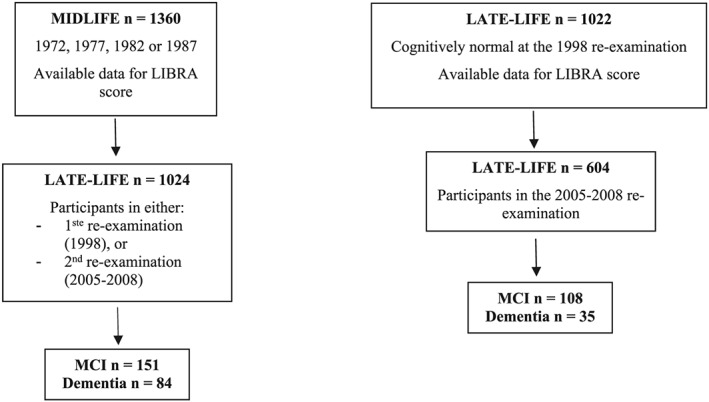
The LIBRA score was calculated for participants from the Finnish Cardiovascular Risk Factors, Aging and Dementia (CAIDE) population-based study examined in midlife (n = 1024) and twice in late-life (n = 604) up to 30 years later. Diagnoses of MCI and dementia were made according to established criteria. Cox proportional hazards models were used to assess the association between LIBRA and risk of dementia and MCI in models adjusted for sex and education (age as timescale).
Higher midlife LIBRA scores were related to higher risk of dementia (hazard ratio [HR] = 1.27; 95% confidence interval [CI], 1.13-1.43) and MCI (unadjusted model: HR = 1.12; 95% CI, 1.03-1.22) up to 30 years later. Higher late-life LIBRA scores were related to higher risk of MCI (HR = 1.11; 95% CI, 1.00-1.25), but not dementia (HR = 1.02; 95% CI, 0.84-1.24). Higher late-life LIBRA scores were related to higher dementia risk among apolipoprotein E (APOE) ε4 non-carriers.
Findings emphasize the importance of modifiable risk and protective factors for dementia prevention.
由于目前尚无治疗痴呆的方法,因此痴呆症研究的重点正逐渐转向预防策略。因此,本研究旨在检验“生活方式对大脑健康的影响”(LIBRA)评分的预测准确性,LIBRA 是一个加权复合评分,包含 12 个可改变的风险和保护因素,用于预测中年人、老年人以及携带载脂蛋白(APOE)ε4 等位基因的个体发生痴呆症和轻度认知障碍(MCI)的风险。
该 LIBRA 评分是根据芬兰心血管危险因素、衰老和痴呆(CAIDE)人群基础研究中的参与者计算得出的,这些参与者在中年(n=1024)和晚年(n=604)进行了两次检查,时间间隔最长可达 30 年。根据既定标准诊断 MCI 和痴呆症。使用 Cox 比例风险模型,在调整性别和教育(年龄作为时间尺度)的模型中评估 LIBRA 与痴呆症和 MCI 风险之间的关联。
较高的中年 LIBRA 评分与痴呆症(危险比 [HR] = 1.27;95%置信区间 [CI],1.13-1.43)和 MCI(未调整模型:HR = 1.12;95%CI,1.03-1.22)的风险增加有关,直到 30 年后。较高的晚年 LIBRA 评分与 MCI 的风险增加有关(HR = 1.11;95%CI,1.00-1.25),但与痴呆症无关(HR = 1.02;95%CI,0.84-1.24)。在载脂蛋白 E(APOE)ε4 非携带者中,较高的晚年 LIBRA 评分与较高的痴呆症风险相关。
研究结果强调了可改变的风险和保护因素对预防痴呆症的重要性。