Department of Epidemiology and Biostatistics, College of Public Health, University of South Florida, Tampa, FL, United States of America.
Department of Rehabilitation, Vinmec Times City Hospital, Vinmec Healthcare System, Hanoi, Vietnam.
PLoS One. 2019 Aug 19;14(8):e0220864. doi: 10.1371/journal.pone.0220864. eCollection 2019.
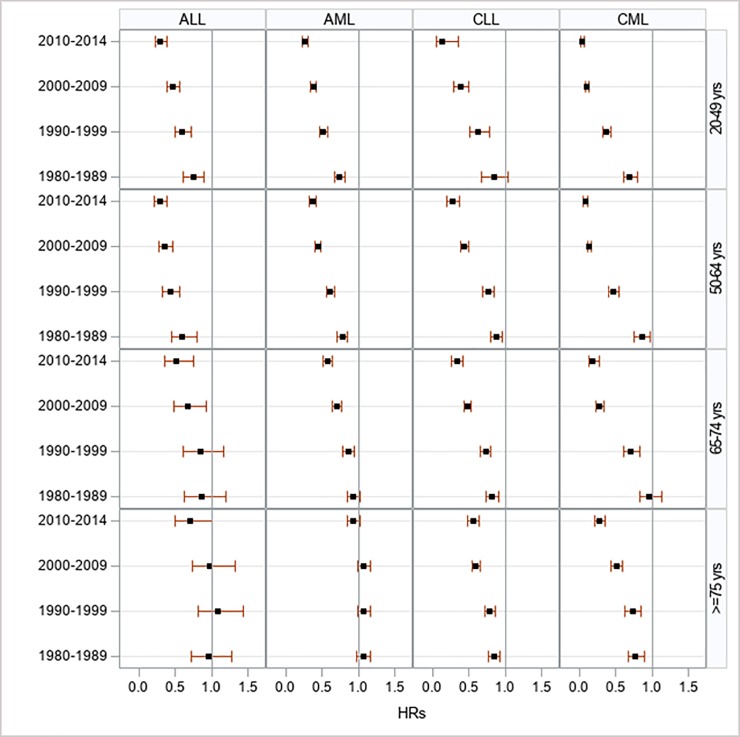
There has been marked improvement in leukemia survival, particularly among children in recent time. However, the long-term trends in survival among adult leukemia patients and the associated sex and racial survival disparities are not well understood. We, therefore, evaluated the secular trends in survival improvement of leukemia patients from 1973 through 2014, using Surveillance Epidemiology and End-Result Survey Program (SEER) data. ICD-O-3 morphology codes were used to group leukemia into four types: acute lymphoblastic leukemia (ALL), acute myeloid leukemia (AML), chronic lymphocytic leukemia (CLL), chronic myeloid leukemia (CML). Survival analysis for each leukemia type stratified by race/ethnicity, age, sex was performed to generate relative survival probability estimates for the baseline time period of 1973 through 1979. Hazard ratios (HR) and respective 95% confidence intervals (CIs) for survival within subsequent 10-year time periods by race, age and sex were calculated using Cox proportional hazard models. Of the 83,255 leukemia patients for the current analysis, the 5-year survival of patients with ALL, AML, CLL, and CML during 1973-1979 were 42.0%, 6.5%, 66.5%, and 20.9%, respectively. Compared to the baseline, there were substantial improvements of leukemia-specific survival in 2010-2014 among African-American (81.0%) and Asian (80.0%) patients with CML and among 20-49 year of age with CLL (96.0%). African-American patients, those with AML and those older than 75 years of age had the lowest survival improvements. Asians experienced some of the largest survival improvements during the study period. Others, including African-American and the elderly, have not benefited as much from advances in leukemia treatment.
白血病的存活率有了显著提高,尤其是近年来儿童白血病的存活率。然而,成人白血病患者的长期存活率趋势以及相关的性别和种族存活率差异尚不清楚。因此,我们使用监测、流行病学和最终结果调查项目(SEER)的数据评估了 1973 年至 2014 年白血病患者生存率的长期趋势。ICD-O-3 形态学代码将白血病分为四种类型:急性淋巴细胞白血病(ALL)、急性髓细胞白血病(AML)、慢性淋巴细胞白血病(CLL)、慢性髓细胞白血病(CML)。对每种白血病类型进行种族/民族、年龄、性别分层的生存分析,生成 1973 年至 1979 年基线期的相对生存概率估计值。使用 Cox 比例风险模型计算种族、年龄和性别在随后 10 年时间内的生存风险比(HR)及其相应的 95%置信区间(CI)。在目前的分析中,有 83255 名白血病患者,1973-1979 年 ALL、AML、CLL 和 CML 患者的 5 年生存率分别为 42.0%、6.5%、66.5%和 20.9%。与基线相比,2010-2014 年,非裔美国人(81.0%)和亚洲人(80.0%)的 CML 患者以及 20-49 岁的 CLL 患者的白血病特异性生存率有了显著提高。非裔美国人患者、AML 患者和 75 岁以上的患者生存率改善最低。亚洲患者在研究期间经历了一些最大的生存改善。其他人群,包括非裔美国人以及老年人,并没有从白血病治疗的进步中受益太多。