Max-Eder Research Group for Pediatric Sarcoma Biology, Institute of Pathology, Faculty of Medicine, LMU Munich, Munich, Germany.
Department of Pediatrics III, West German Cancer Centre, University Hospital Essen, Essen, Germany.
EBioMedicine. 2019 Sep;47:156-162. doi: 10.1016/j.ebiom.2019.08.002. Epub 2019 Aug 16.
Up to 30-40% of Ewing sarcoma (EwS) patients with non-metastatic disease develop local or metastatic relapse within a time span of 2-10 years. This is in part caused by the absence of prognostic biomarkers that can identify high-risk patients and thus assign them to risk-adapted monitoring and treatment regimens. Since cancer stemness has been associated with tumour relapse and poor patient outcomes, we investigated in the current study the prognostic potential SOX2 (sex determining region Y box 2) - a major transcription factor involved in development and stemness - which was previously described to contribute to the undifferentiated phenotype of EwS.
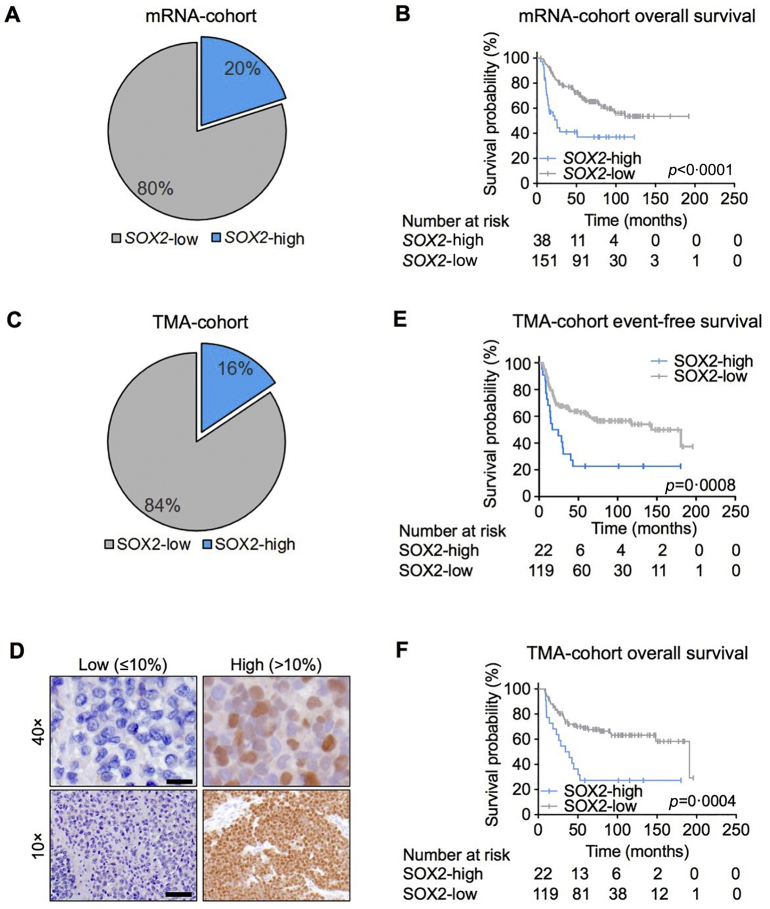
Two independent patient cohorts, one consisting of 189 retrospectively collected EwS tumours with corresponding mRNA expression data (test-cohort) and the other consisting of 141 prospectively collected formalin-fixed and paraffin-embedded resected tumours (validation and cohort), were employed to analyse SOX2 expression levels through DNA microarrays or immunohistochemistry, respectively, and to compare them with clinical parameters and patient outcomes. Two methods were employed to test the validity of the results at both the mRNA and protein levels.
Both cohorts showed that only a subset of EwS patients (16-20%) expressed high SOX2 mRNA or protein levels, which significantly correlated with poor overall survival. Multivariate analyses of our validation-cohort revealed that high SOX2 expression represents a major risk-factor for poor survival (HR = 3·19; 95%CI 1·74-5·84; p < 0·01) that is independent from metastasis and other known clinical risk-factors at the time of diagnosis. Univariate analyses demonstrated that SOX2-high expression was correlated with tumour relapse (p = 0·002). The median first relapse was at 14·7 months (range: 3·5-180·7).
High SOX2 expression constitutes an independent prognostic biomarker for EwS patients with poor outcomes. This may help to identify patients with localised disease who are at high risk for tumour relapse within the first two years after diagnosis.
The laboratory of T. G. P. Grünewald is supported by grants from the 'Verein zur Förderung von Wissenschaft und Forschung an der Medizinischen Fakultät der LMU München (WiFoMed)', by LMU Munich's Institutional Strategy LMUexcellent within the framework of the German Excellence Initiative, the 'Mehr LEBEN für krebskranke Kinder - Bettina-Bräu-Stiftung', the Walter Schulz Foundation, the Wilhelm Sander-Foundation (2016.167.1), the Friedrich-Baur foundation, the Matthias-Lackas foundation, the Barbara & Hubertus Trettner foundation, the Dr. Leopold & Carmen Ellinger foundation, the Gert & Susanna Mayer foundation, the Deutsche Forschungsgemeinschaft (DFG 391665916), and by the German Cancer Aid (DKH-111886 and DKH-70112257). J. Li was supported by a scholarship of the China Scholarship Council (CSC), J. Musa was supported by a scholarship of the Kind-Philipp foundation, and T. L. B. Hölting by a scholarship of the German Cancer Aid. M. F. Orth and M. M. L. Knott were supported by scholarships of the German National Academic Foundation. G. Sannino was supported by a scholarship from the Fritz-Thyssen Foundation (FTF-40.15.0.030MN). The work of U. Dirksen is supported by grants from the German Cancer Aid (DKH-108128, DKH-70112018, and DKH-70113419), the ERA-Net-TRANSCAN consortium (project number 01KT1310), and Euro Ewing Consortium (EEC, project number EU-FP7 602,856), both funded under the European Commission Seventh Framework Program FP7-HEALTH (http://cordis.europa.eu/), the Barbara & Hubertus Trettner foundation, and the Gert & Susanna Mayer foundation. G. Hardiman was supported by grants from the National Science Foundation (SC EPSCoR) and National Institutes of Health (U01-DA045300). The laboratory of J. Alonso was supported by Instituto de Salud Carlos III (PI12/00816; PI16CIII/00026); Asociación Pablo Ugarte (TPY-M 1149/13; TRPV 205/18), ASION (TVP 141/17), Fundación Sonrisa de Alex & Todos somos Iván (TVP 1324/15).
多达 30-40% 的尤文肉瘤(EwS)患者在非转移性疾病中,在 2-10 年内会出现局部或转移性复发。这在一定程度上是由于缺乏预后生物标志物,这些标志物可以识别高危患者,从而为他们分配风险适应的监测和治疗方案。由于癌症干细胞与肿瘤复发和患者预后不良有关,因此我们在当前研究中调查了 SOX2(性别决定区 Y 框 2)的预后潜力——这是一种主要的转录因子,参与发育和干细胞特性,先前已被描述为有助于 EwS 的未分化表型。
两个独立的患者队列,一个由 189 例回顾性收集的尤文肉瘤肿瘤组成,这些肿瘤具有相应的 mRNA 表达数据(测试队列),另一个由 141 例前瞻性收集的福尔马林固定和石蜡包埋的切除肿瘤组成(验证和队列),分别通过 DNA 微阵列或免疫组织化学分析 SOX2 表达水平,并将其与临床参数和患者结局进行比较。使用两种方法在 mRNA 和蛋白质水平上测试结果的有效性。
两个队列均显示,只有一小部分尤文肉瘤患者(16-20%)表达高水平的 SOX2 mRNA 或蛋白质,这与整体生存率显著相关。我们的验证队列的多变量分析显示,高 SOX2 表达是生存不良的主要危险因素(HR=3.19;95%CI 1.74-5.84;p<0.01),这独立于转移和其他已知的临床危险因素在诊断时。单变量分析表明,SOX2 高表达与肿瘤复发相关(p=0.002)。中位首次复发时间为 14.7 个月(范围:3.5-180.7)。
高 SOX2 表达是 EwS 患者预后不良的独立预后生物标志物。这可能有助于识别出在诊断后两年内局部疾病复发风险高的患者。
T.G.P. Grünewald 的实验室得到了“Verein zur Förderung von Wissenschaft und Forschung an der Medizinischen Fakultät der LMU München(WiFoMed)”、LMU 慕尼黑机构战略 LMUexcellent 在德国卓越倡议框架内、“Mehr LEBEN für krebskranke Kinder - Bettina-Bräu-Stiftung”、Walter Schulz 基金会、“Wilhelm Sander-Foundation(2016.167.1)”、Friedrich-Baur 基金会、Matthias-Lackas 基金会、Barbara & Hubertus Trettner 基金会、Dr. Leopold & Carmen Ellinger 基金会、Gert & Susanna Mayer 基金会、德国研究基金会(DFG 391665916)和德国癌症援助协会(DKH-111886 和 DKH-70112257)的支持。J. Li 得到了中国国家留学基金委员会(CSC)奖学金的支持,J. Musa 得到了 Kind-Philipp 基金会的奖学金支持,T.L.B. Hölting 得到了德国癌症援助协会的奖学金支持。M.F.Orth 和 M.M.L. Knott 得到了德国学术交流基金会(DAAD)奖学金的支持。G. Sannino 得到了 Fritz-Thyssen 基金会(FTF-40.15.0.030MN)的奖学金支持。U. Dirksen 的工作得到了德国癌症援助协会(DKH-108128、DKH-70112018 和 DKH-70113419)、ERA-Net-TRANSCAN 联盟(项目编号 01KT1310)和欧洲尤文肉瘤联盟(EEC,项目编号 EU-FP7 602,856)的资助,这些项目均由欧盟第七框架计划 FP7-HEALTH(http://cordis.europa.eu/)、Barbara & Hubertus Trettner 基金会和 Gert & Susanna Mayer 基金会资助。G. Hardiman 得到了美国国家科学基金会(SC EPSCoR)和美国国立卫生研究院(U01-DA045300)的资助。J. Alonso 的实验室得到了西班牙健康研究所(PI12/00816;PI16CIII/00026);Pablo Ugarte 协会(TPY-M 1149/13;TRPV 205/18),ASION(TVP 141/17)和 Fundación Sonrisa de Alex & Todos somos Iván(TVP 1324/15)的支持。