Institute of Science and Engineering, Kanazawa University, Kakuma, Kanazawa, 920-1192, Japan.
Graduate School of Natural Science and Technology, Kanazawa University, Kakuma, Kanazawa, 920-1192, Japan.
Sci Rep. 2019 Aug 19;9(1):12074. doi: 10.1038/s41598-019-48477-7.
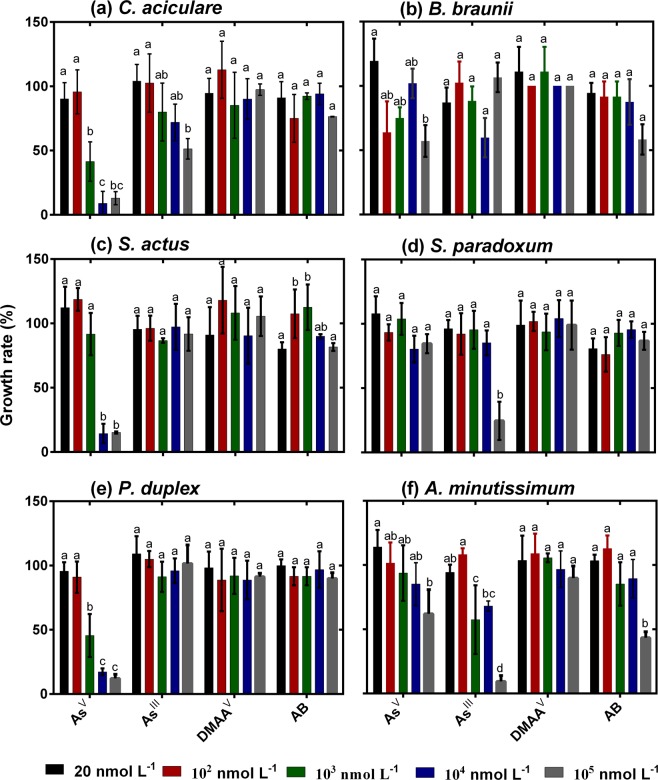
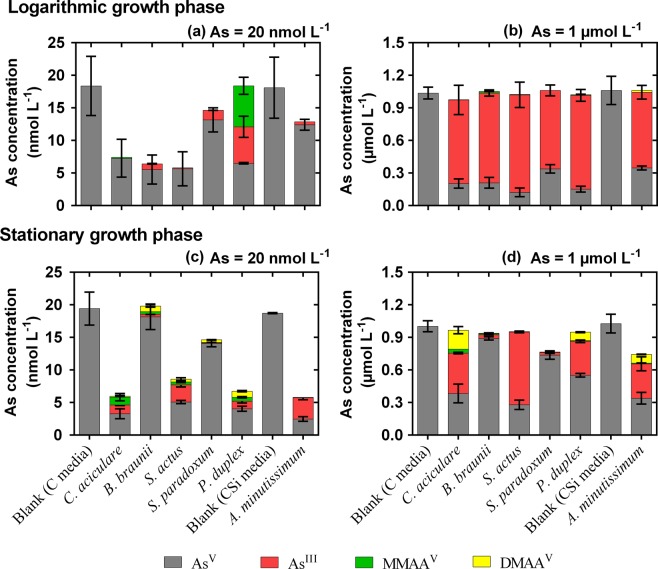
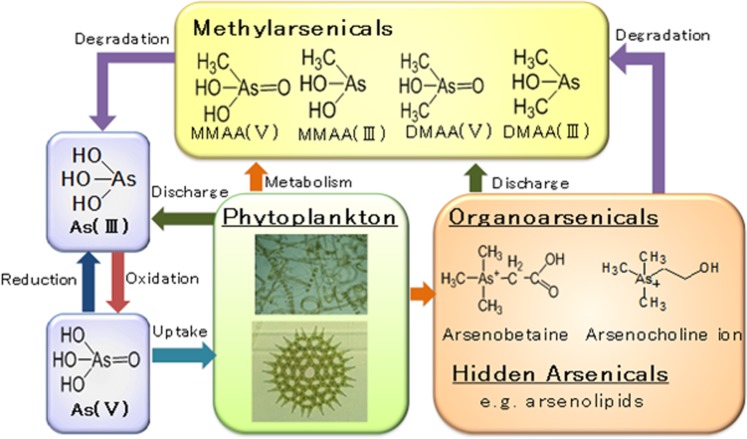
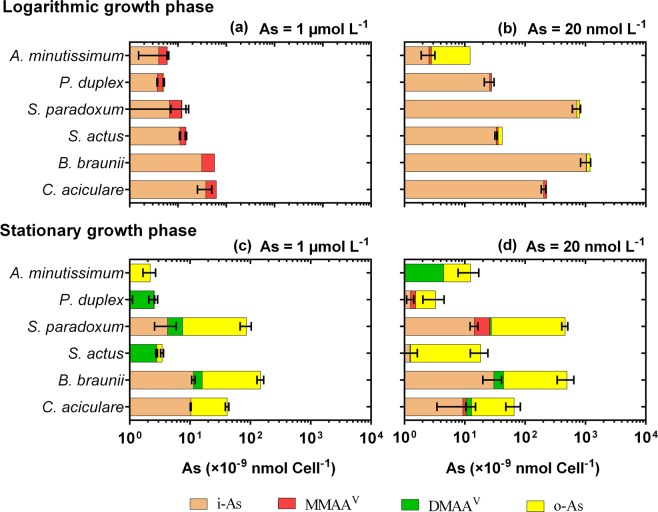
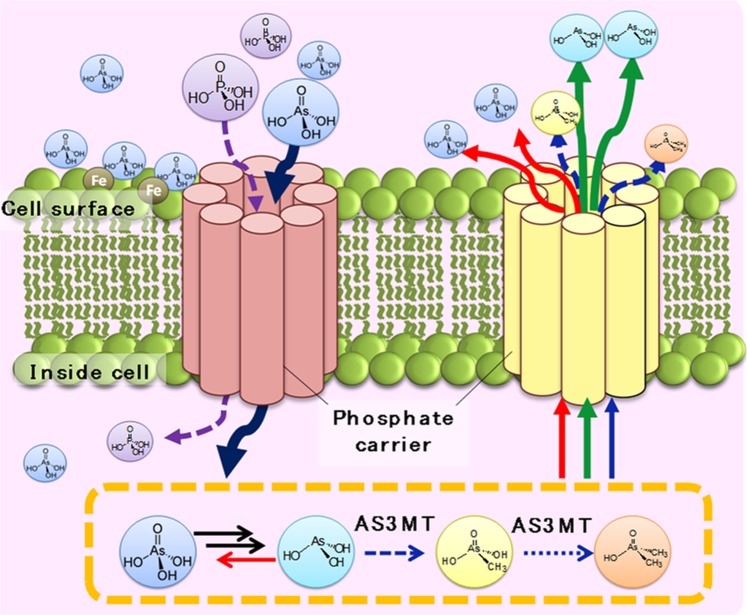
The biotransformation and detoxification mechanisms of arsenic (As) species have been active research topics because of their significance to environmental and human health. Biotransformation of As in phytoplankton has been extensively studied. However, how different growth phases of phytoplankton impact As biotransformation in them remains uncertain. This study investigated the biotransformation of As species in freshwater phytoplankton at different growth phases to ascertain at which growth phase different types of biotransformation occur. At the logarithmic growth phase, arsenate (As) (>90%) and arsenite (As) (>80%) predominated in culture media when phytoplankton were exposed to 20 nmol L and 1.0 µmol L of As, respectively, and methylarsenic (methylAs) species were not detected in them at all. Intracellular As was mainly present in inorganic forms (iAs) at the logarithmic phase, while substantial amounts of organoarsenic (orgAs) species were detected at the stationary phase. At the stationary phase, As comprised the majority of the total As in culture media, followed by As and methylAs, although the methylation of As occurred slowly at the stationary phase. Biotransformation of As into As and As methylation inside phytoplankton cells occurred mainly at the logarithmic phase, while the biotransformation of As into complex orgAs compounds occurred at the stationary phase. Phytoplankton rapidly released iAs and methylAs species out of their cells at the logarithmic phase, while orgAs mostly remained inside their cells.
砷(As)物种的生物转化和解毒机制一直是研究的热点,因为它们对环境和人类健康具有重要意义。已对浮游植物中的 As 生物转化进行了广泛研究。然而,浮游植物不同生长阶段如何影响其体内的 As 生物转化仍不确定。本研究调查了不同生长阶段淡水浮游植物中 As 物种的生物转化,以确定不同类型的生物转化发生在哪个生长阶段。在对数生长期,当浮游植物分别暴露于 20 nmol L 和 1.0 µmol L 的 As 时,培养基中主要存在砷酸盐(As)(>90%)和亚砷酸盐(As)(>80%),而其中根本没有检测到甲基砷(methylAs)。细胞内 As 主要以无机形式(iAs)存在于对数期,而在静止期则检测到大量有机砷(orgAs)。在静止期,As 构成了培养基中总 As 的主要部分,其次是 As 和甲基 As,尽管甲基化在静止期缓慢进行。As 向 As 和 As 内的生物转化以及浮游植物细胞内的甲基化主要发生在对数期,而 As 向复杂 orgAs 化合物的生物转化发生在静止期。浮游植物在对数期迅速将 iAs 和甲基 As 释放到细胞外,而 orgAs 则主要保留在细胞内。