Yavuz-Kodat Enise, Reynaud Eve, Geoffray Marie-Maude, Limousin Nadège, Franco Patricia, Bourgin Patrice, Schroder Carmen M
Centre National de la Recherche Scientifique, Université de Strasbourg, Institut des Neurosciences Cellulaires et Intégratives, Strasbourg, France.
Department of Child and Adolescent Neurodevelopmental Psychiatry, Le Vinatier Hospital, Bron, France.
Front Psychiatry. 2019 Aug 2;10:551. doi: 10.3389/fpsyt.2019.00551. eCollection 2019.
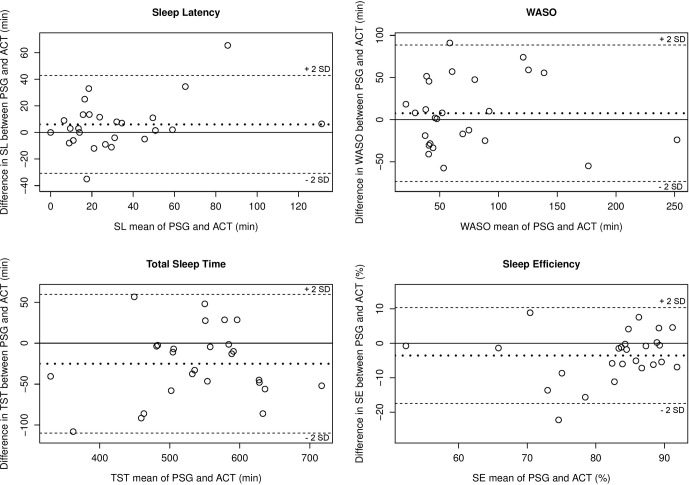
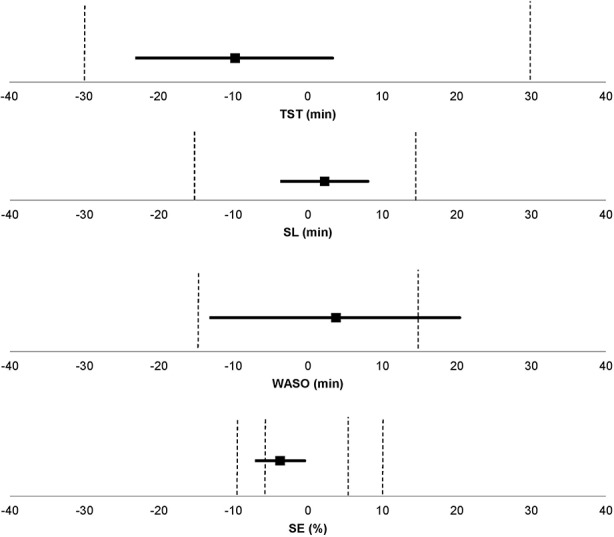
Actigraphy (ACT) is a non-invasive objective assessment tool for the study of sleep-wake rhythms. It is of particular interest in children with autism spectrum disorder (ASD), as sleep disorders are highly prevalent and have a significant impact on both cognitive and behavioral functions. As polysomnography (PSG), the gold standard for the assessment of sleep, is difficult to perform in children with ASD, ACT has become a tool of choice but has not yet been validated against PSG using state-of-the-art methodology. The main objective of this study was to assess, for the first time, the validity of ACT compared to PSG for the measurement of sleep in children with ASD. During the same night of hospitalization, PSG and ACT were conducted in 26 children (6 girls and 20 boys; mean age 5.4 years ± 1.6) diagnosed with ASD according to DSM-5 criteria and standardized diagnostic scales. Sleep parameters were total sleep time (TST), sleep latency (SL), wake after sleep onset (WASO), and sleep efficiency (SE). To compare PSG and ACT, we conducted sleep parameter agreement analyses including: intraclass correlation coefficient (ICC), Bland-Altman plots, and equivalence tests. The comparison also included an epoch-by-epoch (EBE) agreement analysis to determine sensitivity (ability to detect sleep) and specificity (ability to detect wake). According to equivalence tests, the difference between ACT and PSG measures was clinically acceptable for TST (<30 min, p < 0.01), SL (<15 min, p < 0.001), and SE (10%, p < 0.01), but not for WASO (<15 min, p = 0.13). There was a good agreement between methods for SL (ICC = 0.79) and TST (ICC = 0.85) and a moderate agreement for WASO (ICC = 0.73) and SE (ICC = 0.68). The EBE agreement analysis revealed a high sensitivity (0.94 ± 0.06) and moderate specificity (0.5 ± 0.2). Since sleep disorders are one of the most common comorbidities within the ASD population and are highly prevalent, it is essential to validate objective tools of assessment. To our knowledge, our study is the first to validate ACT compared to PSG, using a state-of-the-art methodology, in children with ASD. The results suggest ACT to be a valid method to evaluate sleep within this population, with a good reliability for most sleep parameters.
活动记录仪(ACT)是一种用于研究睡眠-觉醒节律的非侵入性客观评估工具。它对于自闭症谱系障碍(ASD)儿童尤为重要,因为睡眠障碍在该群体中极为普遍,且对认知和行为功能均有重大影响。由于作为睡眠评估金标准的多导睡眠图(PSG)难以应用于ASD儿童,ACT已成为首选工具,但尚未使用先进方法与PSG进行对照验证。本研究的主要目的是首次评估与PSG相比,ACT用于测量ASD儿童睡眠的有效性。在住院的同一晚,对26名根据《精神疾病诊断与统计手册》第5版(DSM-5)标准和标准化诊断量表诊断为ASD的儿童(6名女孩和20名男孩;平均年龄5.4岁±1.6岁)进行了PSG和ACT检测。睡眠参数包括总睡眠时间(TST)、睡眠潜伏期(SL)、睡眠中觉醒时间(WASO)和睡眠效率(SE)。为比较PSG和ACT,我们进行了睡眠参数一致性分析,包括:组内相关系数(ICC)、Bland-Altman图和等效性检验。比较还包括逐时段(EBE)一致性分析,以确定敏感性(检测睡眠的能力)和特异性(检测觉醒的能力)。根据等效性检验,ACT和PSG测量值之间的差异在TST(<30分钟,p<0.01)、SL(<15分钟,p<0.001)和SE(10%,p<0.01)方面在临床上可接受,但在WASO(<15分钟,p = 0.13)方面不可接受。SL(ICC = 0.79)和TST(ICC = 0.85)的方法之间一致性良好,WASO(ICC = 0.73)和SE(ICC = 0.68)的一致性中等。EBE一致性分析显示敏感性高(0.94±0.06),特异性中等(0.5±0.2)。由于睡眠障碍是ASD群体中最常见的共病之一且极为普遍,因此验证客观评估工具至关重要。据我们所知,我们的研究是首次在ASD儿童中使用先进方法将ACT与PSG进行对照验证。结果表明ACT是评估该群体睡眠的有效方法,对大多数睡眠参数具有良好的可靠性。