Galdino Anna Clara M, Viganor Lívia, de Castro Alexandre A, da Cunha Elaine F F, Mello Thaís P, Mattos Larissa M, Pereira Marcos D, Hunt Mary C, O'Shaughnessy Megan, Howe Orla, Devereux Michael, McCann Malachy, Ramalho Teodorico C, Branquinha Marta H, Santos André L S
Department of General Microbiology, Institute of Microbiology Paulo de Góes, Federal University of Rio de Janeiro, Rio de Janeiro, Brazil.
Postgraduate Program in Biochemistry, Institute of Chemistry, Federal University of Rio de Janeiro, Rio de Janeiro, Brazil.
Front Microbiol. 2019 Aug 2;10:1701. doi: 10.3389/fmicb.2019.01701. eCollection 2019.
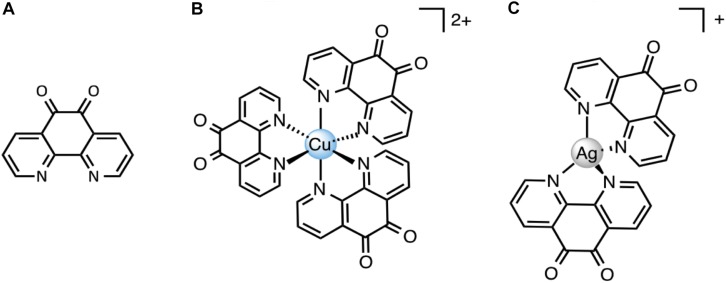
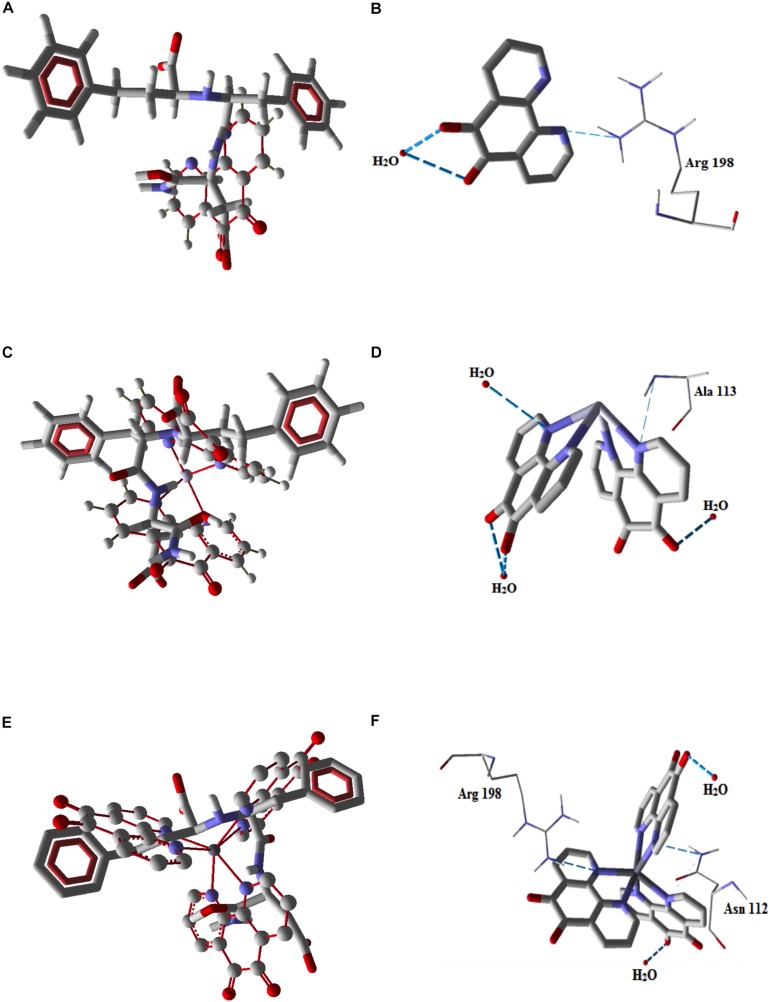
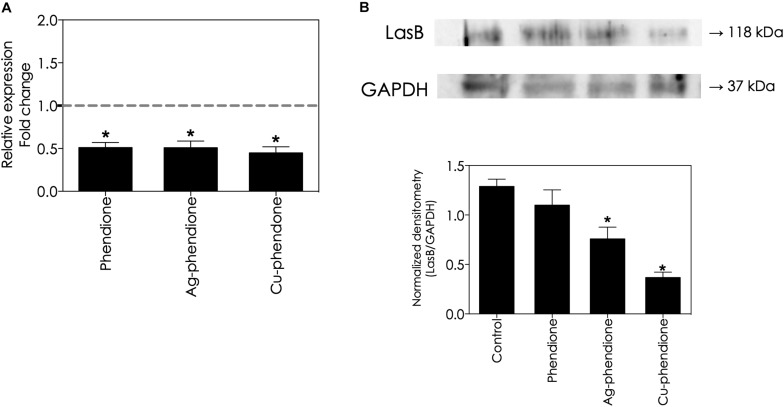
Elastase B (lasB) is a multifunctional metalloenzyme secreted by the gram-negative pathogen , and this enzyme orchestrates several physiopathological events during bacteria-host interplays. LasB is considered to be a potential target for the development of an innovative chemotherapeutic approach, especially against multidrug-resistant strains. Recently, our group showed that 1,10-phenanthroline-5,6-dione (phendione), [Ag(phendione)]ClO (Ag-phendione) and Cu(phendione).4HO (Cu-phendione) had anti- action against both planktonic- and biofilm-growing cells. In the present work, we have evaluated the effects of these compounds on the (i) interaction with the lasB active site using approaches, (ii) lasB proteolytic activity by using a specific fluorogenic peptide substrate, (iii) gene expression by real time-polymerase chain reaction, (iv) lasB protein secretion by immunoblotting, (v) ability to block the damages induced by lasB on a monolayer of lung epithelial cells, and (vi) survivability of larvae after being challenged with purified lasB and lasB-rich bacterial secretions. Molecular docking analyses revealed that phendione and its Ag and Cu complexes were able to interact with the amino acids forming the active site of lasB, particularly Cu-phendione which exhibited the most favorable interaction energy parameters. Additionally, the test compounds were effective inhibitors of lasB activity, blocking the cleavage of the peptide substrate, aminobenzyl-Ala-Gly-Leu-Ala--nitrobenzylamide, with Cu-phendione having the best inhibitory action (K = 90 nM). Treating living bacteria with a sub-inhibitory concentration (½ × MIC value) of the test compounds caused a significant reduction in the expression of the gene as well as its mature protein production/secretion. Further, Ag-phendione and Cu-phendione offered protective action for lung epithelial cells, reducing the A549 monolayer damage by approximately 32 and 42%, respectively. Interestingly, Cu-phendione mitigated the toxic effect of both purified lasB molecules and lasB-containing bacterial secretions in the model, increasing the survival time of larvae. Collectively, these data reinforce the concept of lasB being a veritable therapeutic target and phendione-based compounds (mainly Cu-phendione) being prospective anti-virulence drugs against .
弹性蛋白酶B(lasB)是一种由革兰氏阴性病原体分泌的多功能金属酶,在细菌与宿主相互作用过程中,这种酶协调多种生理病理事件。LasB被认为是开发创新化疗方法的潜在靶点,尤其是针对多重耐药菌株。最近,我们小组发现1,10-菲咯啉-5,6-二酮(苯二酮)、[Ag(苯二酮)]ClO(Ag-苯二酮)和Cu(苯二酮)·4H₂O(Cu-苯二酮)对浮游生长和生物膜生长的细胞均具有抗菌作用。在本研究中,我们评估了这些化合物对以下方面的影响:(i)使用分子对接方法与lasB活性位点的相互作用;(ii)使用特定的荧光肽底物检测lasB的蛋白水解活性;(iii)通过实时聚合酶链反应检测lasB基因表达;(iv)通过免疫印迹检测lasB蛋白分泌;(v)阻断lasB对肺上皮细胞单层诱导损伤的能力;(vi)用纯化的lasB和富含lasB的细菌分泌物攻击后幼虫的存活率。分子对接分析表明,苯二酮及其Ag和Cu配合物能够与构成lasB活性位点的氨基酸相互作用,特别是Cu-苯二酮表现出最有利的相互作用能参数。此外,测试化合物是lasB活性的有效抑制剂,可阻断肽底物氨基苄基-Ala-Gly-Leu-Ala-对硝基苄酰胺的切割,其中Cu-苯二酮具有最佳抑制作用(K₁ = 90 nM)。用亚抑制浓度(½×MIC值)的测试化合物处理活细菌会导致lasB基因表达及其成熟蛋白产生/分泌显著减少。此外,Ag-苯二酮和Cu-苯二酮对肺上皮细胞具有保护作用,分别将A549单层损伤降低约32%和42%。有趣的是,Cu-苯二酮减轻了纯化的lasB分子和含lasB的细菌分泌物在幼虫模型中的毒性作用,延长了幼虫的存活时间。总的来说,这些数据强化了lasB是一个名副其实的治疗靶点以及基于苯二酮的化合物(主要是Cu-苯二酮)是针对该病原体的潜在抗毒力药物这一概念。