Su Junji, Wang Caixiang, Hao Fushun, Ma Qi, Wang Ji, Li Jilian, Ning Xinzhu
Gansu Provincial Key Laboratory of Aridland Crop Science, College of Life Science and Technology, Gansu Agricultural University, Lanzhou, China.
State Key Laboratory of Cotton Biology, Institute of Cotton Research of Chinese Academy of Agricultural Sciences, Anyang, China.
Front Plant Sci. 2019 Aug 2;10:964. doi: 10.3389/fpls.2019.00964. eCollection 2019.
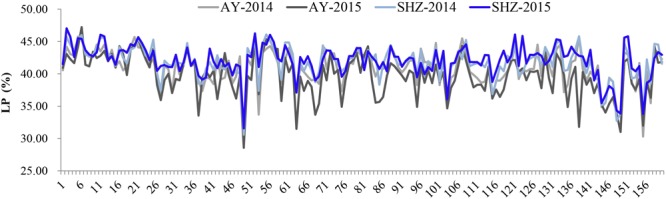
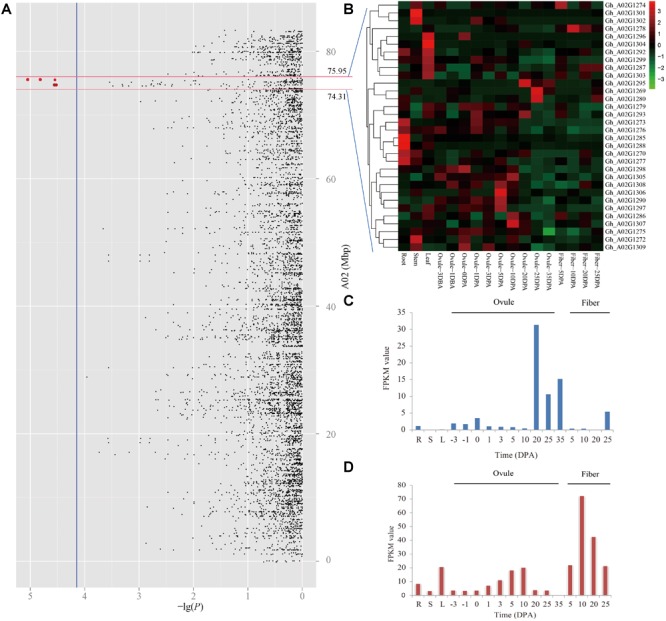
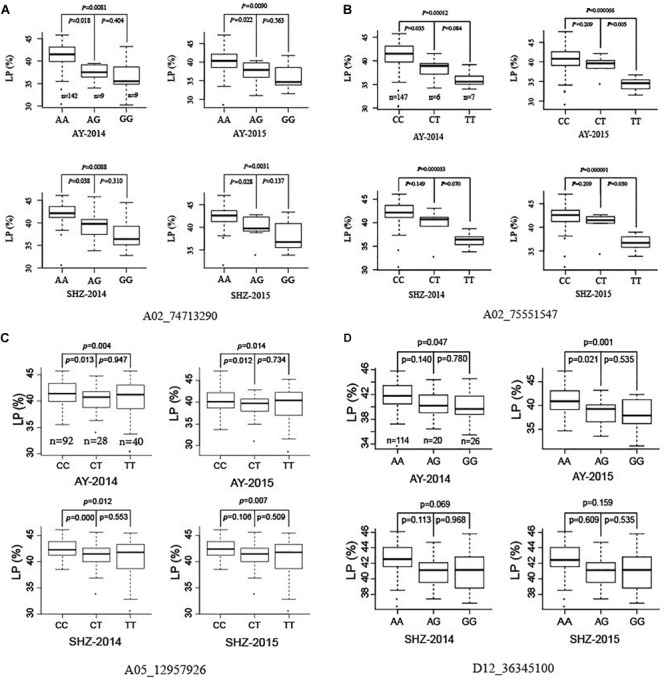
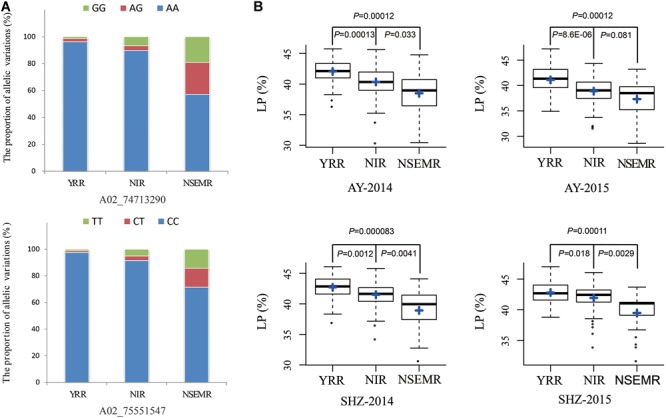
Upland cotton ( L.) is the most important source of natural fiber in the world. Early-maturity upland cotton varieties are commonly planted in China. Nevertheless, lint yield of early-maturity upland cotton varieties is strikingly lower than that of middle- and late-maturity ones. How to effectively improve lint yield of early maturing cotton, becomes a focus of cotton research. Here, based on 72,792 high-quality single nucleotide polymorphisms of 160 early-maturing upland cotton accessions, we performed genome-wide association studies (GWASs) for lint percentage (LP), one of the most lint-yield component traits, applying one single-locus method and six multi-locus methods. A total of 4 and 45 significant quantitative trait nucleotides (QTNs) were respectively identified to be associated with LP. Interestingly, in two of four planting environments, two of these QTNs (A02_74713290 and A02_75551547) were simultaneously detected both one single-locus and three or more multi-locus GWAS methods. Among the 42 genes within a genomic region (A02: 74.31-75.95 Mbp) containing the above two peak QTNs, , and had the highest expression levels in ovules during seed development from 20 to 25 days post anthesis, whereas was preferentially expressed in the fibers rather than other organs. These results imply that the four potential candidate genes might be closely related to cotton LP by regulating the proportion of seed weight and fiber yield. The QTNs and potential candidate genes for LP, identified in this study, provide valuable resource for cultivating novel cotton varieties with earliness and high lint yield in the future.
陆地棉(Gossypium hirsutum L.)是世界上最重要的天然纤维来源。早熟陆地棉品种在中国广泛种植。然而,早熟陆地棉品种的皮棉产量明显低于中晚熟品种。如何有效提高早熟棉花的皮棉产量,成为棉花研究的一个重点。在此,基于160份早熟陆地棉种质的72792个高质量单核苷酸多态性,我们应用一种单基因座方法和六种多基因座方法,对皮棉产量的一个最重要组成性状——皮棉百分率(LP)进行了全基因组关联研究(GWAS)。共鉴定出4个和45个与LP相关的显著数量性状核苷酸(QTN)。有趣的是,在四个种植环境中的两个环境中,其中两个QTN(A02_74713290和A02_75551547)在单基因座和三种或更多多基因座GWAS方法中同时被检测到。在包含上述两个峰值QTN的基因组区域(A02:74.31 - 75.95 Mbp)内的42个基因中, 和 在开花后20至25天种子发育期间的胚珠中表达水平最高,而 在纤维中优先表达而非其他器官。这些结果表明,这四个潜在候选基因可能通过调节种子重量和纤维产量的比例与棉花LP密切相关。本研究中鉴定出的LP的QTN和潜在候选基因,为未来培育早熟、高皮棉产量的新型棉花品种提供了宝贵资源。