Amemori Satoko, Amemori Ken-Ichi, Yoshida Tomoko, Papageorgiou Georgios K, Xu Rui, Shimazu Hideki, Desimone Robert, Graybiel Ann M
Department of Brain and Cognitive Sciences, Massachusetts Institute of Technology, Cambridge, MA, USA.
McGovern Institute for Brain Research, Massachusetts Institute of Technology, Cambridge, MA, USA.
Eur J Neurosci. 2020 Feb;51(3):731-741. doi: 10.1111/ejn.14555. Epub 2019 Sep 23.
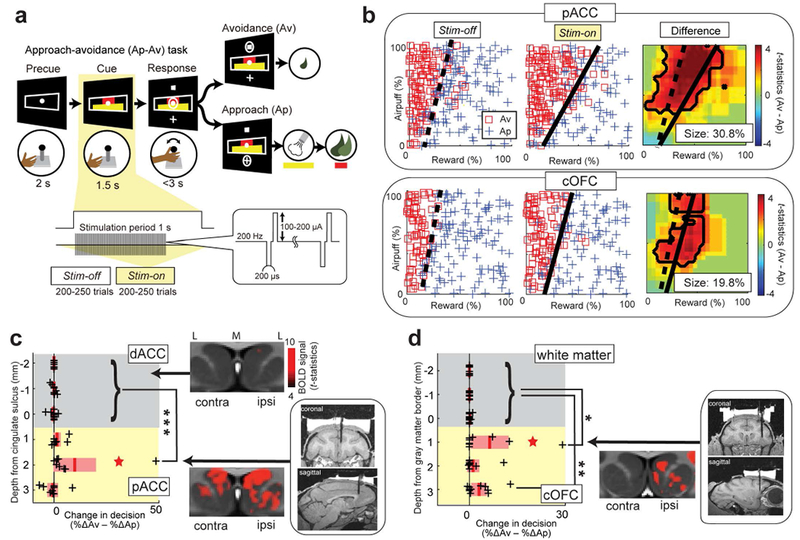
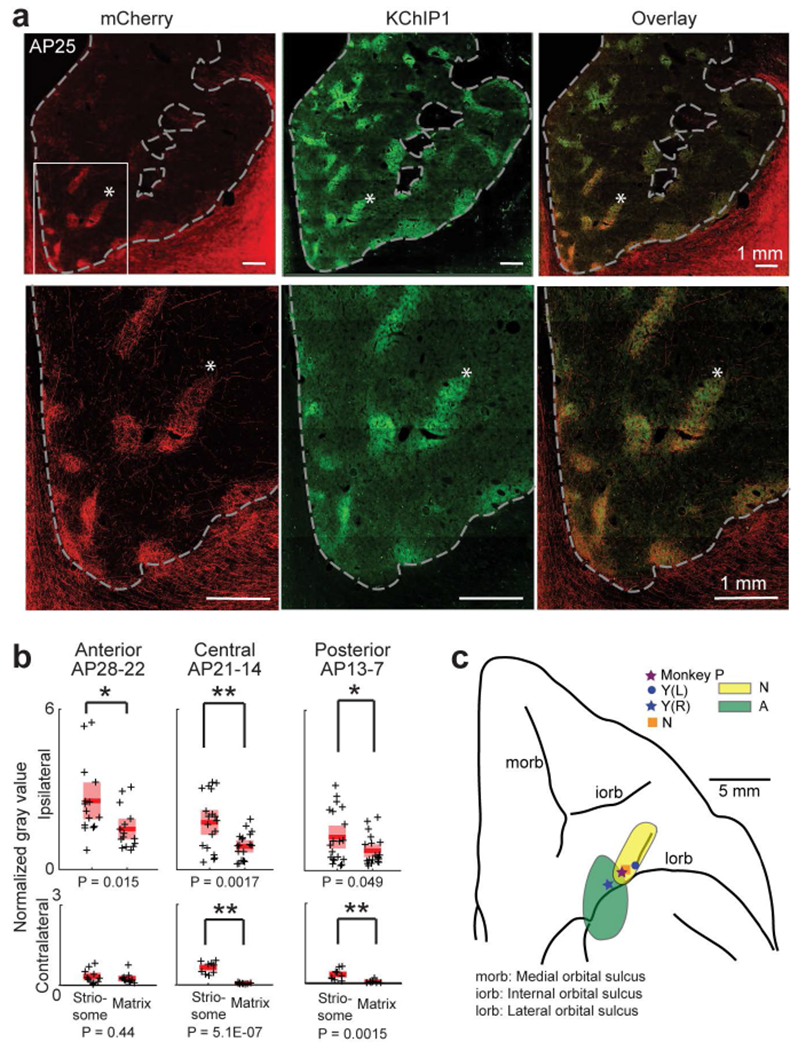
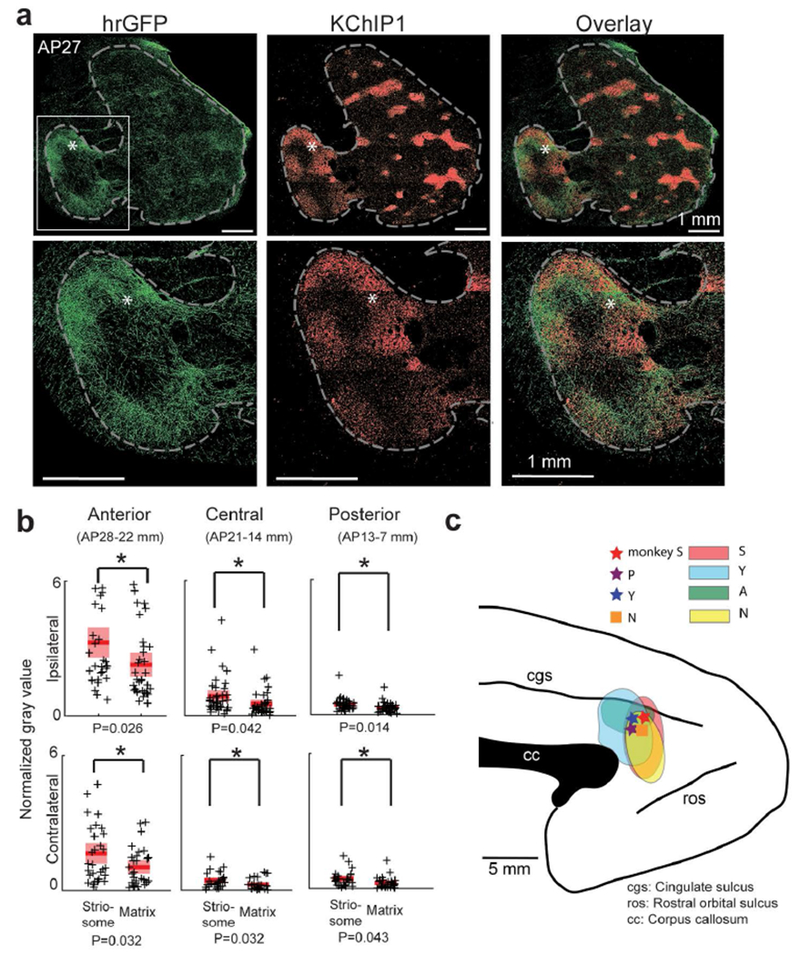
Here, we combined MRI-guided electrical microstimulation and viral tracing to examine the function of a corticostriatal circuit implicated by previous cortical microstimulation as modulating affective judgment and decision-making. Local microstimulation of a small part of the pregenual anterior cingulate cortex (pACC) was found to increase avoidance decisions in a cost-benefit decision-making task (Ap-Av task) in which differing amounts of "good" and "bad" options were given simultaneously. No effect of such stimulation was found when the monkeys performed a task in which both offers were rewarding, but given in different amounts. We asked whether we could identify the targets of such corticostriatal circuits when the cortical microstimulation sites were explicitly identified as affecting approach or avoidance in the Ap-Av task. We explored the pACC and caudal orbitofrontal cortex (cOFC) to look for such sites. For each cortical region, we found sites at which microstimulation induced increased avoidance behavior. After identifying these sites, we injected viral tracers carrying constructs allowing subsequent track-tracing post-mortem. For each site identified behaviorally as increasing avoidance choices, we found strong fiber projections to the anterior striatum with large parts of these targeting striosomes subsequently identified by serial section immunohistochemistry. With fMRI, we demonstrated that microstimulation in an anesthetized monkey at sites pre-identified as affecting Ap-Av choices induced blood oxygen level dependent activation of the anterior striatum, confirming that the microstimulation method that we applied was effective in activating the striatum. These findings outline circuits leading from pACC/cOFC to striosomes and causally modulating decision-making under emotional conflict.
在此,我们结合了磁共振成像引导的电微刺激和病毒示踪技术,以研究先前皮质微刺激所涉及的一个皮质纹状体回路的功能,该回路被认为可调节情感判断和决策。研究发现,对膝前扣带回皮质(pACC)一小部分进行局部微刺激,会增加成本效益决策任务(回避-接近任务)中的回避决策,在该任务中会同时给出不同数量的“好”和“坏”选项。当猴子执行两个选项都有奖励但数量不同的任务时,未发现这种刺激有任何效果。我们询问,当皮质微刺激部位在回避-接近任务中被明确确定为影响接近或回避时,我们是否能够识别这种皮质纹状体回路的靶点。我们探索了pACC和尾侧眶额皮质(cOFC)以寻找此类部位。对于每个皮质区域,我们都发现了微刺激会诱发回避行为增加的部位。确定这些部位后,我们注射了携带构建体的病毒示踪剂,以便随后进行死后追踪。对于行为上确定为增加回避选择的每个部位,我们发现有强大的纤维投射到前纹状体,随后通过连续切片免疫组织化学确定其中大部分靶向纹状体小体。通过功能磁共振成像,我们证明对预先确定为影响回避-接近选择的部位进行微刺激,会在麻醉的猴子中诱发前纹状体的血氧水平依赖性激活,证实我们应用的微刺激方法可有效激活纹状体。这些发现勾勒出了从pACC/cOFC到纹状体小体的回路,并在情感冲突下因果性地调节决策。