From the Laboratory for Structural, Physiologic and Functional Imaging, Department of Radiology (A.C., M.C.L., A.J., F.W.W.), Department of Biostatistics and Epidemiology (W.G.), and Institute for Environmental Medicine and Department of Physiology (S.C.), University of Pennsylvania Perelman School of Medicine, 3400 Spruce St, Philadelphia, PA 19104.
Radiology. 2019 Oct;293(1):97-106. doi: 10.1148/radiol.2019190562. Epub 2019 Aug 20.
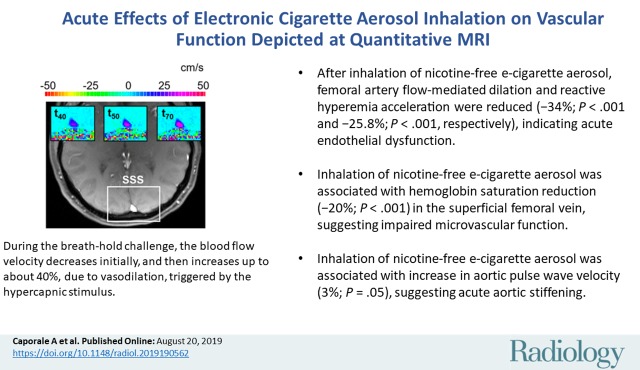
Background Previous studies showed that nicotinized electronic cigarettes (hereafter, e-cigarettes) elicit systemic oxidative stress and inflammation. However, the effect of the aerosol alone on endothelial function is not fully understood. Purpose To quantify surrogate markers of endothelial function in nonsmokers after inhalation of aerosol from nicotine-free e-cigarettes. Materials and Methods In this prospective study (from May to September 2018), nonsmokers underwent 3.0-T MRI before and after inhaling nicotine-free e-cigarette aerosol. Peripheral vascular reactivity to cuff-induced ischemia was quantified by temporally resolving blood flow velocity and oxygenation (SvO) in superficial femoral artery and vein, respectively, along with artery luminal flow-mediated dilation. Precuff occlusion, resistivity index, baseline blood flow velocity, and SvO were evaluated. During reactive hyperemia, blood flow velocity yielded peak velocity, time to peak, and acceleration rate (hyperemic index); SvO yielded washout time of oxygen-depleted blood, rate of resaturation, and maximum SvO increase (overshoot). Cerebrovascular reactivity was assessed in the superior sagittal sinus, evaluating the breath-hold index. Central arterial stiffness was measured via aortic pulse wave velocity. Differences before versus after e-cigarette vaping were tested with Hotelling test. Results Thirty-one healthy never-smokers (mean age, 24.3 years ± 4.3; 14 women) were evaluated. After e-cigarette vaping, resistivity index was higher (0.03 of 1.30 [2.3%]; < .05), luminal flow-mediated dilation severely blunted (-3.2% of 9.4% [-34%]; < .001), along with reduced peak velocity (-9.9 of 56.6 cm/sec [-17.5%]; < .001), hyperemic index (-3.9 of 15.1 cm/sec [-25.8%]; < .001), and delayed time to peak (2.1 of 7.1 sec [29.6%]; = .005); baseline SvO was lower (-13 of 65 %HbO [-20%]; < .001) and overshoot higher (10 of 19 %HbO [52.6%]; < .001); and aortic pulse wave velocity marginally increased (0.19 of 6.05 m/sec [3%]; = .05). Remaining parameters did not change after aerosol inhalation. Conclusion Inhaling nicotine-free electronic cigarette aerosol transiently impacted endothelial function in healthy nonsmokers. Further studies are needed to address the potentially adverse long-term effects on vascular health. © RSNA, 2019
背景 先前的研究表明,尼古丁化的电子烟(以下简称电子烟)会引起全身氧化应激和炎症。然而,气溶胶本身对内皮功能的影响尚不完全清楚。目的 量化非吸烟者吸入无尼古丁电子烟气溶胶后内皮功能的替代标志物。材料与方法 本前瞻性研究(2018 年 5 月至 9 月)纳入 31 名从未吸烟的志愿者,分别在吸入无尼古丁电子烟气溶胶前后接受 3.0-T MRI 检查。通过分别测量股浅动脉和静脉的血流速度和氧饱和度(SvO)来量化外周血管对袖带诱导的缺血的反应性,同时还评估了动脉腔内血流介导的扩张。评估了预袖带闭塞、阻力指数、基线血流速度和 SvO。在反应性充血期间,血流速度产生最大速度、达到最大速度的时间和加速度(充血指数);SvO 产生含氧不足的血液的洗脱时间、再饱和率和最大 SvO 增加(超射)。通过评估上矢状窦中的脑血流反应性,评估呼吸暂停指数。通过测量主动脉脉搏波速度来评估中心动脉僵硬度。通过 Hotelling 检验检验电子烟吸入前后的差异。结果 31 名健康的从不吸烟者(平均年龄,24.3 岁±4.3 岁;14 名女性)纳入本研究。电子烟吸入后,阻力指数升高(1.30 的 0.03 即 2.3%; <.05),腔内血流介导的扩张明显减弱(9.4%的-3.2%[-34%]; <.001),同时最大速度降低(56.6 cm/sec 的-9.9 即-17.5%; <.001),充血指数降低(15.1 cm/sec 的-3.9 即-25.8%; <.001),达最大速度时间延迟(7.1 sec 的 2.1 即 29.6%; =.005);基线 SvO 降低(65%HbO 的-13 即-20%; <.001),超射增加(19%HbO 的 10 即 52.6%; <.001);主动脉脉搏波速度略有升高(6.05 m/sec 的 0.19 即 3%; =.05)。吸入气溶胶后其余参数无变化。结论 吸入无尼古丁电子烟气溶胶可使健康的非吸烟者的内皮功能短暂受损。需要进一步研究以确定其对血管健康的潜在长期不良影响。