Fundação Oswaldo Cruz, Instituto Oswaldo Cruz, Laboratório de Biologia Molecular e Doenças Endêmicas, Avenida Brasil n(o) 4365 - Manguinhos, Rio de Janeiro, 21040-900, RJ, Brazil.
Fundação Oswaldo Cruz, Instituto Oswaldo Cruz, Laboratório de Biologia Molecular e Doenças Endêmicas, Avenida Brasil n(o) 4365 - Manguinhos, Rio de Janeiro, 21040-900, RJ, Brazil; Fundação Oswaldo Cruz, Centro de Desenvolvimento Tecnológico em Saúde, Avenida Brasil n(o) 4365 - Manguinhos, 21040-900, Rio de Janeiro, RJ, Brazil.
Int J Parasitol Drugs Drug Resist. 2019 Aug;10:101-108. doi: 10.1016/j.ijpddr.2019.08.002. Epub 2019 Aug 12.
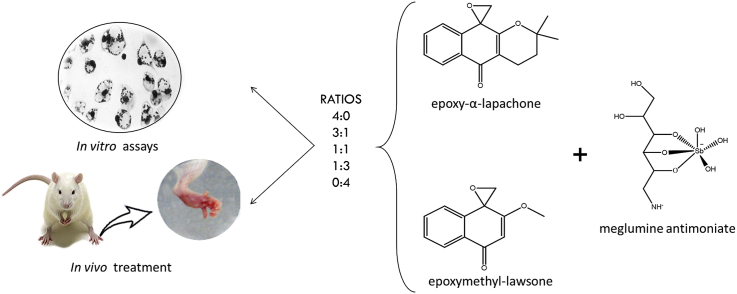
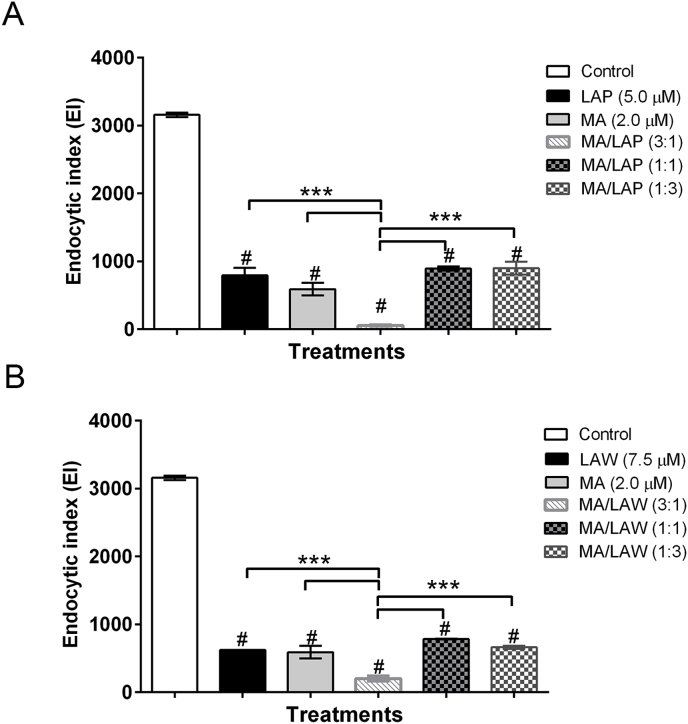
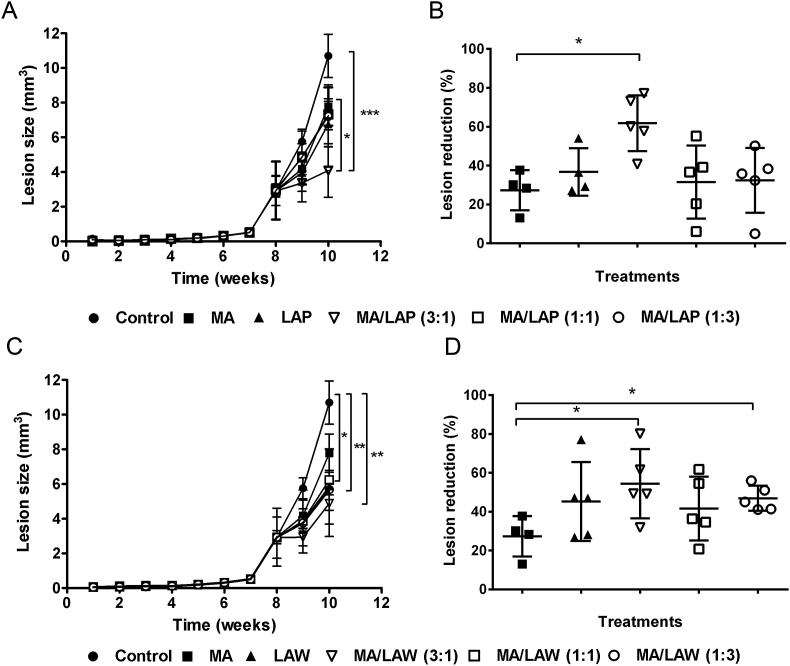
Current treatment of cutaneous leishmaniasis includes pentavalent antimonials as first-line drugs, but this therapy has shown severe adverse effects. An alternative to minimize this issue is based on combination therapy scheme with other drugs. In this study we analyzed the potential of the association of meglumine antimoniate (MA) with the oxiranes epoxy-α-lapachone (LAP) or epoxymethyl-lawsone (LAW). Results demonstrated that association between these drugs enhanced leishmanicidal activity on Leishmania (Leishmania) amazonensis infection. The compounds were tested in monotherapy or in combinations (3:1; 1:1 and 1:3) and reduced intracellular parasite numbers, measured by the endocytic index, in all tested conditions. The most effective combination regimens were MA/LAP or MA/LAW in 3:1 ratio, which achieved a reduction of 98.3% and 93.6% in the endocytic index, respectively. BALB/c mice challenged with L. (L.) amazonensis showed significant reduction in lesion size and parasite load in both footpad and lymph nodes, after four weeks of treatment. Although, MA, LAP or LAW monotherapy were able to control the evolution of lesions when compared to untreated animals (30%, 40% and 40% of reduction, respectively), the combination of MA/LAP and LAW in 3:1 ratio showed better results reducing 61.7 and 54.4%, respectively. The results indicate that the association of meglumine antimoniate to oxiranes lead to an increment in the antileishmanial activity and represent a promising approach for the cutaneous leishmaniasis treatment.
目前,治疗皮肤利什曼病的方法包括使用五价锑作为一线药物,但这种治疗方法已经显示出严重的不良反应。为了尽量减少这个问题,可以采用联合治疗方案,使用其他药物。在这项研究中,我们分析了将葡甲胺锑(MA)与环氧化物环氧-α-拉帕酮(LAP)或环氧甲基劳氏碱(LAW)联合使用的潜力。结果表明,这些药物的联合使用增强了对感染利什曼原虫(Leishmania)亚马逊亚种的杀利什曼原虫活性。这些化合物在单独治疗或联合治疗(3:1;1:1 和 1:3)中进行了测试,在所有测试条件下,通过内吞指数测量,都减少了细胞内寄生虫数量。最有效的联合治疗方案是 MA/LAP 或 MA/LAW 以 3:1 的比例,分别使内吞指数降低了 98.3%和 93.6%。用 L.(L.)亚马逊亚种感染的 BALB/c 小鼠在接受治疗四周后,在足部和淋巴结中,病变大小和寄生虫载量均显著减少。尽管 MA、LAP 或 LAW 单独治疗与未治疗动物相比(分别减少 30%、40%和 40%)能够控制病变的发展,但 MA/LAP 和 LAW 以 3:1 的比例联合使用时效果更好,分别减少了 61.7%和 54.4%。结果表明,葡甲胺锑与环氧化物的联合使用增加了抗利什曼原虫活性,为治疗皮肤利什曼病提供了一种有前途的方法。