
可溶性内皮糖蛋白在 BMP9 信号通路中的作用。
Role of soluble endoglin in BMP9 signaling.
机构信息
Department of Medicine, University of Cambridge, Cambridge CB2 0QQ, United Kingdom.
Department of Cell and Chemical Biology and Oncode Institute, Leiden University Medical Center, 2300 RC Leiden, The Netherlands.
出版信息
Proc Natl Acad Sci U S A. 2019 Sep 3;116(36):17800-17808. doi: 10.1073/pnas.1816661116. Epub 2019 Aug 20.
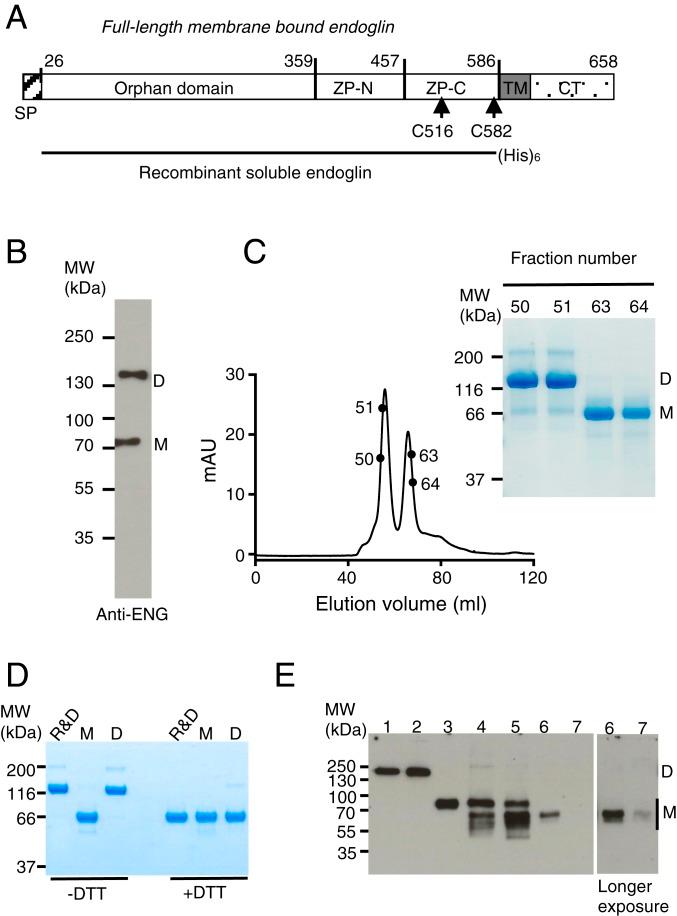
Endoglin (ENG) is a coreceptor of the transforming growth factor-β (TGFβ) family signaling complex, which is highly expressed on endothelial cells and plays a key role in angiogenesis. Its extracellular domain can be cleaved and released into the circulation as soluble ENG (sENG). High circulating levels of sENG contribute to the pathogenesis of preeclampsia (PE). Circulating bone morphogenetic protein 9 (BMP9), a vascular quiescence and endothelial-protective factor, binds sENG with high affinity, but how sENG participates in BMP9 signaling complexes is not fully resolved. sENG was thought to be a ligand trap for BMP9, preventing type II receptor binding and BMP9 signaling. Here we show that, despite cell-surface ENG being a dimer linked by disulfide bonds, sENG purified from human placenta and plasma from PE patients is primarily in a monomeric form. Incubating monomeric sENG with the circulating form of BMP9 (prodomain-bound form) in solution leads to the release of the prodomain and formation of a sENG:BMP9 complex. Furthermore, we demonstrate that binding of sENG to BMP9 does not inhibit BMP9 signaling. Indeed, the sENG:BMP9 complex signals with comparable potency and specificity to BMP9 on human primary endothelial cells. The full signaling activity of the sENG:BMP9 complex required transmembrane ENG. This study confirms that rather than being an inhibitory ligand trap, increased circulating sENG might preferentially direct BMP9 signaling via cell-surface ENG at the endothelium. This is important for understanding the role of sENG in the pathobiology of PE and other cardiovascular diseases.
内皮糖蛋白(ENG)是转化生长因子-β(TGFβ)家族信号复合物的核心受体,在血管内皮细胞中高度表达,在血管生成中发挥关键作用。其细胞外结构域可被切割并释放到循环中,形成可溶性内皮糖蛋白(sENG)。高水平的循环 sENG 有助于子痫前期(PE)的发病机制。循环中的骨形态发生蛋白 9(BMP9)是一种血管静止和内皮保护因子,与 sENG 具有高亲和力结合,但 sENG 如何参与 BMP9 信号复合物尚未完全阐明。sENG 被认为是 BMP9 的配体陷阱,可阻止 II 型受体结合和 BMP9 信号转导。在这里,我们表明,尽管细胞表面 ENG 是通过二硫键连接的二聚体,但从人胎盘和 PE 患者血浆中纯化的 sENG 主要以单体形式存在。在溶液中,将单体 sENG 与循环形式的 BMP9(前肽结合形式)孵育会导致前肽的释放和 sENG:BMP9 复合物的形成。此外,我们证明 sENG 与 BMP9 的结合不会抑制 BMP9 信号转导。事实上,sENG:BMP9 复合物在人原代内皮细胞上的信号转导活性与 BMP9 相当,具有相同的效力和特异性。sENG:BMP9 复合物的完全信号转导活性需要跨膜 ENG。这项研究证实,增加的循环 sENG 可能不是一种抑制性配体陷阱,而是通过内皮细胞表面的 ENG 优先引导 BMP9 信号转导。这对于理解 sENG 在 PE 和其他心血管疾病的病理生物学中的作用非常重要。



 Zotero 插件