Meijer Michael S, Bonnet Sylvestre
Leiden Institute of Chemistry , Leiden University , P.O. Box 9502, 2300 RA Leiden , The Netherlands.
Inorg Chem. 2019 Sep 3;58(17):11689-11698. doi: 10.1021/acs.inorgchem.9b01669. Epub 2019 Aug 21.
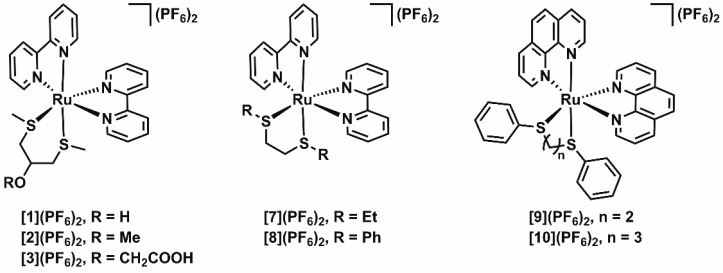
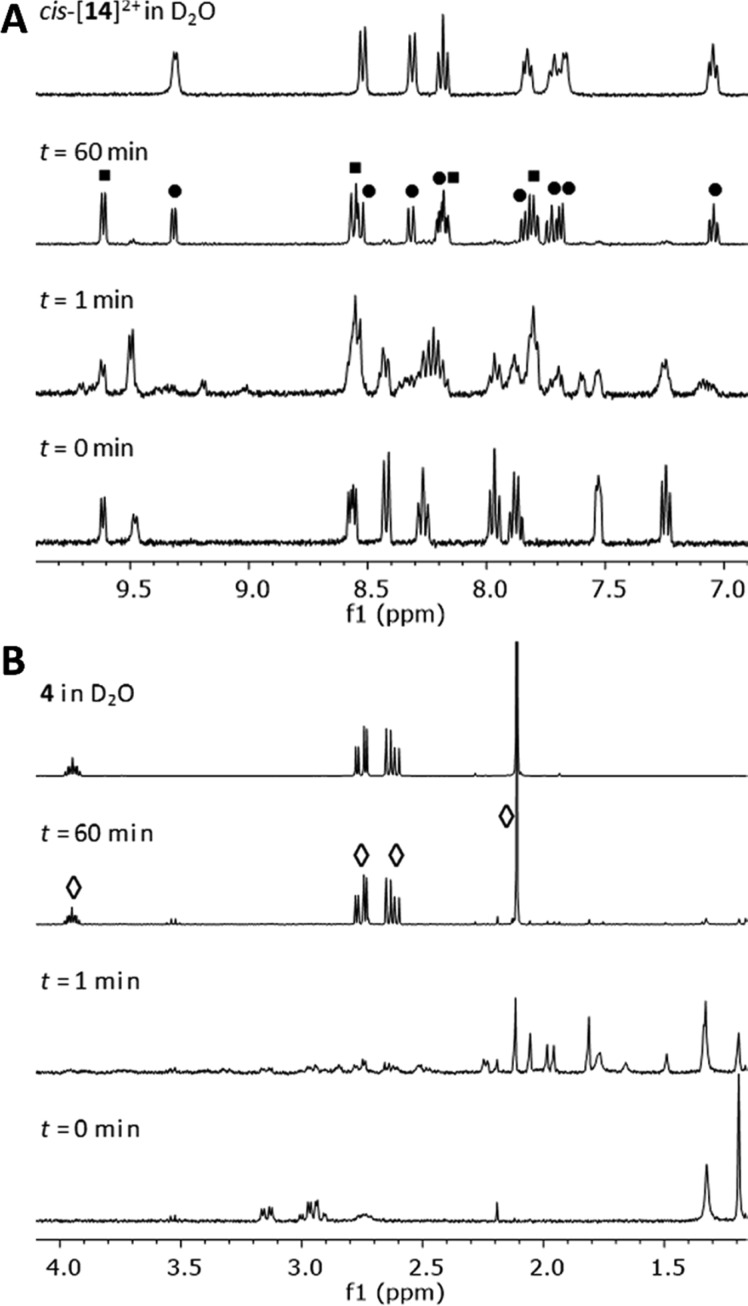
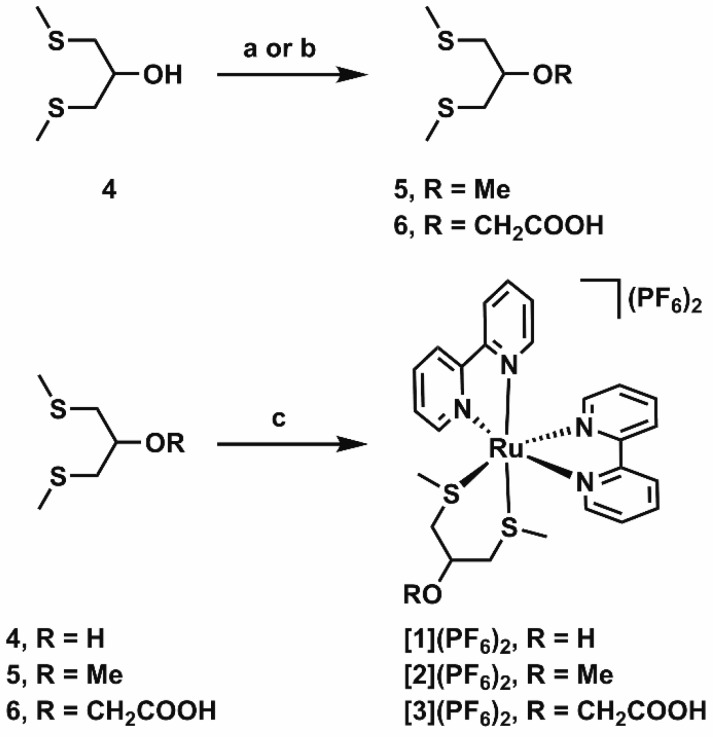
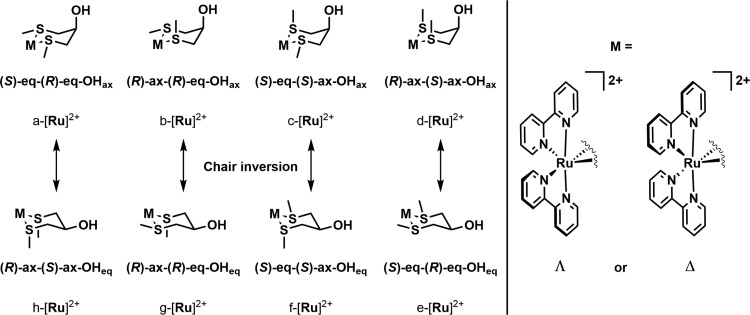
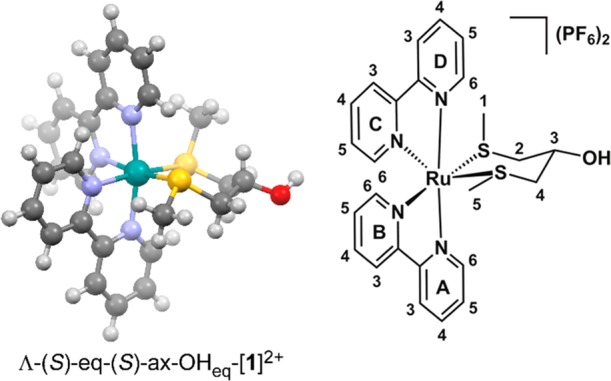
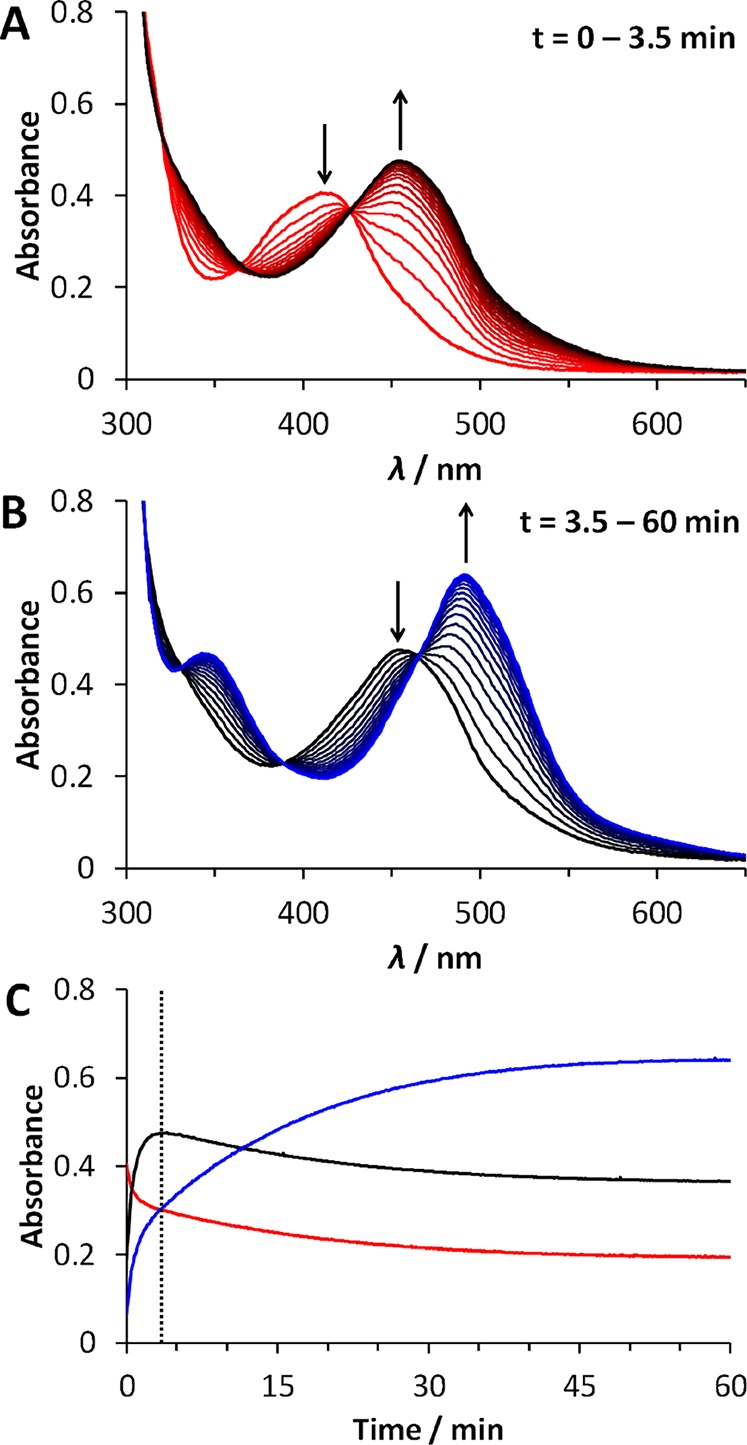
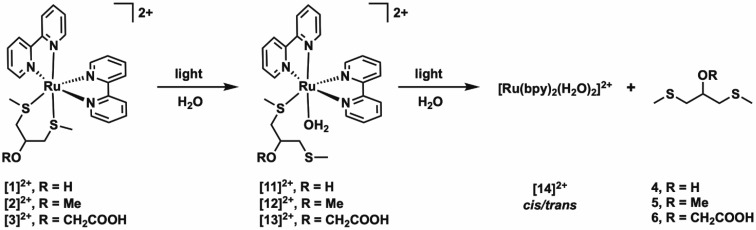
Thioethers are good ligands for photoactivatable ruthenium(II) polypyridyl complexes, as they form thermally stable complexes that are prone to ligand photosubstitution. Here, we introduce a novel symmetric chelating bis(thioether) ligand scaffold, based on 1,3-bis(methylthio)-2-propanol () and report the synthesis and stereochemical characterization of the series of novel ruthenium(II) polypyridyl complexes Ru(bpy)(L) ([]-), where L is ligand , its methyl ether, 1,3-bis(methylthio)-2-methoxypropane (), or its carboxymethyl ether, 1,3-bis(methylthio)-2-(carboxymethoxy)propane (). Coordination of ligands - to the bis(bipyridine)ruthenium center gives rise to 16 possible isomers, consisting of 8 possible Λ diastereoisomers and their Δ enantiomers. We found that the synthesis of []- is diastereoselective, yielding a racemic mixture of the Λ-()-eq-()-ax-OH-[] and Δ-()-ax-()-eq-OH-[] isomers. Upon irradiation with blue light in water, []- selectively substitute their bis(thioether) ligands for water molecules in a two-step photoreaction, ultimately producing [Ru(bpy)(HO)] as the photoproduct. The relatively stable photochemical intermediate was identified as -[Ru(bpy)(κ-L)(HO)] by mass spectrometry. Global fitting of the time evolution of the UV-vis absorption spectra of []- was employed to derive the photosubstitution quantum yields (Φ) for each of the two photochemical reaction steps separately, revealing very high quantum yields of 0.16-0.25 for the first step and lower values (0.0055-0.0093) for the second step of the photoreaction. The selective and efficient photochemical reaction makes the photocleavable bis(thioether) ligand scaffold reported here a promising candidate for use in e.g. ruthenium-based photo-activated chemotherapy.
硫醚是光活化钌(II)多吡啶配合物的良好配体,因为它们能形成热稳定的配合物,易于发生配体光取代反应。在此,我们基于1,3 - 双(甲硫基)-2 - 丙醇( )引入了一种新型对称螯合双(硫醚)配体支架,并报道了一系列新型钌(II)多吡啶配合物Ru(bpy)(L)([ ] )的合成及立体化学表征,其中L为配体 、其甲醚1,3 - 双(甲硫基)-2 - 甲氧基丙烷( )或其羧甲基醚1,3 - 双(甲硫基)-2 - (羧甲氧基)丙烷( )。配体 - 与双(联吡啶)钌中心配位会产生16种可能的异构体,包括8种可能的Λ非对映异构体及其Δ对映体。我们发现[ ] 的合成具有非对映选择性,生成了Λ - ( )-eq - ( )-ax - OH - [ ]和Δ - ( )-ax - ( )-eq - OH - [ ]异构体的外消旋混合物。在水中用蓝光照射时,[ ] 在两步光反应中选择性地将其双(硫醚)配体替换为水分子,最终生成[Ru(bpy)(HO)]作为光产物。通过质谱鉴定相对稳定的光化学中间体为 - [Ru(bpy)(κ - L)(HO)]。采用对[ ] 紫外 - 可见吸收光谱随时间变化的全局拟合,分别得出两个光化学反应步骤各自的光取代量子产率(Φ),结果显示第一步的量子产率非常高,为0.16 - 0.25,而光反应第二步的量子产率较低(0.0055 - 0.0093)。这种选择性高效的光化学反应使得本文报道的可光裂解双(硫醚)配体支架成为例如基于钌的光活化化疗等应用的有前景的候选物。