Goto Tsuyoshi, Sakai Toshinori, Sugiura Kosuke, Manabe Hiroaki, Morimoto Masatoshi, Tezuka Fumitake, Yamashita Kazuta, Takata Yoichiro, Chikawa Takashi, Katoh Shinsuke, Sairyo Koichi
Department of Rehabilitation, Tokushima University Hospital, Tokushima, Japan.
Department of Orthopedics, Institute of Biomedical Sciences, Tokushima University Graduate School, Tokushima, Japan.
Spine Surg Relat Res. 2018 Aug 25;3(2):146-150. doi: 10.22603/ssrr.2018-0020. eCollection 2019 Apr 27.
In past biomechanical studies, repetitive motion of lumbar extension, rotation, or a combination of both, frequently seen in batting or pitching practice in baseball, shooting practice in soccer, and spiking practice in volleyball, have been considered important risk factors of lumbar spondylolysis. However, clinically, these have been identified in many athletes performing on a running track or on the field, which requires none of the practices described above. The purpose of this study was to verify how much impact running has on the pathologic mechanism of lumbar spondylolysis.
In study 1, 89 consecutive pediatric patients diagnosed with lumbar spondylolysis at a single outpatient clinic between January 2012 and February 2017 were retrospectively analyzed. In study 2, motion analysis was performed on 17 male volunteers who had played on a soccer team without experiencing low back pain or any type of musculoskeletal injury. A Vicon motion capture system was used to evaluate four movements: maximal effort sprint (Dash), comfortable running (Jog), instep kick (Shoot), and inside kick (Pass).
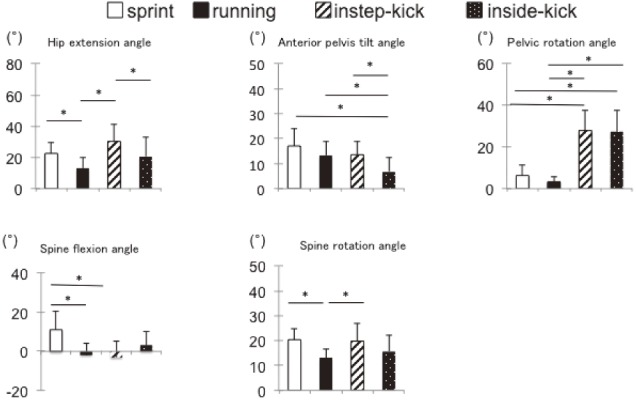
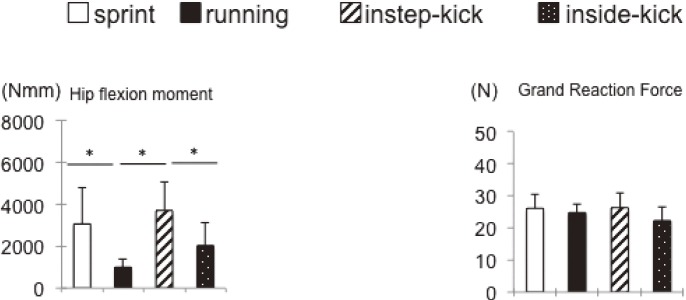
In study 1, 13 of the 89 patients with lumbar spondylolysis were track and field athletes. In study 2, motion analysis revealed that the hip extension angle, spine rotation angle, and hip flexion moment were similar in Dash and Shoot during the maximum hip extension phase. The pelvic rotation angle was significantly greater in the kicking conditions than in the running conditions.
Kinematically and kinetically, the spinopelvic angles in Dash were considered similar to those in Shoot. Dash could cause mechanical stress at the pars interarticularis of the lumbar spine, similar to that caused by Shoot, thus leading to spondylolysis.
在过去的生物力学研究中,腰椎伸展、旋转或两者结合的重复性动作,常见于棒球的击球或投球练习、足球的射门练习以及排球的扣球练习中,这些动作被认为是腰椎峡部裂的重要危险因素。然而,在临床上,许多在跑道上或运动场上进行运动的运动员也被诊断出患有腰椎峡部裂,而他们并未进行上述任何一种练习。本研究的目的是验证跑步对腰椎峡部裂病理机制的影响程度。
在研究1中,对2012年1月至2017年2月期间在一家门诊诊所连续诊断为腰椎峡部裂的89例儿科患者进行了回顾性分析。在研究2中,对17名曾在足球队踢球且未经历过腰痛或任何类型肌肉骨骼损伤的男性志愿者进行了运动分析。使用Vicon运动捕捉系统评估四种动作:全力冲刺(短跑)、舒适跑步(慢跑)、脚背踢球(射门)和内侧踢球(传球)。
在研究1中,89例腰椎峡部裂患者中有13例是田径运动员。在研究2中,运动分析显示,在最大髋关节伸展阶段,短跑和射门时的髋关节伸展角度、脊柱旋转角度和髋关节屈曲力矩相似。踢球时的骨盆旋转角度明显大于跑步时的骨盆旋转角度。
从运动学和动力学角度来看,短跑时的脊柱骨盆角度与射门时的相似。短跑可能会在腰椎峡部关节突产生与射门类似的机械应力,从而导致峡部裂。