Division of Orthopaedic Surgery, Department of Medicine of Sensory and Motor Organs, Faculty of Medicine, University of Miyazaki, 5200 Kihara, Kiyotake, Miyazaki, 889-1692, Japan.
Department of Radiology, Nozaki Higashi Hospital, 2105 Kouso, Murasumi, Miyazaki, 880-0837, Japan.
J Orthop Surg Res. 2020 Sep 3;15(1):378. doi: 10.1186/s13018-020-01910-4.
Spondylolysis is the main cause of low back pain (LBP) in young athletes. There are few studies analyzing the difference of spondylolysis among young athletes with different sports activities. The purpose of this study was to compare the clinical factors and distribution of the lesions of spondylolysis on magnetic resonance imaging (MRI) scans in young soccer and baseball players with symptomatic spondylolysis.
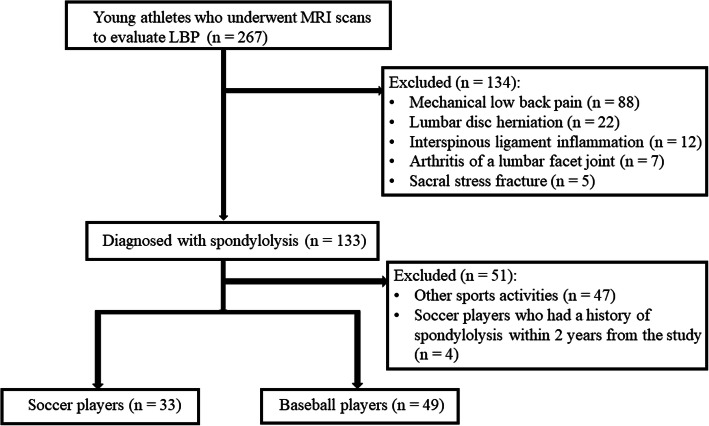
The medical records of 267 young athletes aged 7 to 18 years old who underwent MRI to evaluate the cause of LBP between 2017 and 2020 were retrospectively reviewed to identify patients with spondylolysis. Of the young athletes with symptomatic spondylolysis, clinical factors and MRI findings in soccer and baseball players were retrospectively evaluated. The clinical factors were age, sex, interval from onset of LBP to MRI, and side of the dominant leg in the sports field. MRI findings included number, lumbar level, and side of the lesions.
A total of 33 soccer players (mean age, 15.4 ± 1.4 years) and 49 baseball players (mean age, 15.4 ± 1.6 years) with symptomatic spondylolysis were enrolled. All patients were male. No significant differences were noted in age and the interval from onset of LBP to MRI between the groups. Soccer players had greater numbers of multiple (p < 0.001) and bilateral (p < 0.001) lesions than baseball players. The dominant side of the hand for pitching or batting was correlated with the contralateral-side lesions in baseball players (p = 0.001).
The distribution of the lesions of spondylolysis differed in young soccer and baseball players. Pitching or batting with the dominant-side hand would be associated with contralateral-side lesions in baseball players. Sports-specific movements and the side of the dominant leg should be considered when treating young athletes with symptomatic spondylolysis.
脊椎裂是年轻运动员腰痛(LBP)的主要原因。很少有研究分析不同运动项目的年轻运动员脊椎裂的差异。本研究旨在比较有症状脊椎裂的年轻足球和棒球运动员的临床因素和磁共振成像(MRI)扫描上脊椎裂病变的分布。
回顾性分析了 2017 年至 2020 年间因腰痛接受 MRI 评估的 267 名 7 至 18 岁年轻运动员的病历,以确定患有脊椎裂的患者。对有症状脊椎裂的年轻运动员进行回顾性评估,包括临床因素和足球及棒球运动员的 MRI 发现。临床因素包括年龄、性别、腰痛至 MRI 的时间间隔以及运动场上的优势腿侧。MRI 结果包括病变的数量、腰椎水平和侧别。
共纳入 33 名足球运动员(平均年龄 15.4 ± 1.4 岁)和 49 名棒球运动员(平均年龄 15.4 ± 1.6 岁),他们均为男性。两组间年龄和腰痛至 MRI 的时间间隔无显著差异。足球运动员的多发病变(p < 0.001)和双侧病变(p < 0.001)的比例均高于棒球运动员。棒球运动员用优势手投球或击球与对侧病变相关(p = 0.001)。
年轻足球和棒球运动员的脊椎裂病变分布不同。用优势手投球或击球会与棒球运动员的对侧病变相关。在治疗有症状脊椎裂的年轻运动员时,应考虑特定运动的动作和优势腿侧。