Department of Public Health and General Practice, NTNU, Trondheim, Norway.
Schulich School of Medicine and Dentistry, Western University, Clinical Skills Building, London, Ontario, N6A 5C1, Canada.
Can J Public Health. 2020 Feb;111(1):40-49. doi: 10.17269/s41997-019-00242-z. Epub 2019 Aug 21.
Inequalities between Indigenous and non-Indigenous peoples in Canada persist. Despite the growth of Indigenous populations in urban settings, information on their health is scarce. The objective of this study is to assess the association between experience of discrimination by healthcare providers and having unmet health needs within the Indigenous population of Toronto.
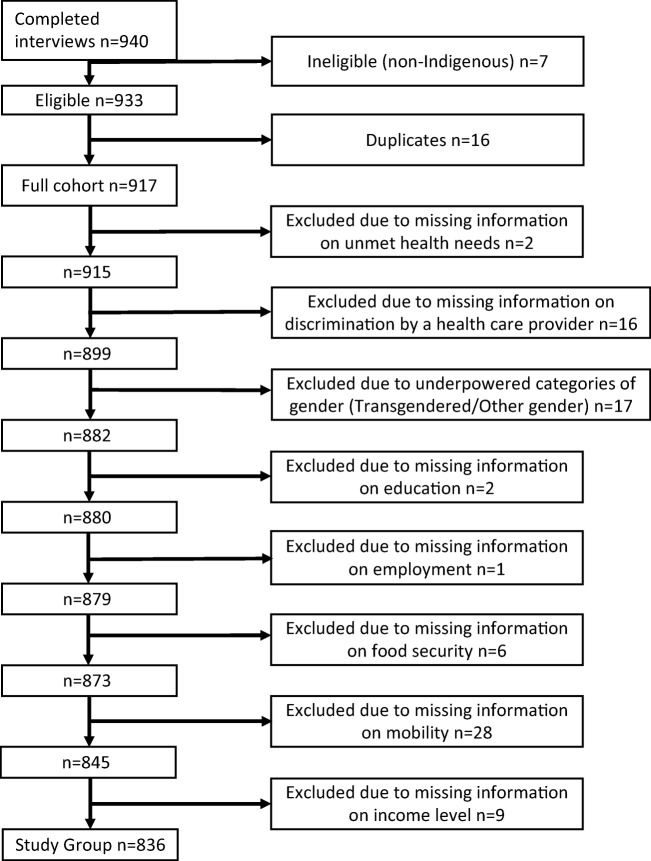
The Our Health Counts Toronto (OHCT) database was generated using respondent-driven sampling (RDS) to recruit 917 self-identified Indigenous adults within Toronto for a comprehensive health assessment survey. This cross-sectional study draws on information from 836 OHCT participants with responses to all study variables. Odds ratios and 95% confidence intervals were estimated to examine the relationship between lifetime experience of discrimination by a healthcare provider and having an unmet health need in the 12 months prior to the study. Stratified analysis was conducted to understand how information on access to primary care and socio-demographic factors influenced this relationship.
The RDS-adjusted prevalence of discrimination by a healthcare provider was 28.5% (95% CI 20.4-36.5) and of unmet health needs was 27.3% (95% CI 19.1-35.5). Discrimination by a healthcare provider was positively associated with unmet health needs (OR 3.1, 95% CI 1.3-7.3).
This analysis provides new evidence linking discrimination in healthcare settings to disparities in healthcare access among urban Indigenous people, reinforcing existing recommendations regarding Indigenous cultural safety training for healthcare providers. Our study further demonstrates Our Health Counts methodologies, which employ robust community partnerships and RDS to address gaps in health information for urban Indigenous populations.
加拿大的原住民和非原住民之间仍然存在不平等现象。尽管原住民在城市环境中的人口有所增加,但有关他们健康的信息却很少。本研究的目的是评估医疗保健提供者歧视经验与多伦多原住民群体中未满足的健康需求之间的关联。
使用受访者驱动抽样 (RDS) 生成了多伦多我们的健康计数 (OHCT) 数据库,以招募多伦多 917 名自我认同的原住民成年人进行全面健康评估调查。这项横断面研究利用了来自 836 名 OHCT 参与者的信息,这些参与者对所有研究变量都有回应。使用比值比和 95%置信区间来检验医疗保健提供者一生中经历歧视与在研究前 12 个月存在未满足的健康需求之间的关系。进行分层分析以了解有关初级保健的获取和社会人口因素的信息如何影响这种关系。
经 RDS 调整后,医疗保健提供者歧视的流行率为 28.5%(95%CI 20.4-36.5),未满足的健康需求的流行率为 27.3%(95%CI 19.1-35.5)。医疗保健提供者的歧视与未满足的健康需求呈正相关(OR 3.1,95%CI 1.3-7.3)。
这项分析提供了新的证据,将医疗保健环境中的歧视与城市原住民获得医疗保健服务的差异联系起来,加强了关于对医疗保健提供者进行原住民文化安全培训的现有建议。我们的研究进一步展示了我们的健康计数方法,该方法采用强大的社区伙伴关系和 RDS 来解决城市原住民人口健康信息的差距。