Department of Medicine, University of California San Diego, La Jolla, CA, United States of America.
Department of Psychiatry, University of California San Diego, La Jolla, CA, United States of America.
PLoS One. 2019 Aug 22;14(8):e0221558. doi: 10.1371/journal.pone.0221558. eCollection 2019.
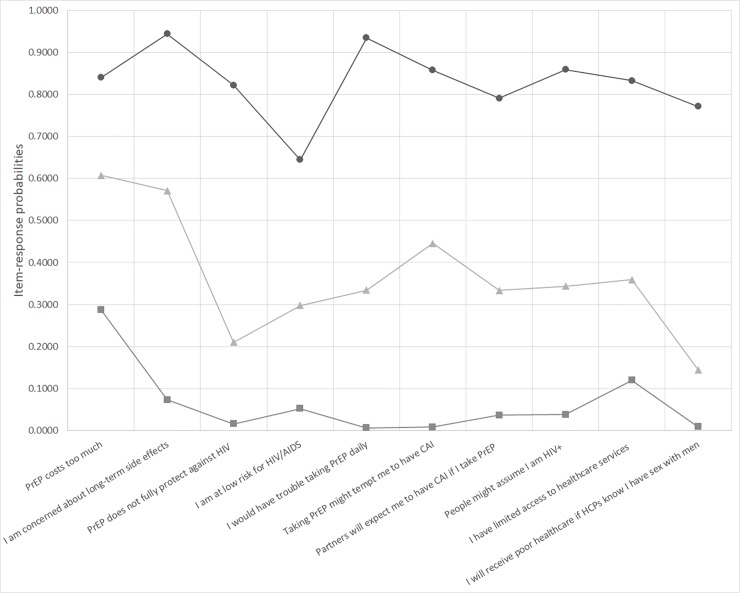
Given the slow uptake of PrEP among cisgender men who have sex with men (MSM) in high-income countries, efforts to roll-out PrEP in low- and middle-income countries (LMIC) should address barriers to PrEP use to facilitate its more rapid uptake. To inform PrEP programs in LMIC, we examined patterns of perceived barriers to PrEP use among HIV-negative MSM in Tijuana, Mexico.
From 03/2016-09/2017, 364 MSM completed interviewer-administered surveys assessing perceived barriers to PrEP use across 4 domains: PrEP attribute, individual, interpersonal, and structural. Latent class analysis was performed to identify distinct classes with respect to perceived barriers to PrEP use. Multinomial logistic regression was used to identify factors associated with class membership.
We identified three classes characterized by (1) high levels of perceived barriers across domains (12%), (2) low levels of perceived barriers across domains (43%), and (3) perceived PrEP attribute barriers (i.e., side-effects and cost) (45%). Membership in the high level of perceived barriers class (vs. the low level of perceived barriers class) was positively associated with having a history of incarceration (AOR: 2.44; 95% CI: 1.04, 5.73) and negatively associated with more social support (AOR: 0.99; 95% CI: 0.98, 1.00). Membership in the perceived PrEP attribute barriers class was positively associated with having seen a healthcare provider in the past year (AOR: 2.78; 95% CI: 1.41, 5.45) and negatively associated with having any HIV-positive or status unknown partners (AOR: 0.56; 95% CI: 0.31, 1.01).
Since most participants were in either the low level of perceived barriers class or the perceived PrEP attribute barriers class, future PrEP uptake may be high among MSM in Tijuana. However, these findings suggest that achieving sufficient PrEP uptake and adherence among MSM in Tijuana may require a range of comprehensive HIV prevention interventions.
在高收入国家,男男性行为者(MSM)对预防用抗逆转录病毒药物(PrEP)的接受速度缓慢,因此在中低收入国家(LMIC)推广 PrEP 时,应解决 PrEP 使用的障碍,以促进其更快速的推广。为了为 LMIC 中的 PrEP 项目提供信息,我们研究了在墨西哥提华纳的 HIV 阴性 MSM 中对 PrEP 使用的感知障碍模式。
从 2016 年 3 月至 2017 年 9 月,364 名 MSM 完成了由访谈者管理的调查,评估了 4 个领域对 PrEP 使用的感知障碍:PrEP 属性、个人、人际和结构。采用潜在类别分析来确定在 PrEP 使用的感知障碍方面具有不同特征的类别。采用多分类逻辑回归来确定与类别成员身份相关的因素。
我们确定了三个特征类别,分别为:(1)各个领域的感知障碍水平较高(12%);(2)各个领域的感知障碍水平较低(43%);(3)感知 PrEP 属性障碍(即副作用和费用)(45%)。与低水平感知障碍类别的成员身份相比,高水平感知障碍类别的成员身份与有监禁史(优势比 [AOR]:2.44;95%置信区间 [CI]:1.04,5.73)呈正相关,与更多的社会支持呈负相关(AOR:0.99;95%CI:0.98,1.00)。感知 PrEP 属性障碍类别的成员身份与过去一年看过医疗保健提供者(AOR:2.78;95%CI:1.41,5.45)呈正相关,与有任何 HIV 阳性或未知状态的伴侣(AOR:0.56;95%CI:0.31,1.01)呈负相关。
由于大多数参与者属于低水平感知障碍类别或感知 PrEP 属性障碍类别,因此,提华纳的 MSM 未来可能会大量使用 PrEP。然而,这些发现表明,要实现提华纳 MSM 对 PrEP 的充分接受和坚持,可能需要一系列全面的 HIV 预防干预措施。