Department of pediatrics, The First people's Hospital of Xiaosha, Hangzhou, China.
Department of pediatrics, Children's Hospital of Hangzhou, No 318 Chaowang Road, Hangzhou, 310005, Zhejiang Province, People's Republic of China.
Ital J Pediatr. 2019 Aug 22;45(1):108. doi: 10.1186/s13052-019-0697-8.
Pentoxifylline may be an important approach to treat neonatal sepsis. However, its use has not been well established. We conduct a systematic review and meta-analysis to evaluate the efficacy of pentoxifylline treatment for neonatal sepsis.
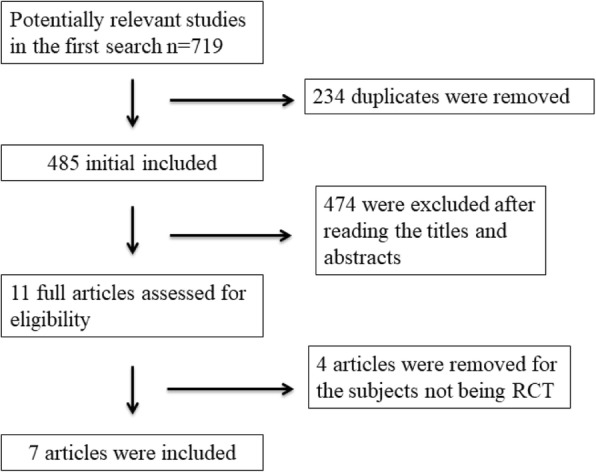
PubMed, Embase, and the Cochrane Central Register of Controlled Trials are searched. Randomized controlled trials (RCTs) assessing the influence of pentoxifylline treatment on neonatal sepsis are included. Two investigators independently have searched articles, extracted data, and assessed the quality of included studies. This meta-analysis is performed using the random-effect model.
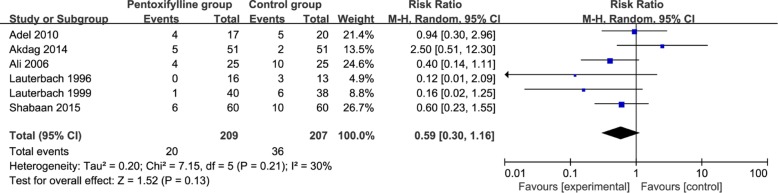
Seven RCTs involving 439 patients are included in the meta-analysis. Compared with control intervention for neonatal sepsis, pentoxifylline treatment is associated with reduced hospital stay (Std. MD = -0.61; 95% CI = -0.93 to - 0.29; P = 0.0002) and metabolic acidosis (RR = 0.38; 95% CI = 0.22 to 0.66; P = 0.0006), but has no remarkable impact on mortality (RR = 0.59; 95% CI = 0.30 to 1.16; P = 0.13), serum TNF-α (Std. MD = -0.38; 95% CI = -1.29 to 0.52; P = 0.41), serum CRP (Std. MD = -0.25; 95% CI = -0.92 to 0.42; P = 0.47), plasma IL-6 (Std. MD = -0.13; 95% CI = -0.41 to 0.15; P = 0.37), disseminated intravascular coagulopathy (RR = 0.55; 95% CI = 0.25 to 1.21; P = 0.14), and oliguria/anuria (RR = 0.77; 95% CI = 0.28 to 2.16; P = 0.62). In addition, pentoxifylline treatment can significantly reduce mortality (RR = 0.50; 95% CI = 0.29 to 0.88; P = 0.02) after excluding the study conducted by Akdag during the sensivity analysis.
Pentoxifylline treatment may be associated with reduced mortality and hospital stay in neonatal sepsis.
己酮可可碱可能是治疗新生儿败血症的重要方法。但是,其应用尚未得到充分证实。我们进行了系统评价和荟萃分析,以评估己酮可可碱治疗新生儿败血症的疗效。
检索了 PubMed、Embase 和 Cochrane 对照试验中心注册库。纳入评估己酮可可碱治疗对新生儿败血症影响的随机对照试验(RCT)。两名研究者独立检索文献、提取数据并评估纳入研究的质量。使用随机效应模型进行荟萃分析。
纳入的荟萃分析共包含 7 项 RCT,涉及 439 例患者。与新生儿败血症的对照干预相比,己酮可可碱治疗与住院时间缩短(Std. MD=-0.61;95%CI=-0.93 至-0.29;P=0.0002)和代谢性酸中毒减少相关(RR=0.38;95%CI=0.22 至 0.66;P=0.0006),但死亡率无显著影响(RR=0.59;95%CI=0.30 至 1.16;P=0.13)、血清 TNF-α(Std. MD=-0.38;95%CI=-1.29 至 0.52;P=0.41)、血清 CRP(Std. MD=-0.25;95%CI=-0.92 至 0.42;P=0.47)、血浆 IL-6(Std. MD=-0.13;95%CI=-0.41 至 0.15;P=0.37)、弥散性血管内凝血(RR=0.55;95%CI=0.25 至 1.21;P=0.14)和少尿/无尿(RR=0.77;95%CI=0.28 至 2.16;P=0.62)。此外,敏感性分析排除 Akdag 的研究后,己酮可可碱治疗可显著降低死亡率(RR=0.50;95%CI=0.29 至 0.88;P=0.02)。
己酮可可碱治疗可能与新生儿败血症的死亡率和住院时间缩短有关。