Rebsamen Stefanie, Knols Ruud H, Pfister Pierrette Baschung, de Bruin Eling D
Directorate of Research and Education, Physiotherapy and Occupational Therapy Research Center, University Hospital Zurich, Zurich, Switzerland.
Institute of Physiotherapy, Zurich University of Applied Sciences, Winterthur, Switzerland.
Front Physiol. 2019 Aug 7;10:1019. doi: 10.3389/fphys.2019.01019. eCollection 2019.
To investigate the feasibility of an exergame-driven high-intensity interval training (HIIT) and its effects on cardiovascular fitness in untrained community dwelling older adults.
Twelve older participants [10 women, age 72.3 (: 4.44) years] performed a high-intensity interval exergame intervention three times a week for 4 weeks. Data was acquired during two baseline and one final measurement. Feasibility outcomes included attrition, adherence, acceptability [Technology Acceptance Model Questionnaire (TAM)], usability [System Usability Scale (SUS)], and enjoyment of exergaming. Furthermore, participants' physical activity levels pre and post intervention were compared to physical activity levels for similar types of training. The secondary outcome was exercise capacity [heart rate at rest (HRrest), heart rate variability (HRV), maximum heart rate (HRmax), and maximum workload (W, in watt)] evaluated through maximal exercise testing.
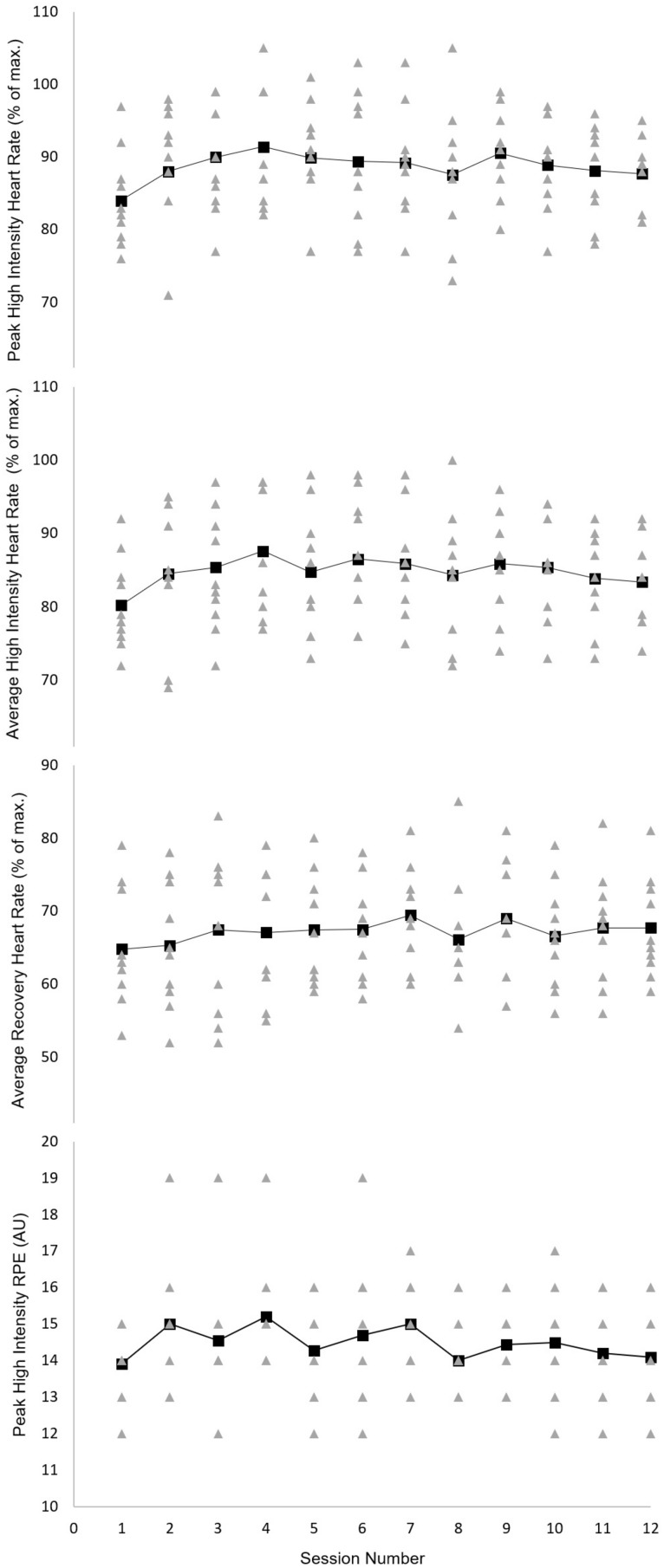
Eleven participants completed the study (8% attrition), without any adverse events. Adherence to the HIIT intervention was 91% and participants showed high acceptance of the intervention with TAM scores between 5.8 and 6.7 points. User satisfaction was rated as excellent (SUS total score: 93.5 of 100) and the overall enjoyment of exergaming scored 4.5 of 5 possible points. Total exercise time ranged from 19 to 35 min with a mean of 30.8 (: 3.6) min. Actual high-intensity exercise time showed consistency with the target exercise time in 98% percent of trainings. Eighty-six percent of high-intensity intervals met the targeted intensity range (>70-90% of HRmax). Thirty-six percent of the recovery periods were completed with a heart rate above the target range of 50-70% of HRmax. Maximum workload (W) during the incremental exercise test post-training increased significantly compared to the baseline measurements one and two ( = 0.032, effect size = 0.77 and = 0.012, = 0.87).
High-intensity interval training through exergaming is feasible, safe, and shows high usability and acceptance in community dwelling older people. Exergame-driven HIIT had a significant effect on maximum power output on an incremental exercise test. A more extensive exergame intervention period, higher work to recovery ratios as well as a higher-intensity activity should be considered in future projects.
探讨一款健身游戏驱动的高强度间歇训练(HIIT)的可行性及其对未受过训练的社区老年人心血管健康的影响。
12名老年参与者[10名女性,年龄72.3(±4.44)岁]每周进行3次高强度间歇健身游戏干预,共持续4周。在两次基线测量和一次最终测量期间收集数据。可行性结果包括损耗率、依从性、可接受性[技术接受模型问卷(TAM)]、可用性[系统可用性量表(SUS)]以及对健身游戏的喜爱程度。此外,将参与者干预前后的身体活动水平与类似类型训练的身体活动水平进行比较。次要结果是通过最大运动测试评估的运动能力[静息心率(HRrest)、心率变异性(HRV)、最大心率(HRmax)和最大工作量(W,以瓦特为单位)]。
11名参与者完成了研究(损耗率为8%),未发生任何不良事件。对HIIT干预的依从性为91%,参与者对该干预表现出高度接受,TAM得分在5.8至6.7分之间。用户满意度被评为优秀(SUS总分:满分100分中的93.5分),健身游戏的总体喜爱程度在5分制中得分为4.5分。总运动时间为19至35分钟,平均为30.8(±3.6)分钟。在98%的训练中,实际高强度运动时间与目标运动时间一致。86%的高强度间歇达到了目标强度范围(>HRmax的70 - 90%)。36%的恢复期心率在HRmax的50 - 70%的目标范围之上完成。与第一次和第二次基线测量相比,训练后递增运动测试期间的最大工作量(W)显著增加(p = 0.032,效应量d = 0.77;p = 0.012,d = 0.87)。
通过健身游戏进行的高强度间歇训练是可行、安全的,并且在社区老年人中显示出高可用性和可接受性。健身游戏驱动的HIIT对递增运动测试中的最大功率输出有显著影响。在未来的项目中应考虑更长的健身游戏干预期、更高的工作与恢复比率以及更高强度的活动。