Huber Simone K, Held Jeremia P O, de Bruin Eling D, Knols Ruud H
Physiotherapy and Occupational Therapy Research Center, Directorate of Research and Education, University Hospital Zurich, Zurich, Switzerland.
Department of Health Science and Technology, Institute of Human Movement Sciences and Sport, Swiss Federal Institute of Technology, ETH Zurich, Zurich, Switzerland.
Front Aging Neurosci. 2021 Oct 20;13:730801. doi: 10.3389/fnagi.2021.730801. eCollection 2021.
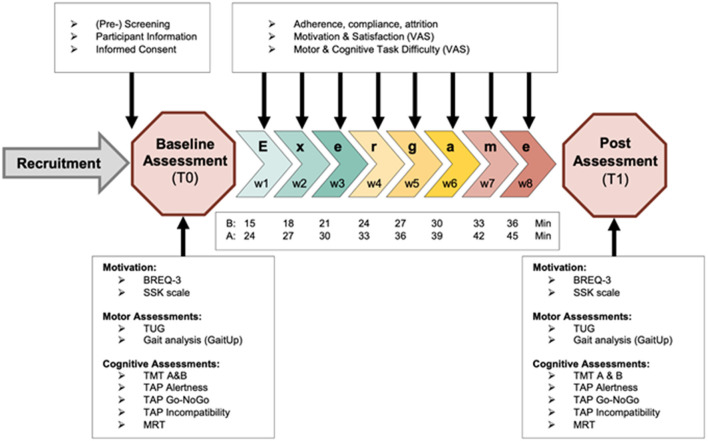
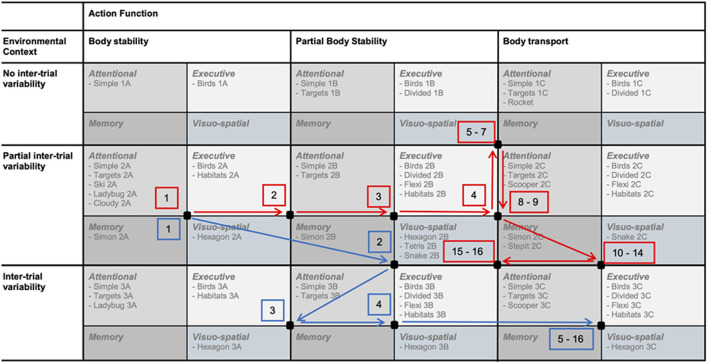
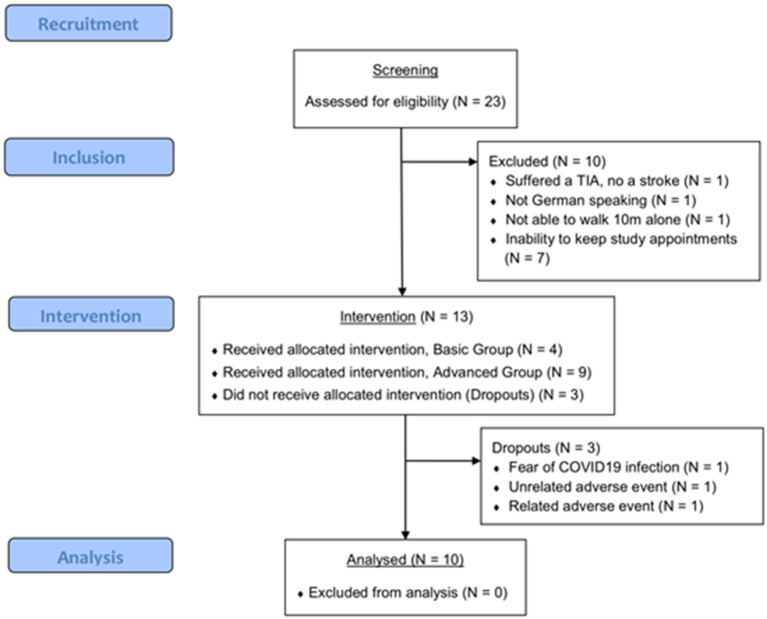
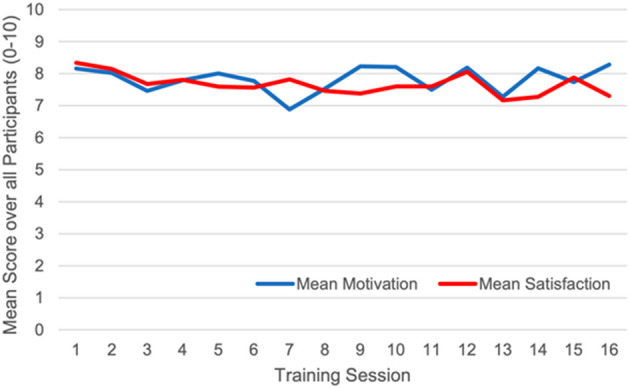
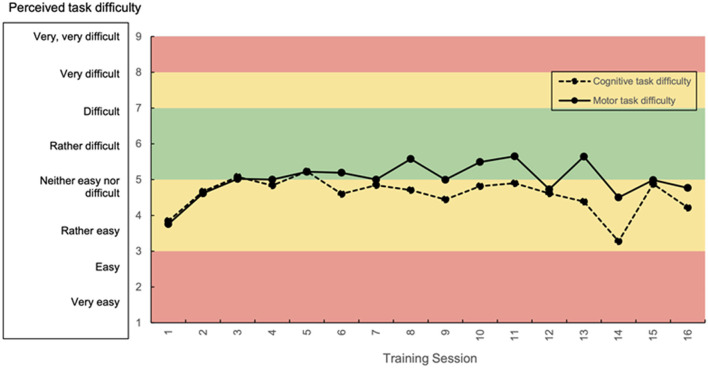
Exergame training may be beneficial for improving long-term outcome in stroke patients. Personalized training prescription applying progression rules, is missing. We adapted a theory-based taxonomy for a rehabilitation approach using user-centered exergames. The aims were primarily to investigate the feasibility of this rehabilitation approach, and secondarily to evaluate its performance of personalizing training progression, as well as explore the effects on secondary outcomes. Chronic stroke patients (≥ 18 years) were included, who were able to walk 10 meters and stand for 3 min. The rehabilitation approach was administered twice per week for 8 weeks. As primary outcome, feasibility was evaluated by comparing achieved rates of inclusion, adherence, compliance, attrition, motivation, and satisfaction to pre-defined thresholds for acceptance. Secondary outcomes were (1) perceived motor and cognitive task difficulty throughout the intervention; (2) measures collected during baseline and post-measurements-a gait analysis, the Timed-up-and-go test (TUG), several cognitive tests assessing attentional, executive, and visuospatial functions. Thirteen patients [median: 68.0 (IQR: 49.5-73.5) years, median: 34.5 (IQR: 12.25-90.75) months post-stroke] were included, of whom ten completed the study. Rates for inclusion (57%), adherence (95%), compliance (99%), motivation (77%), and satisfaction (74%) were acceptable, however, the attrition rate was high (23%). The perceived motor and cognitive task difficulty predominantly moved below the targeted range. We found a significant change in the TUG ( = 0.05, = 0.46) and medium-to-large effect sizes ( > 0.05) for swing time of the affected leg, the asymmetry index, time needed for the Trail-making test (TMT) A and accuracy for the TMT B and the Mental Rotation Test (MRT; 0.26 ≤ r ≤ 0.46). The intervention was feasible with minor modifications necessary, which warrants a larger trial investigating the effects of the rehabilitation approach following the adapted taxonomy on mobility, gait and cognitive functions. Two main limitations of the rehabilitation approach were; (1) the taxonomy decoupled motor and cognitive progression, which may be improper as motor and cognitive learning is coupled; (2) separate subjective ratings were used to guide the progression. Future studies should develop an instrument to objectively assess motor-cognitive task difficulty for monitoring the progression of an exergame-based training.
运动游戏训练可能有助于改善中风患者的长期预后。目前缺少应用进展规则的个性化训练方案。我们采用了一种基于理论的分类法,用于一种以用户为中心的运动游戏康复方法。主要目的是研究这种康复方法的可行性,其次是评估其个性化训练进展的表现,并探索对次要结局的影响。纳入慢性中风患者(≥18岁),他们能够行走10米并站立3分钟。康复方法每周进行两次,共8周。作为主要结局,通过将纳入率、依从性、顺应性、损耗率、动机和满意度与预先定义的接受阈值进行比较来评估可行性。次要结局包括:(1)整个干预过程中感知到的运动和认知任务难度;(2)在基线和测量后收集的指标——步态分析、计时起立行走测试(TUG)、几项评估注意力、执行功能和视觉空间功能的认知测试。纳入了13名患者[中位数:68.0(四分位间距:49.5 - 73.5)岁,中风后中位数:34.5(四分位间距:12.25 - 90.75)个月],其中10名完成了研究。纳入率(57%)、依从性(95%)、顺应性(99%)、动机(77%)和满意度(74%)是可接受的,然而,损耗率较高(23%)。感知到的运动和认知任务难度主要移至目标范围以下。我们发现TUG有显著变化(P = 0.05,效应量 = 0.46),患侧腿摆动时间、不对称指数、连线测验(TMT)A所需时间以及TMT B和心理旋转测试(MRT)的准确性有中到大的效应量(P > 0.05;0.26 ≤ r ≤ 0.46)。该干预在进行一些小修改后是可行的,这值得进行一项更大规模的试验,研究遵循改编分类法的康复方法对运动能力、步态和认知功能的影响。该康复方法的两个主要局限性是:(1)分类法将运动和认知进展解耦,这可能不合适,因为运动和认知学习是相互关联的;(2)使用单独的主观评分来指导进展。未来的研究应该开发一种工具来客观评估运动 - 认知任务难度,以监测基于运动游戏的训练进展。