Wu Xinzhi, Tian Zhongbin, Li Wenqiang, Liu Jian, Zhang Yisen, Zhang Ying, Zhou Yangyang, Yang Xinjian, Mu Shiqing
Department of Interventional Neuroradiology, Beijing Neurosurgical Institute, Beijing Tiantan Hospital, Capital Medical University, Beijing, China.
Front Neurol. 2019 Aug 7;10:838. doi: 10.3389/fneur.2019.00838. eCollection 2019.
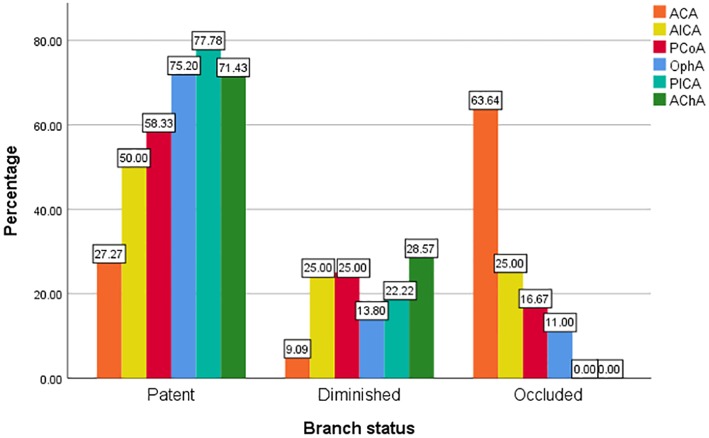
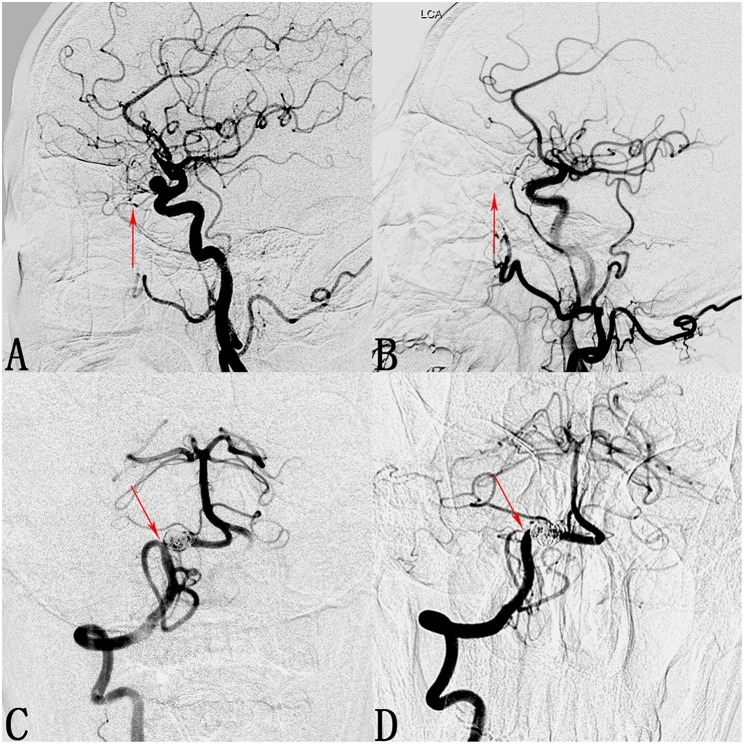
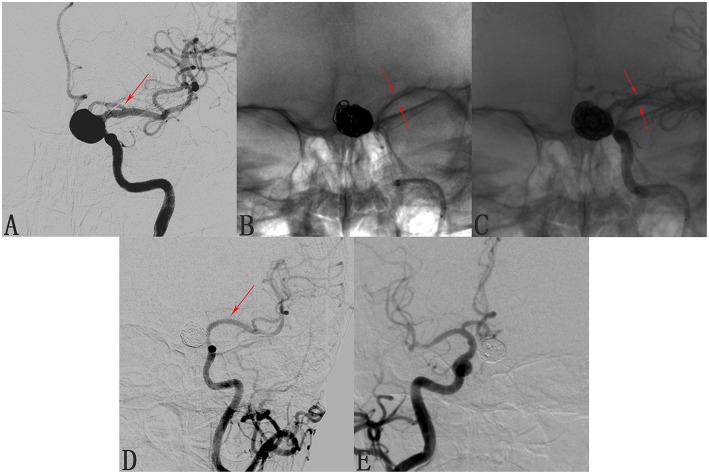
Pipeline embolization devices (PEDs) are widely used to exclude intracranial aneurysms from their parent arteries. Side branches covered by PEDs, however, sometimes experience occlusion and related symptoms. Thus, predictors of branch occlusion and the patency and clinical outcomes of these branches are concerning. We conducted a retrospective review of consecutive patients who had been treated with PEDs in our institution during 2015-2018 to identify those in whom one or more branches were involved. Pretreatment and follow-up angiograms were assessed to determine patency of the involved branches. Demographic and clinical data, treatment strategies, and comorbidities were collected to investigate their relations with branch occlusion. Altogether, 173 branches [24 (13.9%) occluded), 29 (16.8%) with diminished flow] in 126 patients were studied. Five patients (OphA involved) presented with blurred vision and 1 patient (ACA involved) presented with headache. None of the other patients had neurologic complications or clinical strokes related to branch occlusion. Multivariate analysis identified that small PED diameter [ = 0.003, odds ratio (OR) = 0.168], branches arising from the aneurysm ( = 0.004, OR = 6.614), and involvement of the anterior cerebral artery (ACA) ( < 0.001, OR = 25.656) significantly predicted branch occlusion. Branch occlusion rate after PED deployment was low and most occlusions was asymptomatic. Branches with rich collateral supply were more likely to occlude, especially the ACA. Smaller PED diameter, branches arising from the aneurysm, and ACA involvement were significant predictors of branch occlusion after PED treatment.
血流导向装置(PEDs)被广泛用于将颅内动脉瘤与其载瘤动脉隔绝。然而,被PEDs覆盖的分支有时会发生闭塞并出现相关症状。因此,分支闭塞的预测因素以及这些分支的通畅情况和临床结局备受关注。我们对2015年至2018年期间在我院接受PEDs治疗的连续患者进行了回顾性研究,以确定那些有一个或多个分支受累的患者。评估治疗前和随访血管造影以确定受累分支的通畅情况。收集人口统计学和临床数据、治疗策略及合并症,以研究它们与分支闭塞的关系。共研究了126例患者的173个分支[24个(13.9%)闭塞,29个(16.8%)血流减少]。5例(眼动脉受累)出现视力模糊,1例(大脑前动脉受累)出现头痛。其他患者均无与分支闭塞相关的神经并发症或临床卒中。多因素分析确定,PED直径小[ = 0.003,比值比(OR) = 0.168]、动脉瘤发出的分支[ = 0.004,OR = 6.614]以及大脑前动脉(ACA)受累( < 0.001,OR = 25.656)显著预测分支闭塞。PED置入后的分支闭塞率较低,且大多数闭塞无症状。侧支供应丰富的分支更易闭塞,尤其是ACA。较小的PED直径、动脉瘤发出的分支以及ACA受累是PED治疗后分支闭塞的显著预测因素。