Wei Hongkui, Zhao Xichen, Xia Mao, Tan Chengquan, Gao Jun, Htoo John K, Xu Chuanhui, Peng Jian
1Department of Animal Nutrition and Feed Science, College of Animal Science and Technology, Huazhong Agricultural University, Wuhan, People's Republic of China.
2Department of Animal Nutrition and Feed Science, College of Animal Science, South China Agricultural University, Guangzhou, People's Republic of China.
J Anim Sci Biotechnol. 2019 Aug 22;10:76. doi: 10.1186/s40104-019-0373-2. eCollection 2019.
Over the last decade, the nutritional requirements of lactating modern genotype sows have increased. The current nutritional recommendations might be unable to meet the needs of increased litter size and milk production, and thus the nutritional requirements need to be re-evaluated. The current study was conducted to investigate the effects of dietary methionine to lysine (Met:Lys) ratios on the performance of and methionine metabolism in lactating sows.
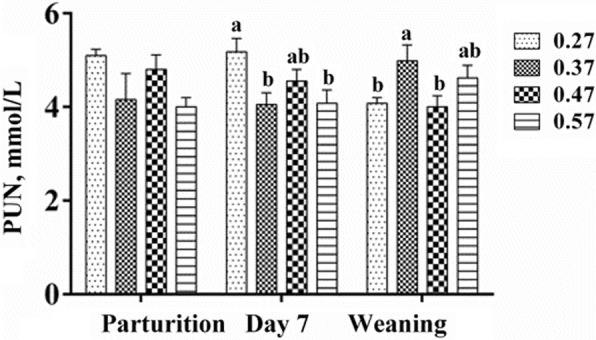
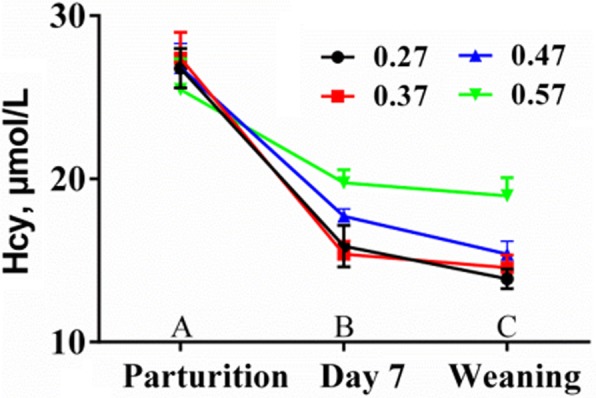
During the 1 week of lactation, piglets reared on sows in the 0.37 to 0.57 Met:Lys ratio groups grew faster than those reared on sows in the control group (0.27) ( < 0.01). The 0.37-ratio group showed increased levels of GSH-Px in plasma during lactation ( < 0.01) and decreased concentrations of urea nitrogen in the plasma of sows ( < 0.05). Compared with the 0.27-ratio group, the levels of T-AOC and GSH-Px in the plasma and homocysteine in the milk of lactating sows were significantly increased in sows in the 0.47-ratio group ( < 0.01). In sows fed a 0.57-ratio diet, the levels of glutathione and taurine in the plasma and milk were improved significantly during lactation. However, the content of TBARS in the blood ( < 0.05 at day 7 and = 0.06 at weaning day) was increased ( < 0.01). Moreover, there were linear increases in the levels of homocysteine in the blood and milk of sows during the lactation period ( < 0.01) with increased dietary Met:Lys ratios in the lactation diet.
The current study indicated that increasing the dietary Met:Lys ratio (0.37~0.57) in the lactation diet had no significant effect on the overall performance of sows or the colostrum and milk composition, but it increased piglet mean BW and piglet ADG during the first week of lactation. Increasing dietary methionine levels had no significant effect on antioxidant function in lactation sows, even though it increased levels of GSH and GSH-Px in the plasma of sows during lactation. However, the content of homocysteine in the plasma and milk increased during lactation due to a high level of dietary methionine.
在过去十年中,现代基因型哺乳母猪的营养需求有所增加。当前的营养建议可能无法满足产仔数增加和产奶量提高的需求,因此需要重新评估营养需求。本研究旨在探讨日粮蛋氨酸与赖氨酸(Met:Lys)比例对哺乳母猪生产性能和蛋氨酸代谢的影响。
在哺乳期的第1周,Met:Lys比例为0.37至0.57组的母猪所哺育的仔猪生长速度比对照组(0.27)的母猪所哺育的仔猪快(<0.01)。0.37比例组在哺乳期血浆中谷胱甘肽过氧化物酶(GSH-Px)水平升高(<0.01),母猪血浆中尿素氮浓度降低(<0.05)。与0.27比例组相比,0.47比例组哺乳母猪血浆中总抗氧化能力(T-AOC)和GSH-Px水平以及乳汁中同型半胱氨酸水平显著升高(<0.01)。在饲喂0.57比例日粮的母猪中,哺乳期血浆和乳汁中谷胱甘肽和牛磺酸水平显著提高。然而,血液中丙二醛(TBARS)含量增加(第7天<0.05,断奶日=0.06)(<0.01)。此外,随着哺乳期日粮中Met:Lys比例的增加,哺乳期母猪血液和乳汁中同型半胱氨酸水平呈线性增加(<0.01)。
本研究表明,在哺乳期日粮中提高Met:Lys比例(0.37~0.57)对母猪的整体生产性能或初乳和乳汁成分没有显著影响,但在哺乳期的第一周提高了仔猪平均体重和仔猪平均日增重。增加日粮蛋氨酸水平对哺乳母猪的抗氧化功能没有显著影响,尽管它在哺乳期增加了母猪血浆中GSH和GSH-Px水平。然而,由于日粮蛋氨酸水平较高,哺乳期血浆和乳汁中同型半胱氨酸含量增加。