Prieto-Centurion Valentin, Basu Sanjib, Bracken Nina, Calhoun Elizabeth, Dickens Carolyn, DiDomenico Robert J, Gallardo Richard, Gordeuk Victor, Gutierrez-Kapheim Melissa, Hsu Lewis L, Illendula Sai, Joo Min, Kazmi Uzma, Mutso Amelia, Pickard A Simon, Pittendrigh Barry, Sullivan Jamie L, Williams Mark, Krishnan Jerry A
Breathe Chicago Center, Department of Medicine, College of Medicine, University of Illinois at Chicago, United States.
Department of Epidemiology and Biostatistics, School of Public Health, University of Illinois at Chicago, United States.
Contemp Clin Trials Commun. 2019 Jul 19;15:100420. doi: 10.1016/j.conctc.2019.100420. eCollection 2019 Sep.
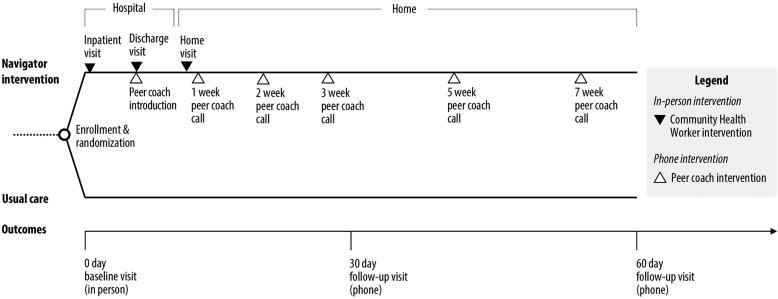
Previous work indicates the potential for community health workers and peer coaches serving as patient navigators to improve processes of care and health outcomes during care transitions, but have not been sufficiently tested to determine if such programs improve measures of patient experience in minority serving institutions. The objectives of the Patient Navigator to Reduce Readmissions (PArTNER) study was to: 1) conduct a pragmatic clinical effectiveness trial comparing a multi-faceted, stakeholder-supported Navigator intervention (in-person CHW visits in the hospital and after hospital discharge, plus telephone-based peer coaching) versus usual care on the experience of hospital-to-home care transitions in patients hospitalized with heart failure, pneumonia, chronic obstructive pulmonary disease, myocardial infarction, or sickle cell disease; 2) examine the effectiveness of the Navigator intervention in patient subgroups; and 3) understand the barriers and facilitators of successfully implementing the Navigator intervention across patient populations. The co-primary outcomes are the 30-day changes in: 1) Patient Reported Outcomes Measurement Information System (PROMIS) emotional distress-anxiety, and 2) PROMIS informational support. Secondary outcomes at 30 and 60 days include other PROMIS health measures and hospital readmissions. Innovative features of the PArTNER study include early and continuous engagement of patients, their caregivers, clinicians, health system administrators, and other stakeholders to inform the design and implementation of the Navigator intervention. In this report, we describe the design of the PArTNER study.
以往的研究表明,社区卫生工作者和同伴指导者有潜力作为患者导航员,在护理过渡期间改善护理流程和健康结果,但尚未得到充分测试,以确定此类项目是否能改善少数族裔服务机构中的患者体验指标。减少再入院患者导航员(PArTNER)研究的目标是:1)进行一项实用的临床有效性试验,比较多方面、由利益相关者支持的导航员干预措施(在医院和出院后由社区卫生工作者进行面对面家访,外加基于电话的同伴指导)与常规护理对心力衰竭、肺炎、慢性阻塞性肺疾病、心肌梗死或镰状细胞病住院患者从医院到家庭护理过渡体验的影响;2)研究导航员干预措施在患者亚组中的有效性;3)了解在不同患者群体中成功实施导航员干预措施的障碍和促进因素。共同主要结局是以下方面的30天变化:1)患者报告结局测量信息系统(PROMIS)情绪困扰焦虑,以及2)PROMIS信息支持。30天和60天的次要结局包括其他PROMIS健康指标和医院再入院情况。PArTNER研究的创新特点包括患者、其护理人员、临床医生、卫生系统管理人员和其他利益相关者的早期和持续参与,以为导航员干预措施的设计和实施提供信息。在本报告中,我们描述了PArTNER研究的设计。