Department of Medicinal Chemistry and Molecular Pharmacology, College of Pharmacy, Purdue University, 575 Stadium Mall Drive, West Lafayette, Indiana 47907, United States.
Biogeochemistry Research Center, Japan Agency for Marine-Earth Science and Technology, 2-15, Natsushima-cho, Yokosuka-city, Kanagawa 237-0061, Japan.
Acc Chem Res. 2022 Sep 20;55(18):2628-2646. doi: 10.1021/acs.accounts.2c00337. Epub 2022 Sep 2.
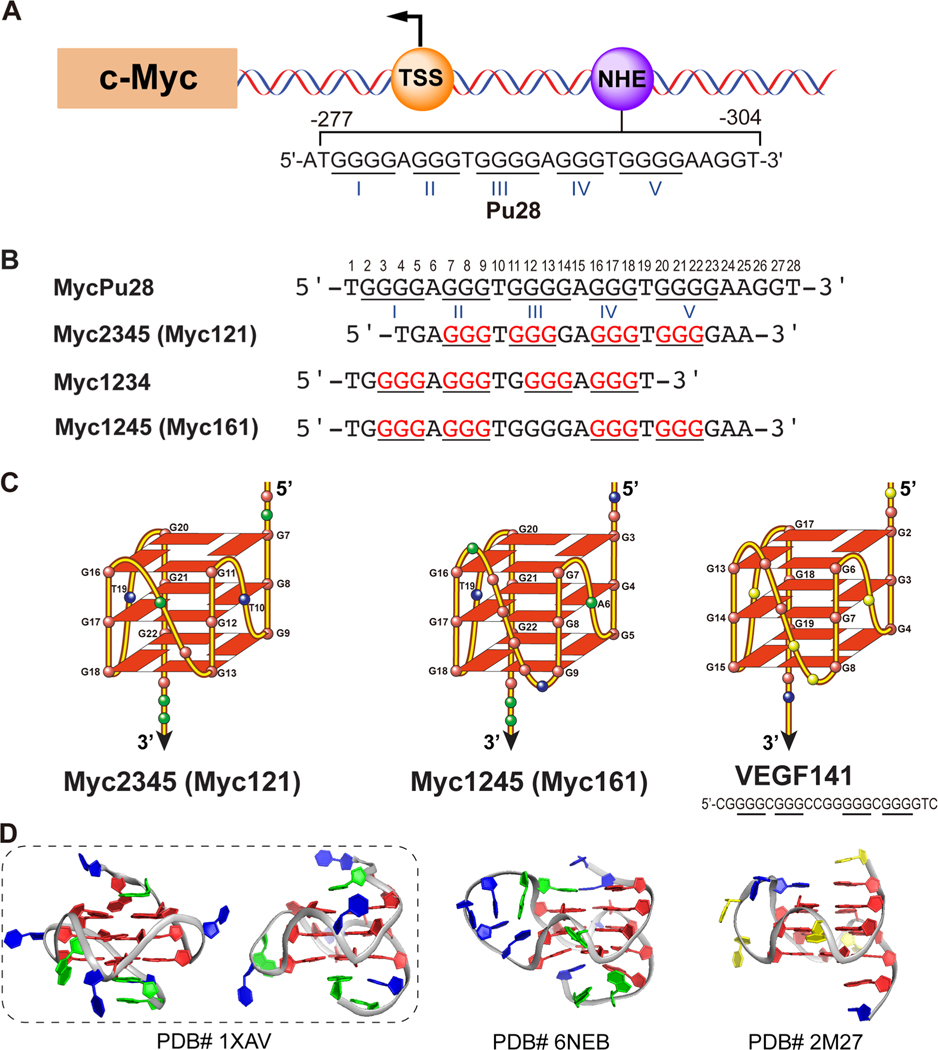
DNA G-quadruplex secondary structures formed in guanine-rich human telomeres and oncogene promoters are functionally important and have emerged as a promising new class of cancer-specific drug targets. These globular intramolecular structures are stabilized by K or Na and form readily under physiological solution conditions. Moreover, G-quadruplexes are epigenetic features and can alter chromatin structure and function together with interactive proteins. Here, we discuss our efforts over the last two decades to understand the structures and functions of DNA G-quadruplexes formed in key oncogene promoters and human telomeres and their interactions with small molecules. Using high-field NMR spectroscopy, we determined the high-resolution structures of physiologically relevant telomeric G-quadruplexes in K solution with a major form (hybrid-2) and a minor form (hybrid-1), as well as a two-tetrad intermediate. The intrinsic structural polymorphism of telomeric DNA may be important for the biology of human telomeres, and we proposed a model for the interconversion. More recently, we have worked on G-quadruplexes of MYC, BCL2, PDGFR-β, VEGF, and k-RAS oncogene promoters. We determined the structure of the major G-quadruplex formed in the MYC promoter, a prototype for parallel G-quadruplexes. It is the first example of the parallel-stranded GNG structure motif with a 1-nt loop, which is prevalent in promoter sequences and likely evolutionarily selected to initiate folding. Remarkably, the parallel MYC promoter G-quadruplexes are highly stable. Additionally, we determined the molecular structures of G-quadruplexes formed in human BCL2, VEGF, and PDGFR-β promoters, each adopting a unique structure. For example, the BCL2 promoter contains distinct interchangeable G-quadruplexes in two adjacent regions, suggesting precise regulation by different proteins. The PDGFR-β promoter adopts unique "broken-strand" and vacancy G-quadruplexes, which can be recognized by cellular guanine metabolites for a potential regulatory role.Structural information on G-quadruplexes in complex with small-molecules is critical for understanding specific recognition and structure-based rational drug design. Our studies show that many G-quadruplexes contain unique structural features such as capping and loop structures, allowing specific recognition by drugs and protein. This represents a paradigm shift in understanding DNA as a drug target: Rather than a uniform, nonselective binding site in duplex DNA, the G-quadruplex is being pursued as a new class of selectively targetable drug receptors. We focus on targeting the biologically relevant MYC promoter G-quadruplex (MycG4) with small molecules and have determined its first and additional drug complex structures. Very recently, we have discovered clinically tested indenoisoquinolines as strong MycG4 binders and potent MYC inhibitors. We have also discovered drugs targeting the unique dGMP-bound-vG4 formed in the PDGFR-β promoter. Moreover, we determined the complex structures of the first small molecules that specifically recognize the physiologically relevant human telomeric G-quadruplexes. Unlike the previously recognized dogma that the optimal G-quadruplex ligands are large aromatic or cyclic compounds, our results suggest that smaller asymmetric compounds with appropriate functional groups are better choices to specifically bind G-quadruplexes. This body of work lays a strong foundation for future work aimed at understanding the cellular functions of G-quadruplexes and G-quadruplex-targeted drug design.
富含鸟嘌呤的人类端粒和致癌基因启动子中形成的 DNA G-四链体二级结构在功能上非常重要,并且已经成为一类有前途的新型癌症特异性药物靶标。这些球状的分子内结构通过 K 或 Na 稳定,并在生理溶液条件下很容易形成。此外,G-四链体是表观遗传特征,可以与相互作用的蛋白质一起改变染色质结构和功能。在这里,我们讨论了过去二十年来我们在理解关键致癌基因启动子和人类端粒中形成的 DNA G-四链体的结构和功能及其与小分子相互作用方面的努力。我们使用高场 NMR 光谱学,确定了 K 溶液中主要形式(杂交-2)和次要形式(杂交-1)以及两个四联体中间物的生理相关端粒 G-四链体的高分辨率结构。端粒 DNA 的固有结构多态性可能对人类端粒的生物学很重要,我们提出了一种相互转化的模型。最近,我们研究了 MYC、BCL2、PDGFR-β、VEGF 和 k-RAS 致癌基因启动子中的 G-四链体。我们确定了 MYC 启动子中形成的主要 G-四链体的结构,这是平行 G-四链体的原型。这是第一个具有 1-nt 环的平行链 GNG 结构基序的例子,这种结构在启动子序列中很普遍,可能是为了启动折叠而在进化上被选择的。值得注意的是,平行 MYC 启动子 G-四链体非常稳定。此外,我们还确定了人 BCL2、VEGF 和 PDGFR-β 启动子中形成的 G-四链体的分子结构,每个结构都采用独特的结构。例如,BCL2 启动子在两个相邻区域包含不同的可互换 G-四链体,这表明不同的蛋白质可以进行精确的调节。PDGFR-β 启动子采用独特的“断链”和空位 G-四链体,可被细胞鸟嘌呤代谢物识别,可能具有潜在的调节作用。了解小分子与 G-四链体复合物的结构信息对于理解特异性识别和基于结构的合理药物设计至关重要。我们的研究表明,许多 G-四链体包含独特的结构特征,例如盖帽和环结构,允许药物和蛋白质的特异性识别。这代表了将 DNA 作为药物靶标的范式转变:与其说是在双链 DNA 中具有一个统一的、非选择性的结合位点,不如说是将 G-四链体作为一种新的可选择性靶向药物受体来进行研究。我们专注于用小分子靶向具有生物学意义的 MYC 启动子 G-四链体(MycG4),并确定了它的第一个和额外的药物复合结构。就在最近,我们发现了临床测试过的吲哚异喹啉类化合物是 MycG4 的强结合物和有效的 MYC 抑制剂。我们还发现了针对 PDGFR-β 启动子中形成的独特 dGMP 结合 vG4 的药物。此外,我们确定了第一个专门识别生理相关人类端粒 G-四链体的小分子的复合物结构。与先前公认的 G-四链体最佳配体是大的芳香族或环状化合物的观点相反,我们的结果表明,具有适当官能团的较小不对称化合物是更好的选择,可以特异性地结合 G-四链体。这项工作为未来旨在理解 G-四链体的细胞功能和 G-四链体靶向药物设计的工作奠定了坚实的基础。