Arizona State University, Tempe, Arizona.
University of North Carolina at Greensboro, Greensboro, North Carolina.
Am J Hum Biol. 2020 Jan;32(1):e23309. doi: 10.1002/ajhb.23309. Epub 2019 Aug 24.
Food and water insecurity have both been demonstrated as acute and chronic stressors and undermine human health and development. A basic untested proposition is that they chronically coexist, and that household water insecurity is a fundamental driver of household food insecurity.
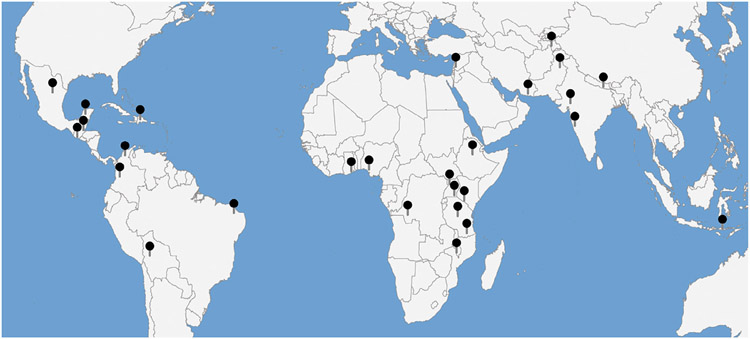
We provide a preliminary assessment of their association using cross-sectional data from 27 sites with highly diverse forms of water insecurity in 21 low- and middle-income countries across Africa, Asia, the Middle East, and the Americas (N = 6691 households). Household food insecurity and its subdomains (food quantity, food quality, and anxiety around food) were estimated using the Household Food Insecurity Access Scale; water insecurity and subdomains (quantity, quality, and opportunity costs) were estimated based on similar self-reported data.
In multilevel generalized linear mixed-effect modeling (GLMM), composite water insecurity scores were associated with higher scores for all subdomains of food insecurity. Rural households were better buffered against water insecurity effects on food quantity and urban ones for food quality. Similarly, higher scores for all subdomains of water insecurity were associated with greater household food insecurity.
Considering the diversity of sites included in the modeling, the patterning supports a basic theory: household water insecurity chronically coexists with household food insecurity. Water insecurity is a more plausible driver of food insecurity than the converse. These findings directly challenge development practices in which household food security interventions are often enacted discretely from water security ones.
食物和水不安全两者都被证明是急性和慢性压力源,破坏人类健康和发展。一个未经证实的基本假设是,它们长期共存,家庭水不安全是家庭粮食不安全的根本驱动因素。
我们使用来自 21 个低收入和中等收入国家的 27 个地点的横断面数据,对它们的相关性进行了初步评估,这些地点的水不安全形式多种多样,分布在非洲、亚洲、中东和美洲(N=6691 户家庭)。家庭粮食不安全及其子领域(粮食数量、粮食质量和对粮食的焦虑)使用家庭粮食不安全获取量表进行估计;水不安全及其子领域(数量、质量和机会成本)根据类似的自我报告数据进行估计。
在多层次广义线性混合效应模型(GLMM)中,综合水不安全评分与粮食不安全所有子领域的评分较高相关。农村家庭对水不安全对粮食数量的影响有更好的缓冲,而城市家庭则对粮食质量有更好的缓冲。同样,水不安全所有子领域的评分较高与家庭粮食不安全程度较高相关。
考虑到建模中包含的地点多样性,这种模式支持一个基本理论:家庭水不安全与家庭粮食不安全长期共存。水不安全是粮食不安全的一个更合理的驱动因素,而不是相反。这些发现直接挑战了发展实践,在这些实践中,家庭粮食安全干预措施往往与水安全干预措施分开实施。