Department of Endocrinology and Metabolism, West China Hospital, Sichuan University, Chengdu, China.
Institute of Health Informatics, University College London, London, UK.
BMJ Open. 2019 Aug 24;9(8):e026677. doi: 10.1136/bmjopen-2018-026677.
Despite the publication of hundreds of trials on gout and hyperuricemia, management of these conditions remains suboptimal. We aimed to assess the quality and consistency of guidance documents for gout and hyperuricemia.
Systematic review and quality assessment using the appraisal of guidelines for research and evaluation (AGREE) II methodology.
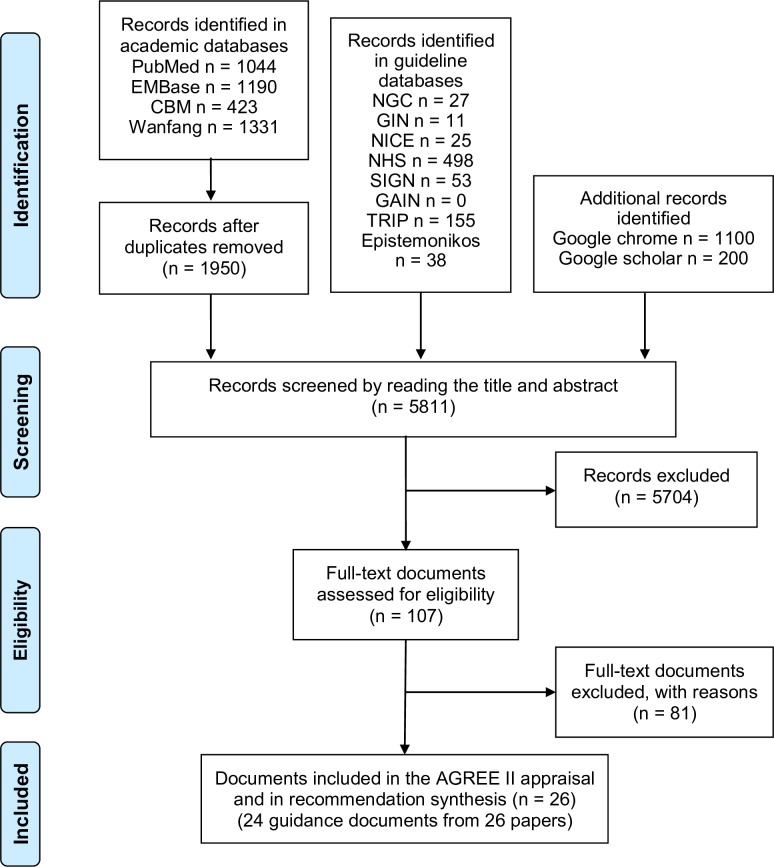
PubMed and EMBASE (27 October 2016), two Chinese academic databases, eight guideline databases, and Google and Google scholar (July 2017).
We included the latest version of international and national/regional clinical practice guidelines and consensus statements for diagnosis and/or treatment of hyperuricemia and gout, published in English or Chinese.
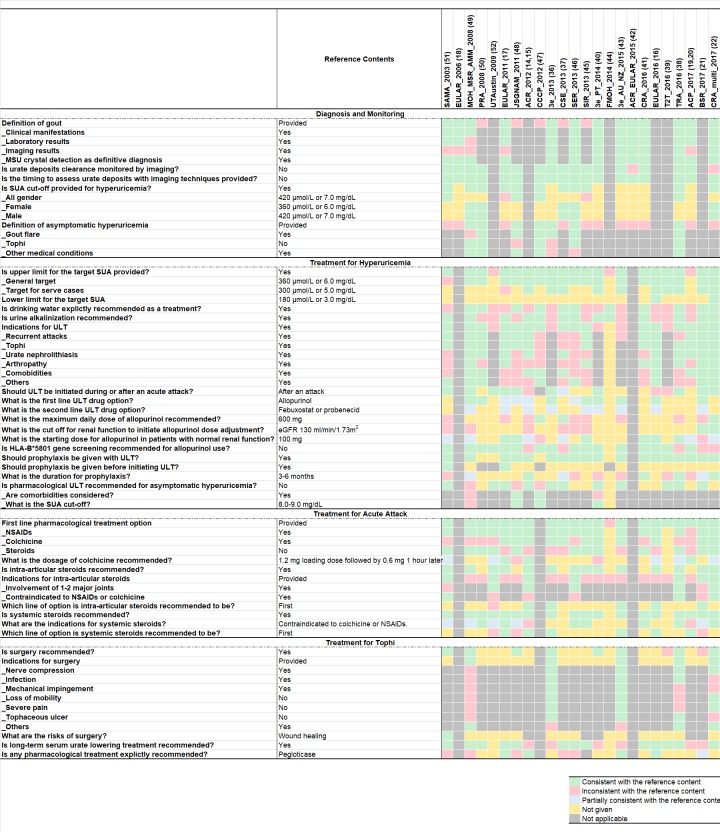
Two reviewers independently screened searched items and extracted data. Four reviewers independently scored documents using AGREE II. Recommendations from all documents were tabulated and visualised in a coloured grid.
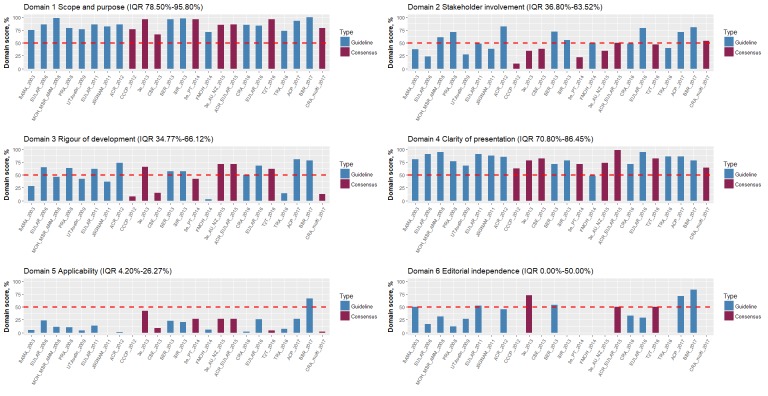
Twenty-four guidance documents (16 clinical practice guidelines and 8 consensus statements) published between 2003 and 2017 were included. Included documents performed well in the domains of scope and purpose (median 85.4%, range 66.7%-100.0%) and clarity of presentation (median 79.2%, range 48.6%-98.6%), but unsatisfactory in applicability (median 10.9%, range 0.0%-66.7%) and editorial independence (median 28.1%, range 0.0%-83.3%). The 2017 British Society of Rheumatology guideline received the highest scores. Recommendations were concordant on the target serum uric acid level for long-term control, on some indications for urate-lowering therapy (ULT), and on the first-line drugs for ULT and for acute attack. Substantially inconsistent recommendations were provided for many items, especially for the timing of initiation of ULT and for treatment for asymptomatic hyperuricemia.
Methodological quality needs improvement in guidance documents on gout and hyperuricemia. Evidence for certain clinical questions is lacking, despite numerous trials in this field. Promoting standard guidance development methods and synthesising high-quality clinical evidence are potential approaches to reduce recommendation inconsistencies.
CRD42016046104.
尽管已经发表了数百项关于痛风和高尿酸血症的试验,但这些疾病的治疗仍不尽人意。我们旨在评估痛风和高尿酸血症相关指导文件的质量和一致性。
系统评价和质量评估采用评估研究和评价指南(AGREE)Ⅱ方法。
PubMed 和 EMBASE(2016 年 10 月 27 日)、两个中文学术数据库、8 个指南数据库以及 Google 和 Google Scholar(2017 年 7 月)。
纳入了国际和国家/地区最新的关于高尿酸血症和痛风诊断和/或治疗的临床实践指南和共识声明,发表语言为英文或中文。
两名审查员独立筛选搜索项并提取数据。四名审查员独立使用 AGREE Ⅱ对文件进行评分。所有文件的推荐意见都列在一个彩色网格中。
纳入了 2003 年至 2017 年期间发表的 24 项指南文件(16 项临床实践指南和 8 项共识声明)。纳入的文件在范围和目的(中位数 85.4%,范围 66.7%-100.0%)和表述清晰度(中位数 79.2%,范围 48.6%-98.6%)方面表现良好,但在适用性(中位数 10.9%,范围 0.0%-66.7%)和编辑独立性(中位数 28.1%,范围 0.0%-83.3%)方面表现不佳。2017 年英国风湿病学会指南获得了最高评分。对于长期控制的目标血清尿酸水平、某些降尿酸治疗(ULT)的适应证以及 ULT 和急性发作的一线药物,建议是一致的。对于许多项目,特别是 ULT 起始时间和无症状高尿酸血症的治疗,提供了明显不一致的建议。
痛风和高尿酸血症相关指导文件的方法学质量需要改进。尽管该领域已有多项试验,但某些临床问题仍缺乏证据。推广标准指导文件的制定方法和综合高质量的临床证据可能是减少推荐意见不一致的潜在方法。
PROSPERO 注册号:CRD42016046104。