Kasai Nobukazu, Kojima Chihiro, Sumi Daichi, Ikutomo Akiho, Goto Kazushige
Graduate School of Sport and Health Science, Ritsumeikan University, Kusatsu, Japan.
Japan Society for the Promotion of Science, Tokyo, Japan.
Front Physiol. 2019 Aug 9;10:844. doi: 10.3389/fphys.2019.00844. eCollection 2019.
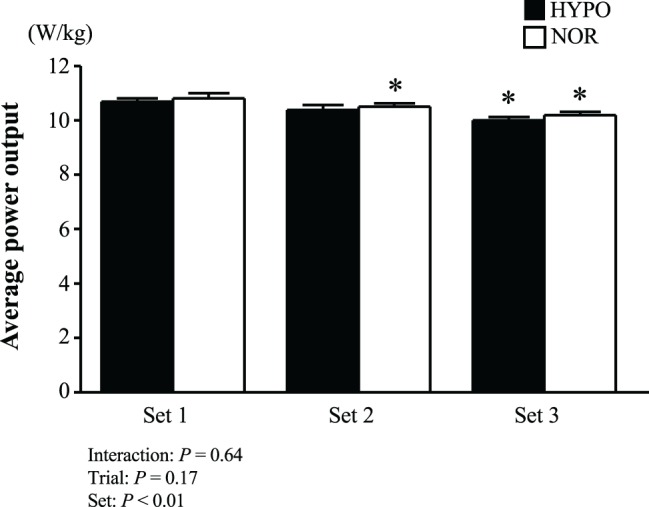
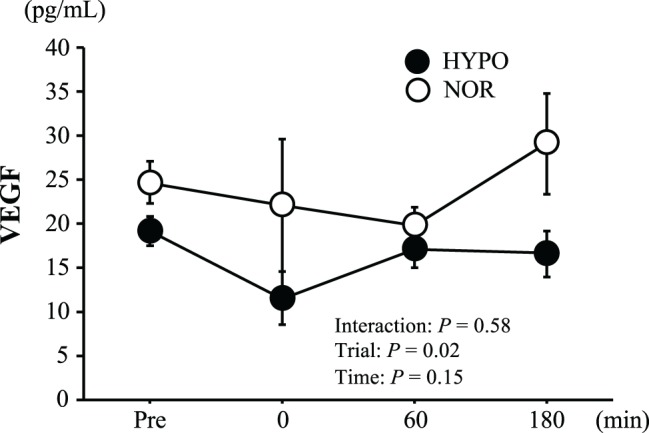
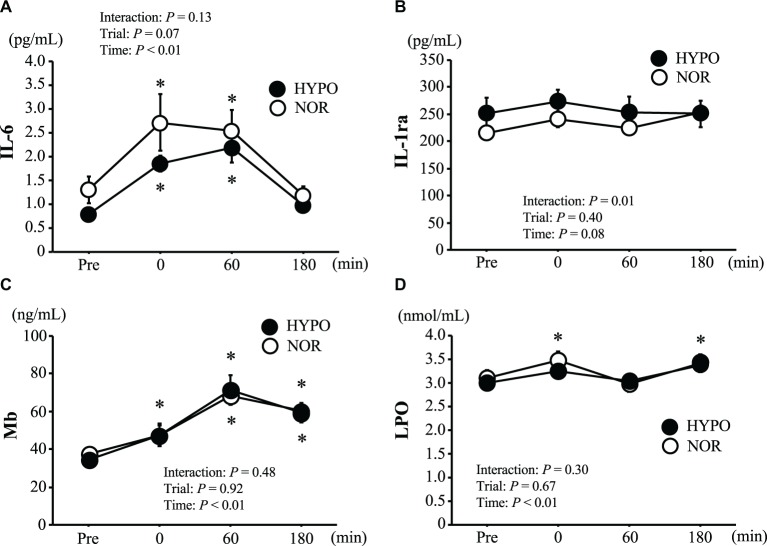
The present study was designed to determine the effects of repeated-sprint exercise in moderate hypoxia on inflammatory, muscle damage, oxidative stress, and angiogenic growth factor responses among athletes. Ten male college track and field sprinters [mean ± standard error (SE): age, 20.9 ± 0.1 years; height, 175.7 ± 1.9 cm; body weight, 67.3 ± 2.0 kg] performed two exercise trials in either hypoxia [HYPO; fraction of inspired oxygen (FO), 14.5%] or normoxia (NOR; FO, 20.9%). The exercise consisted of three sets of 5 s × 6 s maximal sprints with 30 s rest periods between sprints and 10 min rest periods between sets. After completing the exercise, subjects remained in the chamber for 3 h under the prescribed oxygen concentration (hypoxia or normoxia). The average power output during exercise did not differ significantly between trials ( = 0.17). Blood lactate concentrations after exercise were significantly higher in the HYPO trial than in the NOR trial ( < 0.05). Plasma interleukin-6 concentrations increased significantly after exercise ( < 0.01), but there was no significant difference between the two trials ( = 0.07). Post-exercise plasma interleukin-1 receptor antagonist, serum myoglobin, serum lipid peroxidation, plasma vascular endothelial growth factor (VEGF), and urine 8-hydroxydeoxyguanosine concentrations did not differ significantly between the two trials ( > 0.05). In conclusion, exercise-induced inflammatory, muscle damage, oxidative stress, and VEGF responses following repeated-sprint exercise were not different between hypoxia and normoxia.
本研究旨在确定在中度低氧环境下进行重复冲刺运动对运动员炎症、肌肉损伤、氧化应激和血管生成生长因子反应的影响。十名男性大学田径短跑运动员[平均值±标准误(SE):年龄,20.9±0.1岁;身高,175.7±1.9厘米;体重,67.3±2.0千克]在低氧环境[HYPO;吸入氧分数(FO),14.5%]或常氧环境(NOR;FO,20.9%)下进行了两次运动试验。运动包括三组5秒×6秒的最大冲刺,每组冲刺之间休息30秒,组间休息10分钟。运动结束后,受试者在规定的氧气浓度(低氧或常氧)下在舱内停留3小时。两次试验期间运动时的平均功率输出无显著差异( = 0.17)。运动后血乳酸浓度在HYPO试验中显著高于NOR试验( < 0.05)。运动后血浆白细胞介素-6浓度显著升高( < 0.01),但两次试验之间无显著差异( = 0.07)。运动后血浆白细胞介素-1受体拮抗剂、血清肌红蛋白、血清脂质过氧化、血浆血管内皮生长因子(VEGF)和尿8-羟基脱氧鸟苷浓度在两次试验之间无显著差异( > 0.05)。总之,低氧和常氧环境下重复冲刺运动后运动诱导的炎症、肌肉损伤、氧化应激和VEGF反应无差异。