Wang Jian, Xiang Yang, Jiang Shisong, Li Hongchang, Caviezel Flurin, Katawatin Suporn, Duangjinda Monchai
Faculty of Veterinary Medicine, Southwest University, Chongqing, 400700, China.
Department of Oncology, Oxford University, Oxford, OX3 7DQ, UK.
BMC Vet Res. 2021 Jun 7;17(1):209. doi: 10.1186/s12917-021-02912-y.
Extreme panting under heat stress threatens dairy cattle milk production. Previous research has revealed that the gas exchange-mediated respiratory drive in critically ill dairy cattle with low O saturation induces panting. Vascular endothelial growth factor (VEGF) signaling may play important roles in immunosuppression and oxidative stress during severe respiratory stress responses in heat-stressed cattle. The objectives of this study were to transcriptomically analyze mRNA expression mediating heat-induced respiratory stress-associated panting, evaluate gas exchange, screen hub genes, and verify the expression of proteins encoded by differentially expressed genes in lymphocyte pathways.
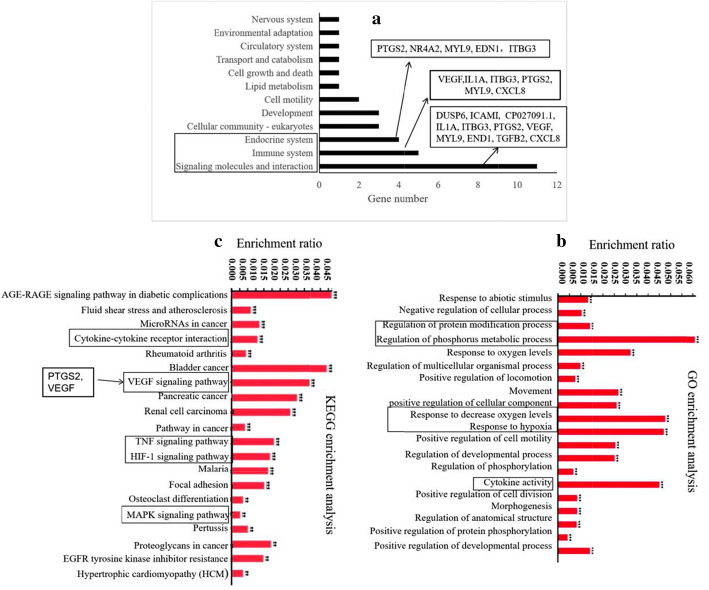
Jersey cattle were naturally heat-exposed. Physiological data were collected for response evaluation, and blood was collected for gas exchange and gene expression assays at 06:00, 10:00 and 14:00 continuously for 1 week. Lymphocytes were isolated from whole-blood samples for mRNA-seq and expression analysis of key pathway genes/proteins. The cattle respiration rates differed with time, averaging 51 bpm at 06:00, 76 bpm at 10:00, and 121 bpm at 14:00 (p < 0.05). Gas exchange analysis showed that both pH and pCO differed with time: they were 7.41 and 41 mmHg at 06:00, 7.45 and 37.5 mmHg at 10:00, and 7.49 and 33 mmHg at 14:00, respectively (p < 0.01). Sixteen heat-related differentially expressed genes (DEGs; 13 upregulated and 3 downregulated) were screened between 212 DEGs and 1370 heat stress-affected genes. Kyoto Encyclopedia of Genes and Genomes (KEGG) hub gene functional analysis annotated eleven genes to signal transduction, six genes to the immune response, and five genes to the endocrine response, including both prostaglandin-endoperoxide synthase 2 (PTGS2) and VEGF. Gene Ontology (GO) functional enrichment analysis revealed that oxygen regulation was associated with the phosphorus metabolic process, response to oxygen levels, response to decreased oxygen levels, response to hypoxia and cytokine activity terms. The main signaling pathways were the VEGF, hypoxia inducible factor-1(HIF-1), cytokine-cytokine receptor interaction and TNF pathways. Four genes involved Integrin beta 3 (ITBG3), PTGS2, VEGF, and myosin light chain 9 (MYL9) among the 16 genes related to immunosuppression, oxidative stress, and endocrine dysfunction were identified as participants in the VEGF signaling pathway and oxygenation.
These findings help elucidate the underlying immune and oxygen regulation mechanisms associated with the VEGF signaling pathway in heat-stressed dairy cattle.
热应激下的极度喘气会威胁奶牛的产奶量。先前的研究表明,氧饱和度低的重症奶牛中,气体交换介导的呼吸驱动会引发喘气。血管内皮生长因子(VEGF)信号传导可能在热应激奶牛严重呼吸应激反应期间的免疫抑制和氧化应激中发挥重要作用。本研究的目的是通过转录组学分析介导热诱导呼吸应激相关喘气的mRNA表达,评估气体交换,筛选核心基因,并验证淋巴细胞途径中差异表达基因编码的蛋白质的表达。
泽西牛自然暴露于高温环境。收集生理数据以进行反应评估,并在连续1周的06:00、10:00和14:00采集血液用于气体交换和基因表达分析。从全血样本中分离淋巴细胞用于mRNA测序和关键途径基因/蛋白质的表达分析。牛的呼吸频率随时间变化,06:00平均为51次/分钟,10:00为76次/分钟,14:00为121次/分钟(p < 0.05)。气体交换分析表明,pH值和pCO均随时间变化:06:00时分别为7.41和41 mmHg,10:00时为7.45和37.5 mmHg,14:00时为7.49和33 mmHg(p < 0.01)。在212个差异表达基因(DEG)和1370个热应激影响基因之间筛选出16个与热相关的差异表达基因(13个上调和3个下调)。京都基因与基因组百科全书(KEGG)核心基因功能分析将11个基因注释为信号转导,6个基因注释为免疫反应,5个基因注释为内分泌反应,包括前列腺素内过氧化物合酶2(PTGS2)和VEGF。基因本体论(GO)功能富集分析表明,氧调节与磷代谢过程、对氧水平的反应、对氧水平降低的反应、对缺氧的反应和细胞因子活性术语相关。主要信号通路为VEGF、缺氧诱导因子-1(HIF-1)、细胞因子-细胞因子受体相互作用和TNF通路。在与免疫抑制、氧化应激和内分泌功能障碍相关的16个基因中,鉴定出四个基因,即整合素β3(ITBG3)、PTGS2、VEGF和肌球蛋白轻链9(MYL9),它们参与VEGF信号通路和氧合作用。
这些发现有助于阐明热应激奶牛中与VEGF信号通路相关的潜在免疫和氧调节机制。