Zhu Hai-Zhen, Zhang Zhi-Feng, Zhou Nan, Jiang Cheng-Ying, Wang Bao-Jun, Cai Lei, Liu Shuang-Jiang
State Key Laboratory of Microbial Resources and Environmental Microbiology Research Center at Institute of Microbiology, Chinese Academy of Sciences, Beijing, China.
College of Life Sciences, University of Chinese Academy of Sciences, Beijing, China.
Front Microbiol. 2019 Aug 6;10:1726. doi: 10.3389/fmicb.2019.01726. eCollection 2019.
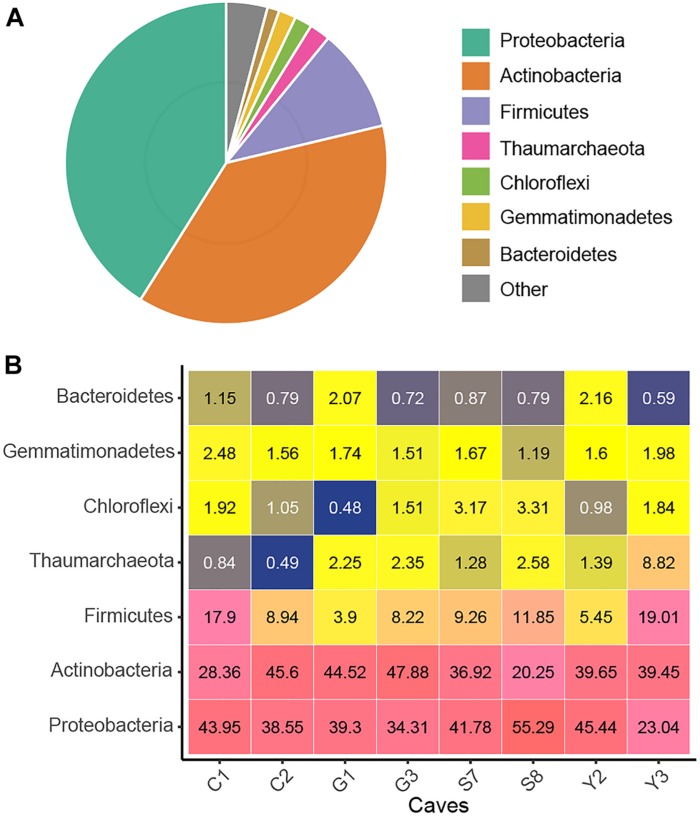
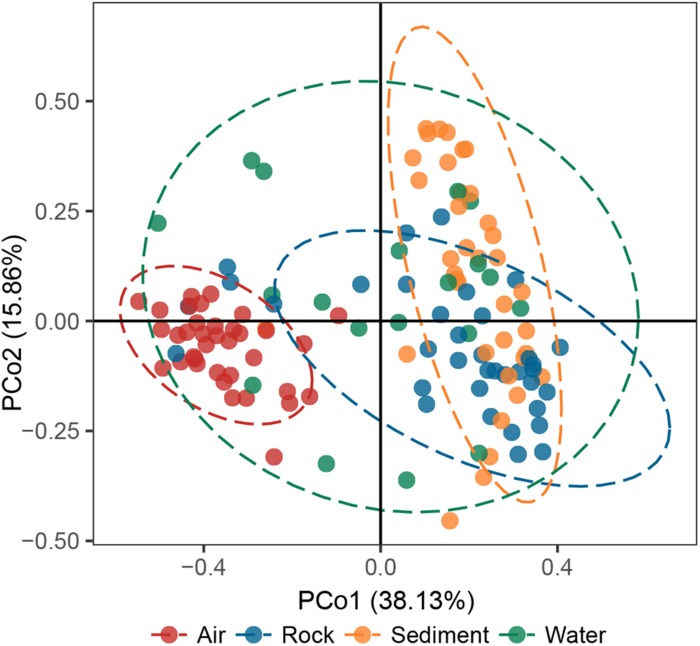
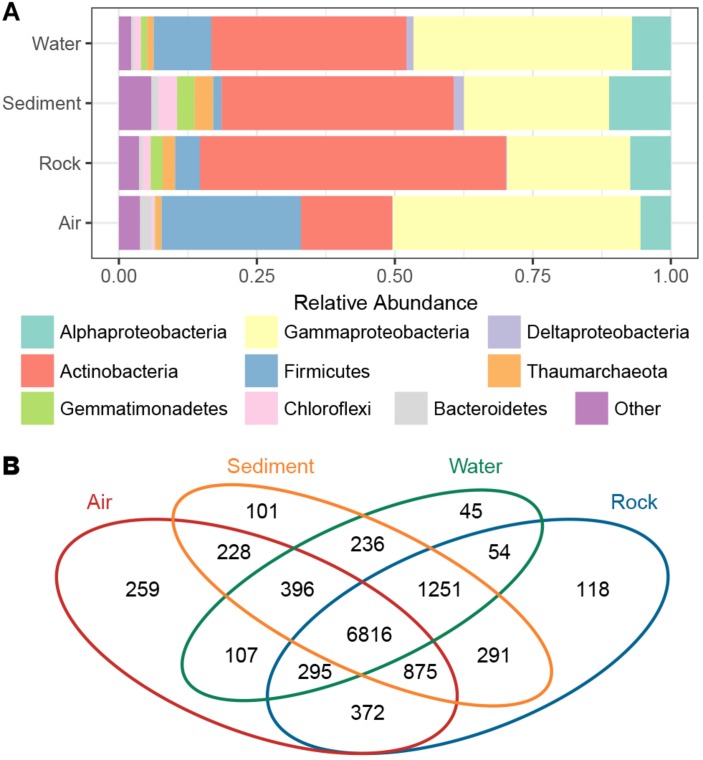
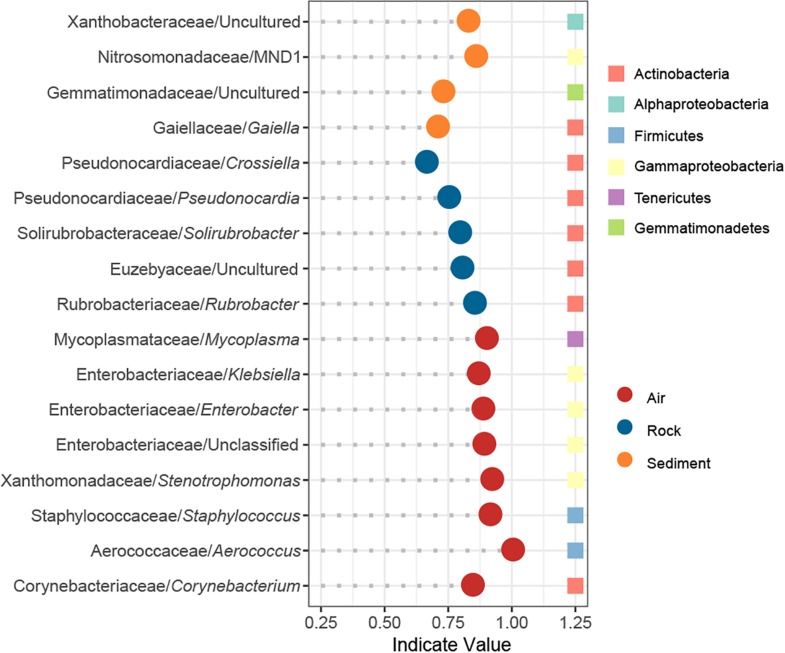
Caves are typified by their permanent darkness and a shortage of nutrients. Consequently, bacteria play an important role in sustaining such subsurface ecosystems by dominating primary production and fueling biogeochemical cycles. China has one of the world's largest areas of karst topography in the Yunnan-Guizhou Plateau, yet the bacteriomes in these karst caves remain unexplored. In this study, bacteriomes of eight karst caves in southwest China were examined, and co-occurrence networks of cave bacterial communities were constructed. Results revealed abundant and diversified bacterial communities in karst caves, with , , and being the most abundant phyla. Statistical analysis revealed no significant difference in bacteriomes among the eight caves. However, a PCoA plot did show that the bacterial communities of 128 cave samples clustered into groups corresponding to sampling types (air, water, rock, and sediment). These results suggest that the distribution of bacterial communities is driven more by sample types than the separate caves from which samples were collected. Further community-level composition analysis indicated that were most dominant in water and air samples, while dominated the sediment and rock samples. Co-occurrence analysis revealed highly modularized assembly patterns of the cave bacterial community, with wb1-P19, an uncultured group in , and an uncultured group in , being the top-three keystone members. These results not only expand our understanding of cave bacteriomes but also inspires functional exploration of bacterial strains in karst caves.
洞穴的特点是常年黑暗且营养物质匮乏。因此,细菌在维持此类地下生态系统方面发挥着重要作用,它们主导着初级生产并推动生物地球化学循环。中国云贵高原拥有世界上最大面积的喀斯特地貌区域之一,但这些喀斯特洞穴中的细菌群落仍未得到探索。在本研究中,对中国西南部八个喀斯特洞穴的细菌群落进行了检测,并构建了洞穴细菌群落的共生网络。结果显示喀斯特洞穴中存在丰富多样的细菌群落,其中变形菌门、放线菌门和酸杆菌门最为丰富。统计分析表明,八个洞穴的细菌群落之间没有显著差异。然而,主坐标分析图确实显示,128个洞穴样本的细菌群落聚为与采样类型(空气、水、岩石和沉积物)相对应的组。这些结果表明,细菌群落的分布更多地受样本类型驱动,而非采集样本的各个洞穴。进一步的群落水平组成分析表明,变形菌门在水和空气样本中最为占主导地位,而酸杆菌门在沉积物和岩石样本中占主导地位。共生分析揭示了洞穴细菌群落高度模块化的组装模式,其中酸杆菌门中的一个未培养类群wb1 - P19以及变形菌门中的一个未培养类群是前三大关键成员。这些结果不仅扩展了我们对洞穴细菌群落的理解,也激发了对喀斯特洞穴中细菌菌株的功能探索。