Franklin Samuel P
Colorado Canine Orthopedics and Rehab, Colorado Springs, CO, United States.
Front Vet Sci. 2019 Aug 9;6:243. doi: 10.3389/fvets.2019.00243. eCollection 2019.
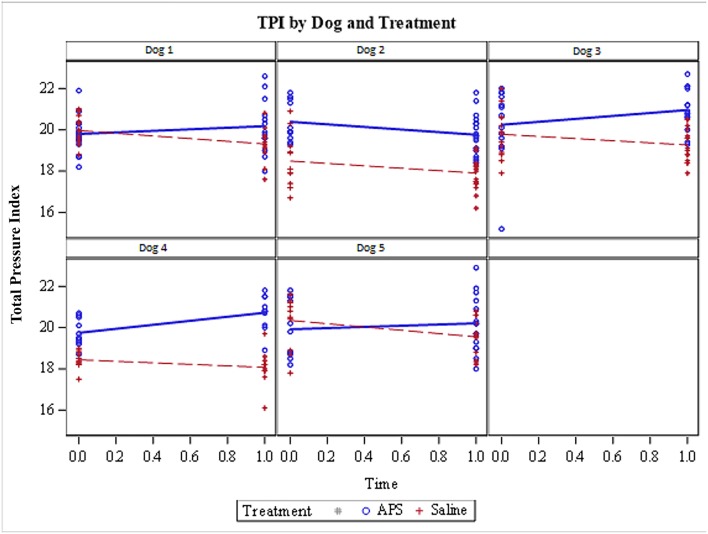
Five dogs with bilateral hip dysplasia and without osteoarthritis of other joints were enrolled in this pilot study. Objective kinetic data using a pressure sensitive mat and owner assessments using the canine brief pain inventory (CBPI) and Liverpool Osteoarthritis for Dogs (LOAD) questionnaires were obtained prior to treatment. Enrolled dogs were treated in one hip with autologous protein solution (APS) and the contralateral hip was injected with an equal volume of saline. The hip to be treated was selected using a random number generator. At exactly 28 days following treatment dogs were re-assessed using the pressure sensitive mat and the CBPI and LOAD questionnaires. No dogs were treated with any other medications or supplements throughout the study period. Assessment of the total pressure index (TPI) collected using the pressure sensitive mat showed that the hips treated with APS improved significantly more than hips treated with saline ( = 0.0005) and that the hips treated with APS bore significantly more weight than the hips treated with saline at day 28 ( < 0.05). Statistically significant improvement was noted by owners in "pain" and "function" as assessed by the CBPI as well "mobility at exercise" using the LOAD questionnaire. This pilot study provided proof of principle that APS is beneficial in treating pain and lameness in dogs affected by coxofemoral osteoarthritis.
五只患有双侧髋关节发育不良且其他关节无骨关节炎的犬只被纳入了这项初步研究。在治疗前,使用压力感应垫获取客观动力学数据,并通过犬类简短疼痛量表(CBPI)和犬类利物浦骨关节炎问卷(LOAD)让主人进行评估。入选的犬只一侧髋关节接受自体蛋白溶液(APS)治疗,对侧髋关节注射等量的生理盐水。使用随机数生成器选择要治疗的髋关节。在治疗后第28天,使用压力感应垫以及CBPI和LOAD问卷对犬只进行重新评估。在整个研究期间,没有犬只接受任何其他药物或补充剂治疗。对使用压力感应垫收集的总压力指数(TPI)的评估表明,接受APS治疗的髋关节比接受生理盐水治疗的髋关节改善更为显著(P = 0.0005),并且在第28天,接受APS治疗的髋关节比接受生理盐水治疗的髋关节承受的重量明显更多(P < 0.05)。主人通过CBPI评估的“疼痛”和“功能”以及使用LOAD问卷评估的“运动时的活动能力”方面均注意到了具有统计学意义的改善。这项初步研究提供了原理证明,即APS对治疗受股髋关节炎影响的犬只的疼痛和跛行有益。