Department of Psychiatry and Behavioral Sciences.
Neuropsychology. 2019 Sep;33(6):808-821. doi: 10.1037/neu0000572.
To review deficits in emotional processing and social cognition potentially contributing to the dysfunctional emotion regulation and difficulties with interpersonal relationships observed in individuals with alcohol use disorder (AUD) and to provide directions for future research.
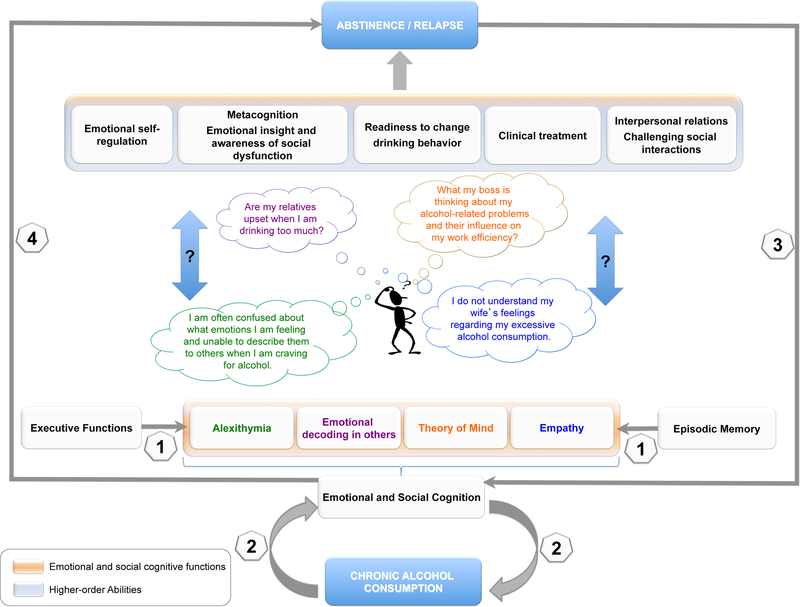
First is presented a review of emotional and social-cognitive impairments in recently detoxified AUD individuals that include alexithymia, difficulties in decoding others' emotions, and reduced theory of mind and empathy skills. Social cognition disorders in AUD pose different issues discussed, such as whether (1) these deficits are consequences of excessive alcohol consumption or premorbid risk factors for addiction, (2) emotional and social impairments impede positive treatment outcome, (3) recovery of social abilities is possible with sustained abstinence, and (4) AUD patients are unaware of their emotional and social dysfunctions. Finally, current knowledge on structural and functional brain correlates of these deficits in AUD are reviewed.
Emotional and social-cognitive functions affected in AUD can potentially compromise efforts to initiate and maintain abstinence by hampering efficacy of clinical treatment. Such dysfunction can obstruct efforts to enable or reinstate higher-order abilities such as emotional self-regulation, motivation to change, success in interpersonal/social interactions, and emotional insight and awareness of social dysfunctions (i.e., accurate metacognition).
The present review highlights the need to account for emotional processing and social cognition in the evaluation and rehabilitation of alcohol-related neurocognitive disorders and to consider psychotherapeutic treatment involving remediation of emotional and social skills as implemented in psychiatric and neurological disorders. (PsycINFO Database Record (c) 2019 APA, all rights reserved).
回顾情感处理和社会认知方面的缺陷,这些缺陷可能导致酒精使用障碍(AUD)个体出现功能失调的情绪调节和人际关系困难,并为未来的研究提供方向。
首先,本文回顾了最近戒毒的 AUD 个体中存在的情感和社会认知障碍,包括述情障碍、他人情绪解码困难以及心理理论和同理心技能降低。然后讨论了 AUD 中的社会认知障碍问题,例如:(1)这些缺陷是过度饮酒的后果还是成瘾的潜在风险因素;(2)情绪和社会障碍是否会影响积极的治疗效果;(3)社会能力的恢复是否可能与持续戒断有关;(4)AUD 患者是否意识到自己的情绪和社会功能障碍。最后,本文回顾了 AUD 中这些缺陷的结构和功能脑相关性的现有知识。
AUD 中受影响的情感和社会认知功能可能会通过阻碍临床治疗的效果,从而影响启动和维持戒酒的努力。这种功能障碍可能会阻碍情感自我调节、改变动机、人际/社交互动成功以及情绪洞察力和社会功能障碍意识(即准确的元认知)等更高阶能力的发展。
本综述强调了在评估和康复与酒精相关的神经认知障碍时需要考虑情感处理和社会认知,并且需要考虑涉及情绪和社会技能矫正的心理治疗,就像在精神和神经障碍中实施的那样。(美国心理协会,2019)。