Darwin Bioprospecting Excellence SL, Catedrático Agustín Escardino, 9, 46980, Paterna, Spain.
Institute for Integrative Systems Biology, I2SysBio (Universitat de València-CSIC), Parc Científic de la Universitat de València, C. Catedràtic José Beltrán 2, 46980, Paterna, Spain.
Microb Biotechnol. 2020 Mar;13(2):435-441. doi: 10.1111/1751-7915.13480. Epub 2019 Aug 27.
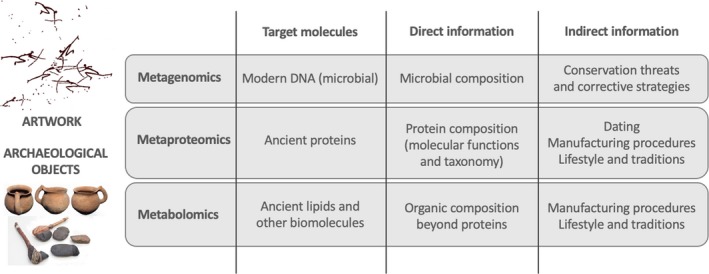
Multi-omics can informally be described as the combined use of high-throughput techniques allowing the characterization of complete microbial communities by the sequencing/identification of total pools of biomolecules including DNA, proteins or metabolites. These techniques have allowed an unprecedented level of knowledge on complex microbial ecosystems, which is having key implications in land and marine ecology, industrial biotechnology or biomedicine. Multi-omics have recently been applied to artistic or archaeological objects, with the goal of either contributing to shedding light on the original context of the pieces and/or to inform conservation approaches. In this minireview, we discuss the application of -omic techniques to the study of prehistoric artworks and ancient man-made objects in three main technical blocks: metagenomics, proteomics and metabolomics. In particular, we will focus on how proteomics and metabolomics can provide paradigm-breaking results by unambiguously identifying peptides associated with a given, palaeo-cultural context; and we will discuss how metagenomics can be central for the identification of the microbial keyplayers on artworks surfaces, whose conservation can then be approached by a range of techniques, including using selected microorganisms as 'probiotics' because of their direct or indirect effect in the stabilization and preservation of valuable art objects.
多组学可以非正式地描述为高通量技术的组合使用,这些技术允许通过测序/鉴定包括 DNA、蛋白质或代谢物在内的生物分子的总池来描述完整的微生物群落。这些技术使我们对复杂的微生物生态系统有了前所未有的了解,这对陆地和海洋生态学、工业生物技术或生物医学都有重要的影响。多组学最近已应用于艺术或考古物体,目的是要么有助于揭示这些物体的原始背景,要么为保护方法提供信息。在这篇综述中,我们讨论了在三个主要技术块中应用组学技术来研究史前艺术品和古代人造物体:宏基因组学、蛋白质组学和代谢组学。特别是,我们将重点讨论蛋白质组学和代谢组学如何通过明确鉴定与特定古文化背景相关的肽来提供突破性的结果;我们还将讨论宏基因组学如何成为识别艺术品表面上的微生物关键参与者的核心,然后可以通过一系列技术来保护这些微生物,包括使用选定的微生物作为“益生菌”,因为它们在稳定和保存有价值的艺术物体方面具有直接或间接的作用。