Zoratti Michael James, Zhou Ting, Chan Kelvin, Levine Oren, Krahn Murray, Husereau Don, Clifford Tammy, Schunemann Holger, Guyatt Gordon, Xie Feng
Department of Health Research Methods, Evidence, and Impact, McMaster University, Hamilton, Ontario, Canada.
Sunnybrook Health Sciences Centre, Toronto, Ontario, Canada.
MDM Policy Pract. 2019 Aug 13;4(2):2381468319852594. doi: 10.1177/2381468319852594. eCollection 2019 Jul-Dec.
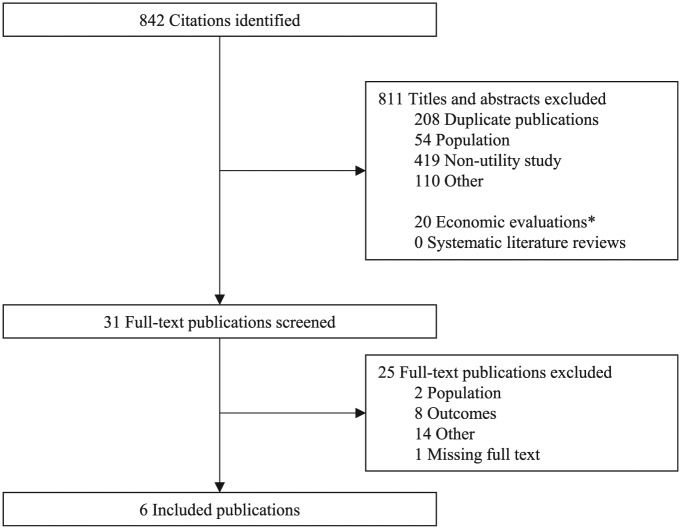
Treatment options in oncology are rapidly advancing, and public payer systems are increasingly under pressure to adopt new but expensive cancer treatments. Cost-utility analyses (CUAs) are used to estimate the relative costs and effects of competing interventions, where health outcomes are measured using quality-adjusted life years (QALYs). Health state utility values (HSUVs) are used to reflect health-related quality of life or health status in the calculation of QALYs. To support reimbursement agencies in the appraisal of oncology drug submissions, which typically include a CUA component, we have proposed a systematic literature review of published HSUV estimates in the field of oncology. The following databases will be searched: MEDLINE, EMBASE, EconLit, and CINAHL. A team of reviewers, working independently and in duplicate, will evaluate abstracts and full-text publications for eligibility against broad inclusion criteria. Studies using a direct, indirect, or combination approach to eliciting preferences related to cancer or cancer treatments are eligible. Data extraction will capture details of study methodology, participants, health states, and corresponding HSUVs. We will summarize our findings with descriptive analyses at this stage. A pilot review in thyroid cancer is presented to illustrate the proposed methods. This systematic review will generate a comprehensive summary of the oncology HSUV literature. As a component of the Health Utility Book (HUB) project, we anticipate that this work will assist both health economic modelers as well as critical reviewers in the development and appraisal of CUAs in oncology.
肿瘤学的治疗选择正在迅速发展,公共支付系统面临着越来越大的压力,需要采用新的但昂贵的癌症治疗方法。成本效用分析(CUA)用于估计相互竞争的干预措施的相对成本和效果,其中健康结果使用质量调整生命年(QALY)来衡量。健康状态效用值(HSUV)用于在计算QALY时反映与健康相关的生活质量或健康状况。为了支持报销机构评估肿瘤学药物申报材料(通常包括一个CUA部分),我们提议对肿瘤学领域已发表的HSUV估计值进行系统的文献综述。将检索以下数据库:MEDLINE、EMBASE、EconLit和CINAHL。一组评审人员将独立且重复地工作,根据广泛的纳入标准评估摘要和全文出版物的资格。使用直接、间接或组合方法来获取与癌症或癌症治疗相关偏好的研究符合要求。数据提取将获取研究方法、参与者、健康状态和相应HSUV的详细信息。在此阶段,我们将通过描述性分析总结我们的发现。本文展示了一项针对甲状腺癌的初步综述,以说明所提议的方法。这项系统综述将对肿瘤学HSUV文献进行全面总结。作为健康效用手册(HUB)项目的一个组成部分,我们预计这项工作将有助于健康经济建模人员以及关键评审人员在肿瘤学CUA的开发和评估中发挥作用。