Center for Gerontology and Healthcare Research, Brown University, School of Public Health, Providence, Rhode Island.
Department of Health Services, Policy & Practice, Brown University, School of Public Health, Providence, Rhode Island.
J Am Geriatr Soc. 2020 Jan;68(1):70-77. doi: 10.1111/jgs.16146. Epub 2019 Aug 27.
High-need (HN) Medicare beneficiaries heavily use healthcare services at a high cost. This population is heterogeneous, composed of individuals with varying degrees of medical complexity and healthcare needs. To improve healthcare delivery and decrease costs, it is critical to identify the subpopulations present within this population. We aimed to (1) identify distinct clinical phenotypes present within HN Medicare beneficiaries, and (2) examine differences in outcomes between phenotypes.
Latent class analysis was used to identify phenotypes within a sample of HN fee-for-service (FFS) Medicare beneficiaries aged 65 years and older using Medicare claims and post-acute assessment data.
Not applicable.
Two cross-sectional cohorts were used to identify phenotypes. Cohorts included FFS Medicare beneficiaries aged 65 and older who survived through 2014 (n = 415 659) and 2015 (n = 416 643).
The following variables were used to identify phenotypes: acute and post-acute care use, functional dependency in one or more activities of daily living, presence of six or more chronic conditions, and complex chronic conditions. Mortality, hospitalizations, healthcare expenditures, and days in the community were compared between phenotypes.
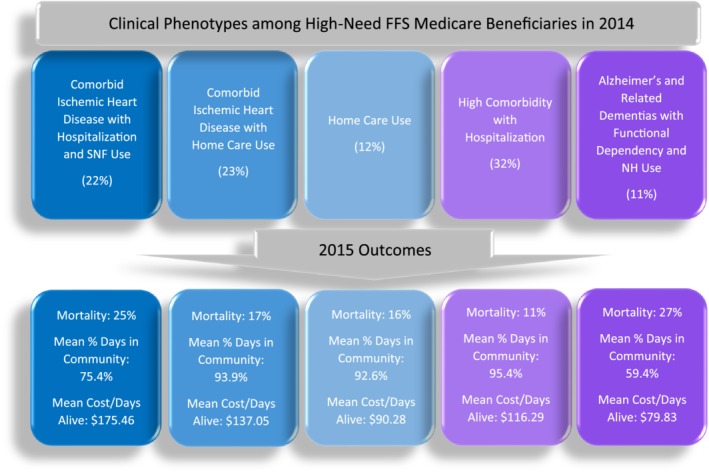
Five phenotypes were identified: (1) comorbid ischemic heart disease with hospitalization and skilled nursing facility use (22% of the HN sample), (2) comorbid ischemic heart disease with home care use (23%), (3) home care use (12%), (4) high comorbidity with hospitalization (32%), and (5) Alzheimer's disease/related dementias with functional dependency and nursing home use (11%). Mortality was highest in phenotypes 1 and 2; hospitalizations and expenditures were highest in phenotypes 1, 3, and 4.
Our findings represent a first step toward classifying the heterogeneity among HN Medicare beneficiaries. Further work is needed to identify modifiable utilization patterns between phenotypes to improve the value of healthcare provided to these subpopulations. J Am Geriatr Soc 68:70-77, 2019.
高需求(HN)医疗保险受益人大量使用医疗服务,费用高昂。这一人群具有异质性,由具有不同程度医疗复杂性和医疗需求的个体组成。为了改善医疗服务的提供并降低成本,关键是要确定该人群中存在的亚人群。我们旨在:(1)确定 HN 医疗保险受益人群中存在的不同临床表型,以及(2)检查表型之间的结果差异。
使用潜在类别分析,根据医疗保险索赔和康复后评估数据,确定年龄在 65 岁及以上的 HN 按服务项目付费(FFS)医疗保险受益人群中的表型。
不适用。
使用两个横截面队列来确定表型。队列包括在 2014 年(n=415659)和 2015 年(n=416643)期间存活下来的年龄在 65 岁及以上的 FFS 医疗保险受益人。
用于确定表型的变量包括:急性和康复后护理使用、一项或多项日常生活活动的功能依赖、存在六种或更多种慢性疾病、以及复杂的慢性疾病。在表型之间比较死亡率、住院率、医疗支出和在社区的天数。
确定了 5 种表型:(1)合并缺血性心脏病伴住院和熟练护理机构使用(HN 样本的 22%),(2)合并缺血性心脏病伴家庭护理使用(23%),(3)家庭护理使用(12%),(4)高合并症伴住院(32%),以及(5)阿尔茨海默病/相关痴呆伴功能依赖和疗养院使用(11%)。表型 1 和 2 的死亡率最高;表型 1、3 和 4 的住院率和支出最高。
我们的发现代表了对 HN 医疗保险受益人群进行分类的第一步。需要进一步研究以确定表型之间可改变的利用模式,从而提高向这些亚人群提供的医疗服务的价值。美国老年学会杂志 68:70-77,2019 年。