Centers for Disease Control and Prevention, Division of Laboratory Sciences, Tobacco and Volatiles Branch, Atlanta, GA 30341, United States of America.
Centers for Disease Control and Prevention, Division of Laboratory Sciences, Tobacco and Volatiles Branch, Atlanta, GA 30341, United States of America.
J Chromatogr B Analyt Technol Biomed Life Sci. 2019 Sep 15;1126-1127:121746. doi: 10.1016/j.jchromb.2019.121746. Epub 2019 Aug 14.
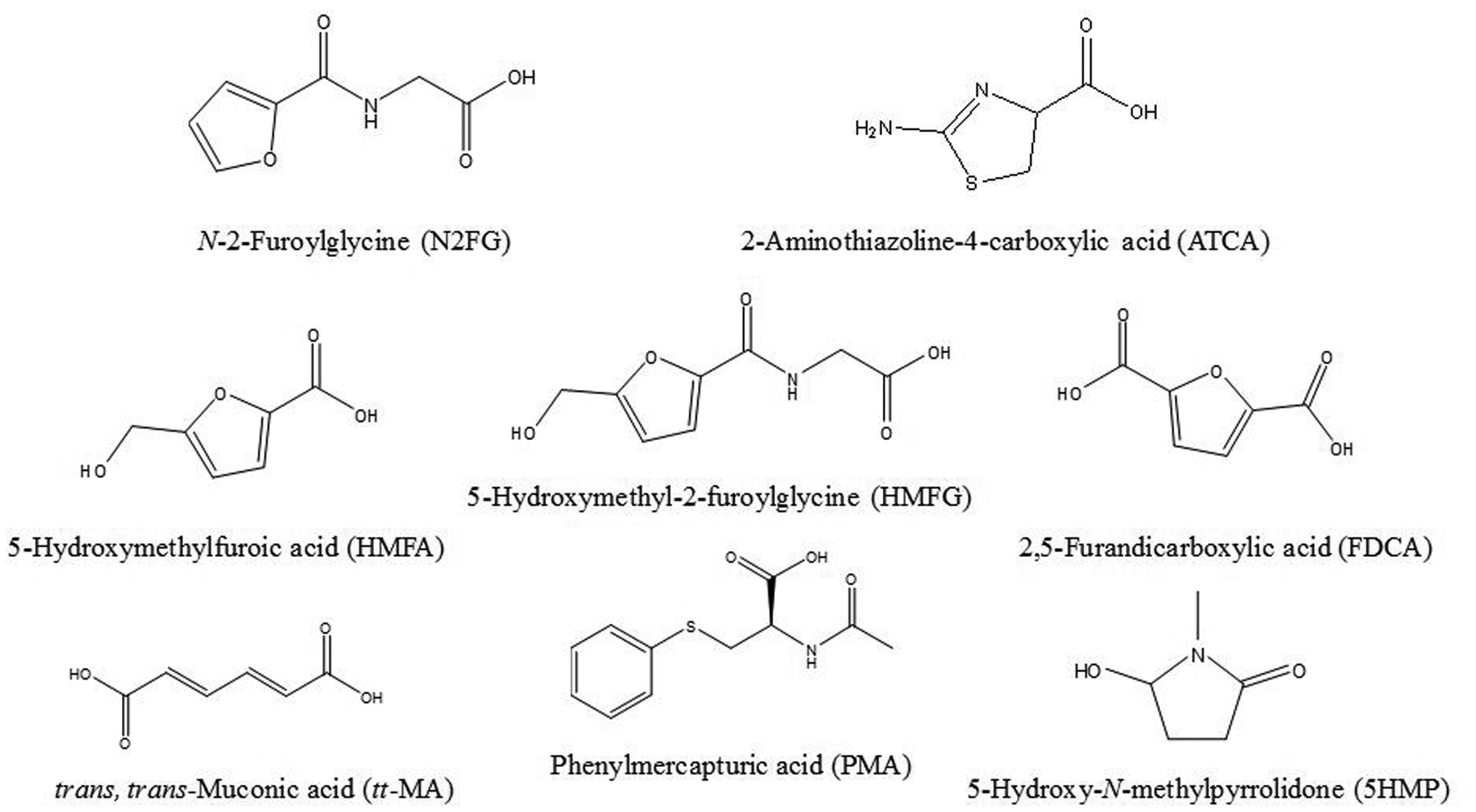
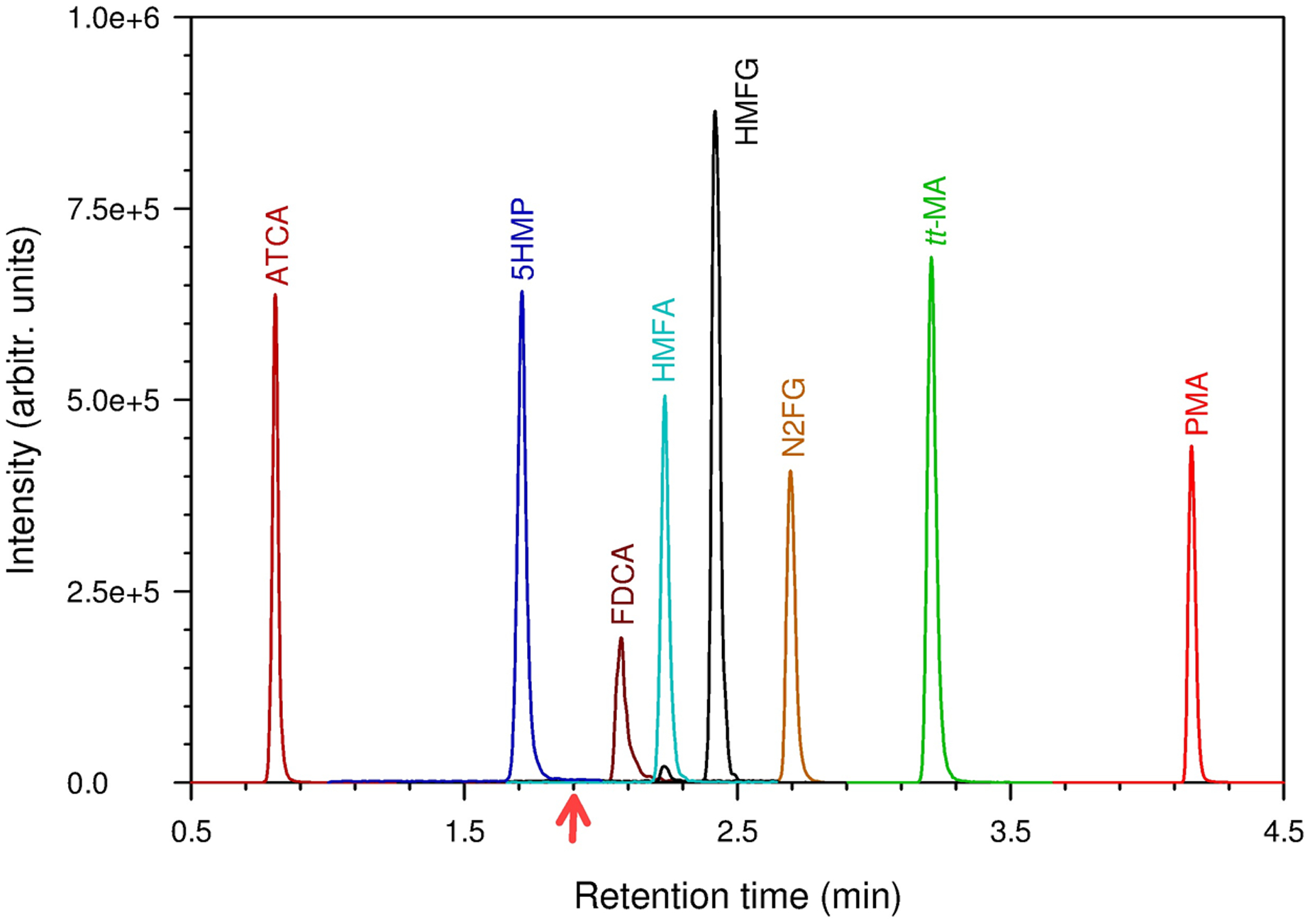
We report on the development of an ultra-performance liquid chromatography-tandem mass spectrometry (UPLC-MS/MS) method for simultaneously measuring eight biomarkers of volatile organic compound (VOC) exposure, with potential application to e-cigarette aerosol biomonitoring. Phenylmercapturic acid (PMA) and trans, trans-muconic acid (tt-MA) are metabolites of benzene; 2-aminothiazoline-4-carboxylic acid (ATCA) is a metabolite of cyanide; N-2-furoylglycine (N2FG) is a metabolite of furfural and furfuryl alcohol; 5-hydroxymethylfuroic acid (HMFA), 5-hydroxymethyl-2-furoylglycine (HMFG), and 2,5-furandicarboxylic acid (FDCA) are metabolites of 5-hydroxymethylfurfural; and 5-hydroxy-N-methylpyrrolidone (5HMP) is a metabolite of N-methyl-2-pyrrolidone. A pentafluorophenyl-modified silica column was used for chromatographic separation. The overall run time for the method is about 6 min per sample injection. The method has low to sub-nanograms per milliliter sensitivity, linearity over 3 orders of magnitude, and precision and accuracy within 15%. The method was used to measure human urine samples. Results showed that people with known benzene exposure (daily cigarette smokers) had higher levels of tt-MA and PMA compared with non-smokers. The method is advantageous for high-throughput analysis of selected VOC metabolites in large-scale, population-based studies such as the National Health and Nutrition Examination Survey (NHANES). Quantifying these urinary biomarkers is important to public health efforts to understand human exposure to VOCs from various sources, including tobacco products and electronic nicotine delivery systems.
我们报告了一种超高效液相色谱-串联质谱(UPLC-MS/MS)方法的开发,用于同时测量八种挥发性有机化合物(VOC)暴露生物标志物,该方法具有应用于电子烟气溶胶生物监测的潜力。苯巯基尿酸(PMA)和反式,反式-粘康酸(tt-MA)是苯的代谢物;2-氨基噻唑-4-羧酸(ATCA)是氰化物的代谢物;N-2-糠酰甘氨酸(N2FG)是糠醛和糠醇的代谢物;5-羟甲基糠酸(HMFA)、5-羟甲基-2-糠酰甘氨酸(HMFG)和 2,5-呋喃二甲酸(FDCA)是 5-羟甲基糠醛的代谢物;5-羟甲基-N-甲基吡咯烷酮(5HMP)是 N-甲基-2-吡咯烷酮的代谢物。采用五氟苯基改性硅胶柱进行色谱分离。该方法的整体运行时间约为每个样品注射 6 分钟。该方法具有低至亚纳克/毫升的灵敏度、3 个数量级的线性度以及 15%以内的精密度和准确度。该方法用于测量人尿样。结果表明,与不吸烟者相比,已知苯暴露(每日吸烟者)的人 tt-MA 和 PMA 水平更高。该方法有利于在全国健康和营养检查调查(NHANES)等大规模基于人群的研究中对选定 VOC 代谢物进行高通量分析。量化这些尿生物标志物对于公共卫生努力了解人类从各种来源(包括烟草产品和电子尼古丁输送系统)接触 VOC 非常重要。