Centre de Recherche du CHU de Québec-Université Laval, Québec, Québec, Canada.
Centre de Recherche du CHU de Québec-Université Laval, Québec, Québec, Canada; Département de Pédiatrie, Université Laval, Québec, Québec, Canada.
Environ Res. 2019 Nov;178:108679. doi: 10.1016/j.envres.2019.108679. Epub 2019 Aug 19.
Lead (Pb) exposure is associated with adverse neurological development. Most notably, it has been observed through externalizing behavior symptoms, as observed among Inuit children from northern Québec. Evidence for a persistent neurological impact of early Pb exposure later in life is however scarce. Pb exposure may initiate a developmental cascade that increases the risk of long-term behavior problems.
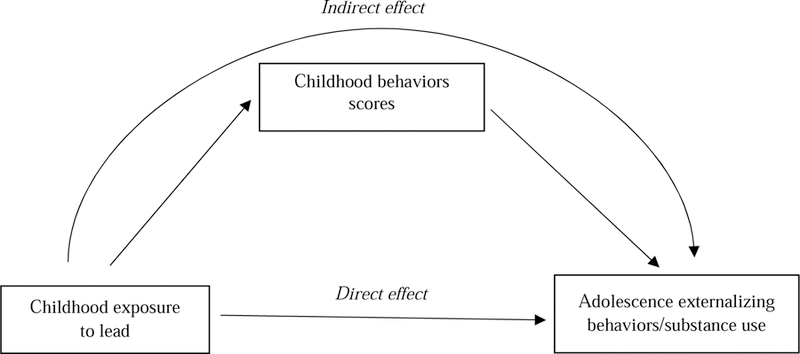
Testing for direct associations between childhood Pb concentrations and adolescent externalizing symptoms and substance use, as well as indirect associations through childhood behavior assessments.
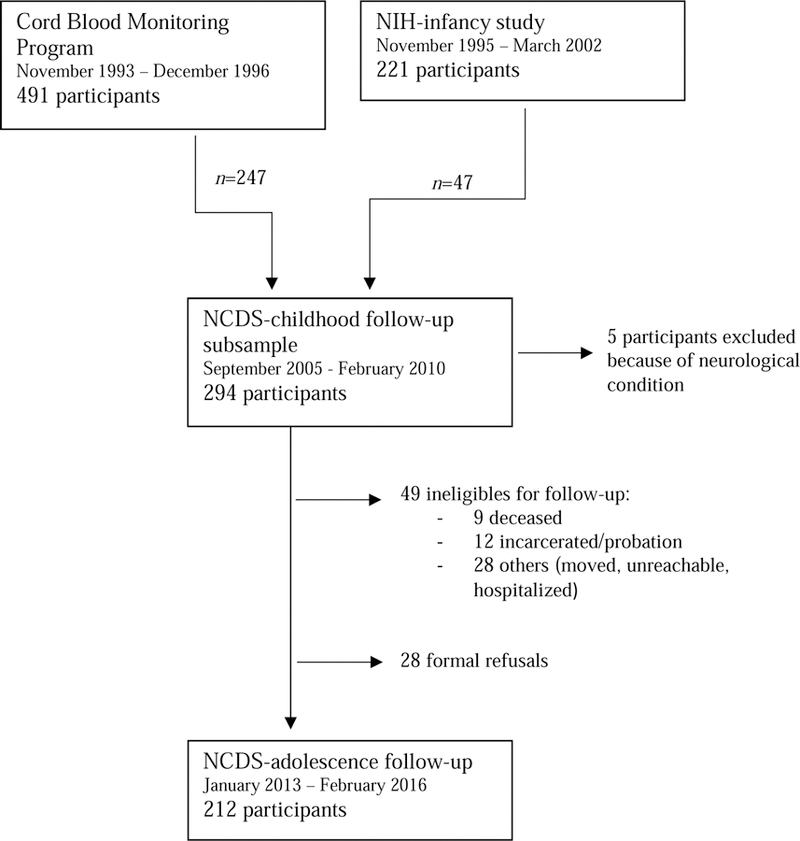
The study sample is a longitudinal cohort of Inuit children (n = 212) followed since birth. Blood Pb concentrations were measured during childhood (median age = 11.4 years) and adolescence (median age = 18.5 years). Externalizing/inattentive behavior were teacher-assessed through the Teacher Report Form and the Disruptive Behavior Disorders Rating Scale for children. At the adolescence follow-up, behavior problems were self-reported by filling Achenbach's Youth Self-Report, the Barkley Adult ADHD-IV Rating Scale, and the Diagnostics Interview Schedule for Children. Adolescent substance use was also self-assessed through the DEP-ADO. Direct and indirect associations of child Pb concentrations with adolescent outcomes were tested through mediation models.
Child blood Pb concentrations were not directly associated with any adolescent outcomes. On the contrary, childhood Pb exposure was indirectly associated, through childhood externalizing behavior assessments, with adolescent externalizing behaviors, binge drinking, and cannabis use. These indirect associations held after controlling for adolescents' concurrent Pb blood concentrations.
Our results highlight the indirect but lasting effects of child Pb exposure on adolescent behavior problems, and the importance of childhood externalizing behavior in this relationship. Adverse early-life environment put children on a riskier developmental trajectory, increasing their likelihood of lifelong psychological, social and health problems.
铅(Pb)暴露与不良神经发育有关。最值得注意的是,在来自魁北克北部的因纽特儿童中观察到了这种情况,表现为外化行为症状。然而,关于早期 Pb 暴露对以后生活中持续存在的神经影响的证据却很少。Pb 暴露可能引发发育级联反应,增加长期行为问题的风险。
检验儿童期 Pb 浓度与青少年外化症状和物质使用之间的直接关联,以及通过儿童期行为评估的间接关联。
研究样本是一个自出生以来就被追踪的因纽特儿童纵向队列(n=212)。在儿童期(中位数年龄=11.4 岁)和青少年期(中位数年龄=18.5 岁)期间测量血液 Pb 浓度。通过教师报告表和儿童破坏性行为障碍评定量表对教师评定的外显/注意力不集中行为进行评估。在青少年随访中,青少年通过填写 Achenbach 的青少年自我报告、Barkley 成人 ADHD-IV 评定量表和儿童诊断访谈量表自我报告行为问题。青少年物质使用也通过 DEP-ADO 进行自我评估。通过中介模型检验儿童期 Pb 浓度与青少年结局的直接和间接关联。
儿童期血 Pb 浓度与任何青少年结局均无直接关联。相反,通过儿童期外化行为评估,儿童期 Pb 暴露与青少年外化行为、狂欢饮酒和大麻使用呈间接关联。这些间接关联在控制了青少年当前 Pb 血浓度后仍然存在。
我们的研究结果强调了儿童期 Pb 暴露对青少年行为问题的间接但持久的影响,以及儿童期外化行为在这种关系中的重要性。不良的早期生活环境使儿童处于更危险的发育轨迹,增加了他们终生心理、社会和健康问题的可能性。