From the Service of Neurology (C.G., A.I., J.S.), Hospital Clinic, Barcelona, Spain; Multidisciplinary Sleep Disorders Unit (C.G., A.I., J.S.), Hospital Clinic, Barcelona, Spain; Department of Immunology (G.E., E.P.), Hospital Clínic, Barcelona, Spain; Institute of Biotechnology and Biomedicine (X.D.), Universitat Autònoma de Barcelona, Barcelona, Spain; Institució Catalana de Recerca i Estudis Avançats (ICREA) (X.D., J.D.), Barcelona, Spain; Laboratory of Parkinson Disease and Other Neurodegenerative Movement Disorders (M.E., R.F.-S.), Institut d'Investigacions Biomèdiques August Pi i Sunyer (IDIBAPS), Barcelona, Spain; Neuroimmunology Program (L.S., J.D., F.G.), Institut d'Investigacions Biomèdiques August Pi i Sunyer (IDIBAPS), Barcelona, Spain; Institute of Neurology (R.H.), Medical University of Vienna, Austria; Institute for Sleep Medicine and Neuromuscular Disorders (A.H.), University Hospital Muenster, Muenster, Germany; Department of Neurology (B.H.), Medical University of Innsbruck, Innsbruck, Austria; and Department of Neurology (J.D.), University of Pennsylvania, Philadelphia, PA.
Neurol Neuroimmunol Neuroinflamm. 2019 Aug 12;6(6). doi: 10.1212/NXI.0000000000000605. Print 2019 Nov.
We investigated the associations with HLA and microtubule-associated protein tau () H1 haplotype in anti-IgLON5 disease, a recently identified disorder characterized by gait instability, brainstem dysfunction, and a prominent sleep disorder in association with IgLON5 antibodies and pathologic findings of a novel neuronal-specific tauopathy.
We compared the HLA alleles and H1/H1 genotype of 35 patients with anti-IgLON5 with healthy controls. The on-line server tool NetMHCIIpan 3.1 was used to predict the IgLON5 peptide binding to HLA Class II molecules.
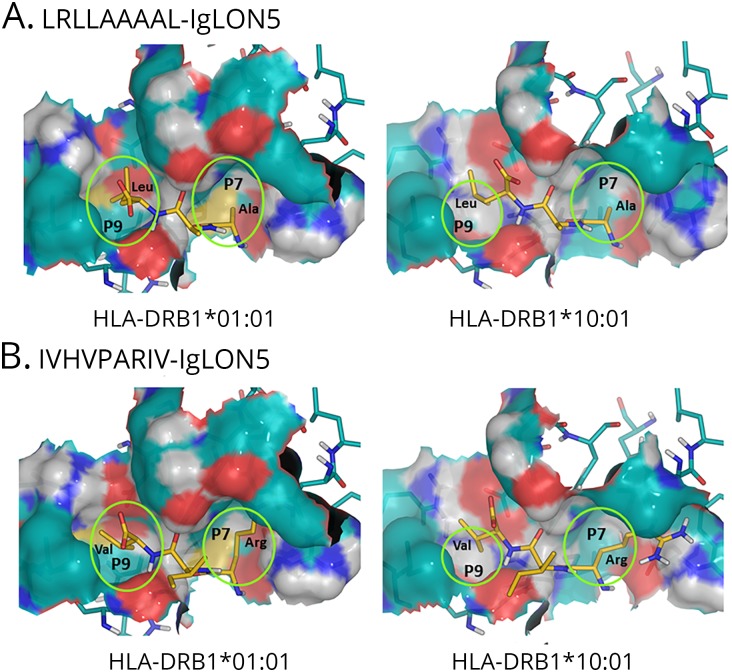
The HLA-DRB110:01-DQB105:01 haplotype was overrepresented in patients with anti-IgLON5 disease (OR = 54.5; 95% CI: 22.2-133.9, < 0.0001). In addition, HLA-DQA was genotyped in 27 patients, and 25 (92.6%) of them had DQ molecules composed by DQA101 and DQB105 chains compared with 148/542 (27.3%) controls (OR = 43.9; 95% CI: 10.4-185.5, < 0.0001). Patients DRB110:01 positive developed more frequently sleep or bulbar symptoms than those carrying other HLA alleles (70.0% vs 26.7%; = 0.011). Prediction algorithms identified 2 IgLON5 peptides (1 located in the signal sequence) that showed strong binding to HLA-DRB110:01 and other HLA-DRB1, but not to HLA-DQA and HLA-DQB molecules. The H1/H1 homozygous genotype was present in 20/24 (83.3%) anti-IgLON5 Caucasian patients compared with 54/116 (46.5%) healthy controls ( = 0.0007).
The robust association of anti-IgLON5 disease with distinct HLA Class II molecules supports a primary autoimmune origin. The significant association of H1 haplotype also suggests that an underlying neurodegenerative process could be involved in anti-IgLON5 disease.
我们研究了 HLA 与微管相关蛋白 tau()H1 单倍型与抗 IgLON5 病的关联,抗 IgLON5 病是一种最近确定的疾病,其特征为步态不稳、脑干功能障碍和突出的睡眠障碍,与 IgLON5 抗体和新型神经元特异性 tau 病的病理发现有关。
我们比较了 35 例抗 IgLON5 患者与健康对照者的 HLA 等位基因和 H1/H1 基因型。使用在线服务器工具 NetMHCIIpan 3.1 预测 IgLON5 肽与 HLA Ⅱ类分子的结合。
抗 IgLON5 病患者 HLA-DRB110:01-DQB105:01 单倍型过度表达(OR=54.5;95%CI:22.2-133.9,<0.0001)。此外,对 27 例患者进行了 HLA-DQA 基因分型,其中 25 例(92.6%)患者具有由 DQA101 和 DQB105 链组成的 DQ 分子,而 542 例对照者中有 148 例(27.3%)(OR=43.9;95%CI:10.4-185.5,<0.0001)。HLA-DRB110:01 阳性的患者比携带其他 HLA 等位基因的患者更常出现睡眠或延髓症状(70.0% vs 26.7%;=0.011)。预测算法确定了 2 个 IgLON5 肽(1 个位于信号序列中),它们与 HLA-DRB110:01 和其他 HLA-DRB1 强烈结合,但与 HLA-DQA 和 HLA-DQB 分子不结合。24 例(83.3%)抗 IgLON5 白人患者的 H1/H1 纯合基因型与 116 例(46.5%)健康对照者相比(=0.0007)。
抗 IgLON5 病与特定的 HLA Ⅱ类分子的强烈关联支持原发性自身免疫起源。H1 单倍型的显著关联也表明,潜在的神经退行性过程可能与抗 IgLON5 病有关。