BRAC James P Grant School of Public Health, BRAC University, 68 Shahid Tajuddin Ahmed Sharani, Mohakhali, Dhaka, 1212, Bangladesh.
Centre for Primary Health Care and Equity, University of New South Wales, Sydney, Australia.
Nutr J. 2019 Aug 27;18(1):47. doi: 10.1186/s12937-019-0473-z.
Despite progress, suboptimal feeding practices and undernutrition particularly in the form of stunting still remains a major issue among children aged less than 5 years in Bangladesh. Since mothers are the primary caregivers of young children, maternal nutrition counselling can be effective in improving knowledge and practices on child feeding. The Building Resources Across Communities (BRAC) initiated a nutrition counselling intervention using its essential health care (EHC) skeleton in 114 sub-districts of Bangladesh in 2012. This study assessed the role of this intervention on the prevalence of stunting and feeding practices among children aged less than 5 years.
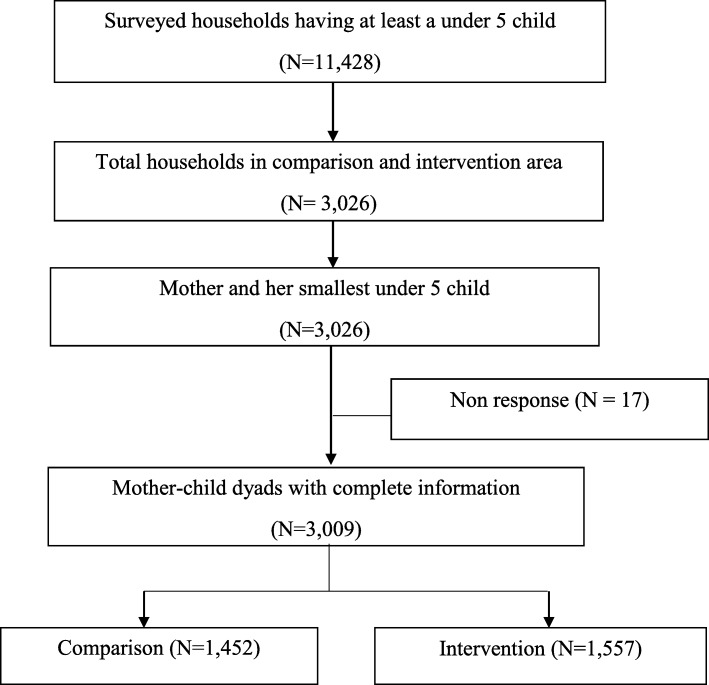
The data was collected as part of a nationwide cross-sectional survey, which followed a two-stage cluster random sampling procedure and was conducted between October 2015 and January 2016. The present study analyzed the information of 3009 mother-children dyads from two selected survey areas: i) areas where the EHC package was delivered (comparison; n = 1452), ii) areas with EHC plus nutrition counselling package (intervention; n = 1557) was delivered. The Chi-square test was done to compare the child feeding practices and stunting prevalence between intervention and comparison. The degree of strength of the association of stunting and the intervention was estimated using a mixed-effect logistic regression model.
The study revealed that the prevalence of stunting was significantly lower in areas where the intervention was delivered compared to the comparison areas (29% vs. 37%, P < 0.001). Furthermore, after adjusting for administrative zone, household wealth quintile, child's age, gender, maternal age, education, occupation, cluster disparity, and variation between study groups, it was seen that the risk of stunting was 25% lower in the intervention areas compared to the comparison areas (aOR: 0.75, 95% CI: 0.60-0.94; P = 0.012). Optimal child feeding practices were also more common among mothers from intervention areas than those of the comparison areas (exclusive breastfeeding: 72.7 vs. 59.4%, P = 0.008; feeding 4+ food groups: 42.9 vs. 34.1%, P < 0.001; having minimum acceptable diet: 31.2 vs. 25.3%, P = 0.017; feeding multiple micro-nutrient powder: 16.2 vs. 7.4%, P < 0.001).
The study highlighted that nutrition counselling of mothers may be effective in reducing childhood stunting with concomitant improvement in optimal feeding practices in children under 5 years of age. The frontline community health workers can be trained to counsel mothers on optimal child feeding practices and this could help reduce the prevalence of stunting.
尽管取得了进展,但在孟加拉国,5 岁以下儿童中仍然存在喂养方法不佳和营养不足的问题,尤其是发育迟缓。由于母亲是幼儿的主要照顾者,因此对母亲进行营养咨询可以有效提高其在儿童喂养方面的知识和实践水平。BRAC 组织于 2012 年在孟加拉国的 114 个分区启动了一项营养咨询干预措施,该措施利用其基本保健 (EHC) 框架。本研究评估了该干预措施对 5 岁以下儿童发育迟缓发生率和喂养方法的影响。
该数据是作为全国性横断面调查的一部分收集的,该调查采用两阶段聚类随机抽样程序,于 2015 年 10 月至 2016 年 1 月进行。本研究分析了来自两个选定调查区域的 3009 对母子对的数据:i)提供 EHC 一揽子计划的区域(比较;n=1452),ii)提供 EHC 加营养咨询一揽子计划的区域(干预;n=1557)。使用卡方检验比较干预组和对照组的儿童喂养方式和发育迟缓发生率。使用混合效应逻辑回归模型评估发育迟缓与干预的关联强度。
研究表明,与对照组相比,接受干预的地区发育迟缓的发生率显著降低(29%比 37%,P<0.001)。此外,在校正行政区、家庭财富五分位数、儿童年龄、性别、母亲年龄、教育、职业、聚类差异和研究组之间的差异后,与对照组相比,干预组发育迟缓的风险降低了 25%(调整后的比值比[aOR]:0.75,95%置信区间[CI]:0.60-0.94;P=0.012)。与对照组相比,干预组的母亲更倾向于采用最佳的儿童喂养方式(纯母乳喂养:72.7%比 59.4%,P=0.008;喂养 4+种食物组:42.9%比 34.1%,P<0.001;食用最低可接受饮食:31.2%比 25.3%,P=0.017;食用多种微量营养素粉:16.2%比 7.4%,P<0.001)。
本研究强调,对母亲进行营养咨询可能有助于降低儿童发育迟缓的发生率,并同时改善 5 岁以下儿童的最佳喂养方式。可以培训基层社区卫生工作者对母亲进行最佳儿童喂养实践方面的咨询,这有助于降低发育迟缓的发生率。