Department of Microbiology, Immunology, and Cancer Biology, University of Virginia School of Medicine, Charlottesville, Virginia, USA.
Department of Microbiology, Immunology, and Cancer Biology, University of Virginia School of Medicine, Charlottesville, Virginia, USA
mBio. 2019 Aug 27;10(4):e01520-19. doi: 10.1128/mBio.01520-19.
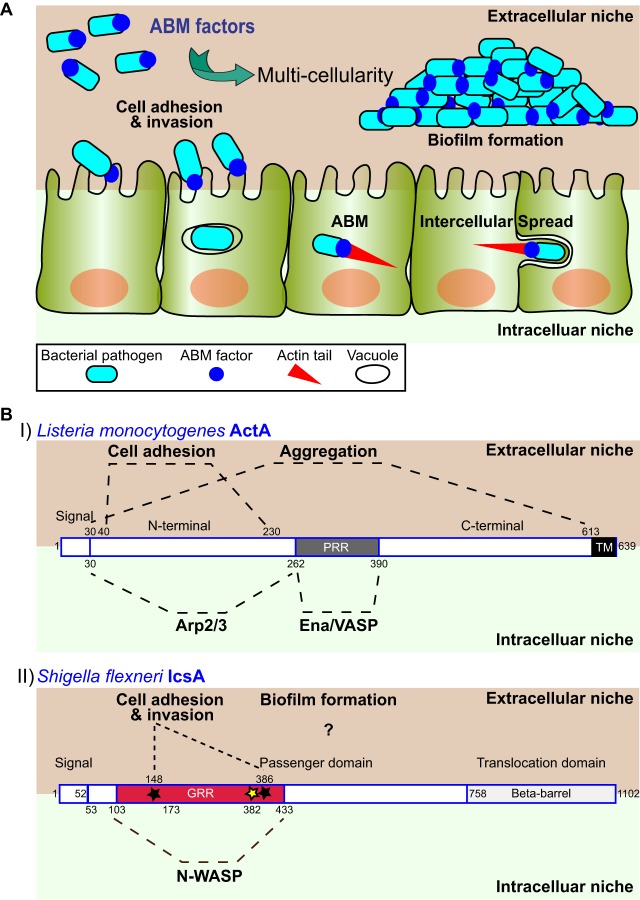
Various bacterial pathogens display an intracellular lifestyle and spread from cell to cell through actin-based motility (ABM). ABM requires actin polymerization at the bacterial pole and is mediated by the expression of bacterial factors that hijack the host cell actin nucleation machinery or exhibit intrinsic actin nucleation properties. It is increasingly recognized that bacterial ABM factors, in addition to having a crucial task during the intracellular phase of infection, display "moonlighting" adhesin functions, such as bacterial aggregation, biofilm formation, and host cell adhesion/invasion. Here, we review our current knowledge of ABM factors and their additional functions, and we propose that intracellular ABM functions have evolved from ancestral, extracellular adhesin functions.
各种细菌病原体表现出细胞内生活方式,并通过肌动蛋白基础运动(ABM)在细胞间传播。ABM 需要在细菌极处进行肌动蛋白聚合,并通过表达劫持宿主细胞肌动蛋白成核机制的细菌因子或表现出固有肌动蛋白成核特性来介导。越来越多的人认识到,除了在感染的细胞内阶段具有关键任务外,细菌 ABM 因子还具有“兼职”黏附素功能,例如细菌聚集、生物膜形成和宿主细胞黏附和入侵。在这里,我们回顾了我们对 ABM 因子及其其他功能的现有认识,并提出细胞内 ABM 功能是从祖先的细胞外黏附素功能进化而来的。