Doenyas Ceymi
Research Center for Translational Medicine, Koç University, Istanbul, Turkey.
Front Endocrinol (Lausanne). 2019 Aug 13;10:508. doi: 10.3389/fendo.2019.00508. eCollection 2019.
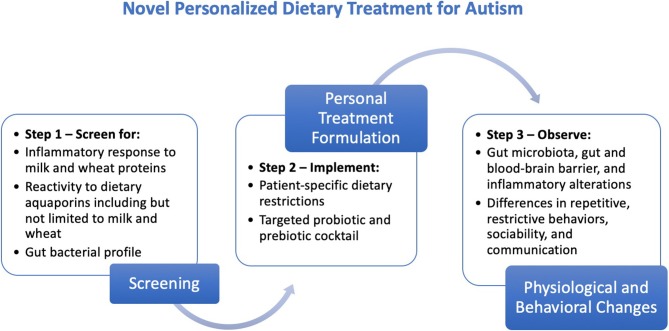
Autism spectrum disorder (ASD) is a neurodevelopmental condition manifesting with impaired social interaction and communication, and restricted and repetitive behaviors and interests. In this perspective article, a more comprehensive approach than the gut-brain axis, hereby termed the "gut-immune-endocrine-brain" axis, is taken, based on which a personalized treatment plan for ASD is presented. ASD has no known etiology or cure, making desperate parents willing to try any treatment that worked for an individual with ASD, without much regard for its effectiveness, safety or side effects. This has been the case for restrictive dietary interventions as gluten-free/casein-free and ketogenic diets and recently, probiotics have emerged as the new such fad. One of the concerns about these dietary and probiotic treatments is their non-specificity: they may not be effective for all individuals with ASD, not all probiotic strains may have the beneficial qualities advertised indiscriminately for probiotics, and strains conferring benefits in one condition may not be probiotic in another. Not all children with ASD show immune reactivity to dietary proteins in wheat and milk, and wheat and milk may not be the only dietary elements to which reactivity is exhibited, where dietary aquaporins that resemble human aquaporins may elicit antibody reactivity in genetically susceptible individuals, which may include individuals with ASD. These observations are utilized to formulate a three-step plan to create effective, targeted, personalized treatments with as few side effects as possible, enabled by a systems approach connecting the various findings for dietary, immune, and neuroautoimmune reactivity in individuals with ASD.
自闭症谱系障碍(ASD)是一种神经发育疾病,表现为社交互动和沟通受损,以及行为和兴趣受限且重复。在这篇观点文章中,我们采用了一种比肠-脑轴更全面的方法,即所谓的“肠-免疫-内分泌-脑”轴,并在此基础上提出了针对ASD的个性化治疗方案。ASD的病因不明且无法治愈,这使得绝望的父母愿意尝试任何对患有ASD的个体有效的治疗方法,而不太考虑其有效性、安全性或副作用。无麸质/无酪蛋白饮食和生酮饮食等限制性饮食干预措施就是如此,最近,益生菌也成为了新的这类热潮。对这些饮食和益生菌治疗的担忧之一是它们的非特异性:它们可能并非对所有ASD个体都有效,并非所有益生菌菌株都具有不加区分地宣传的益生菌有益特性,而且在一种情况下具有益处的菌株在另一种情况下可能并非益生菌。并非所有患有ASD的儿童都对小麦和牛奶中的饮食蛋白表现出免疫反应,而且小麦和牛奶可能不是唯一会引发反应的饮食元素,与人类水通道蛋白相似的饮食水通道蛋白可能会在基因易感性个体(可能包括患有ASD的个体)中引发抗体反应。利用这些观察结果制定了一个三步计划,以创建尽可能少副作用的有效、有针对性的个性化治疗方案,该方案通过一种系统方法实现,该方法将ASD个体饮食、免疫和神经自身免疫反应的各种发现联系起来。