Ye Meng, Pasta Mauro, Xie Xing, Dubrawski Kristian L, Xu Jianqaio, Liu Chong, Cui Yi, Criddle Craig S
Department of Civil and Environmental Engineering, Department of Materials Science and Engineering, and Woods Institute for the Environment and the Department of Civil and Environmental Engineering, Stanford University, Stanford, California 94305, United States.
Stanford Institute for Materials and Energy Sciences, SLAC National Accelerator Laboratory, Menlo Park, California 94025, United States.
ACS Omega. 2019 Jul 8;4(7):11785-11790. doi: 10.1021/acsomega.9b00863. eCollection 2019 Jul 31.
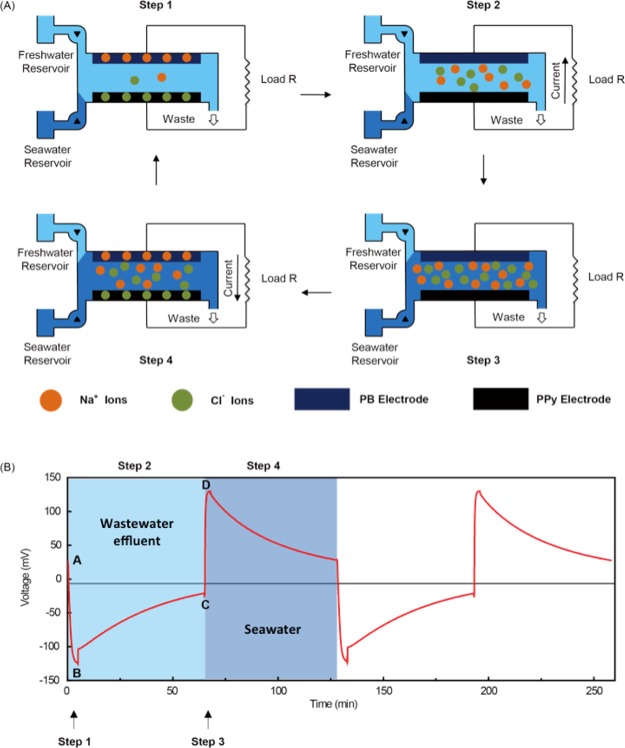
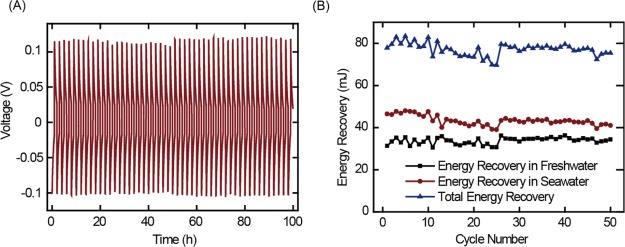
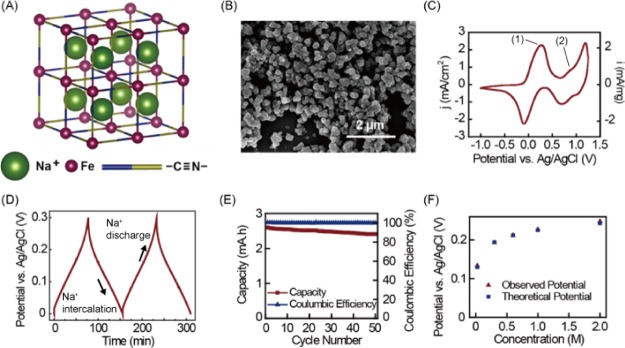
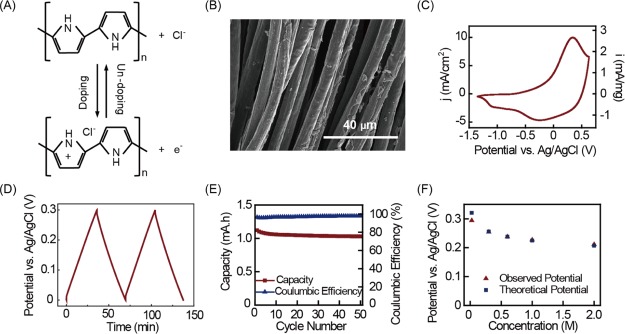
Salinity gradients are a vast and untapped energy resource. For every cubic meter of freshwater that mixes with seawater, approximately 0.65 kW h of theoretically recoverable energy is lost. For coastal wastewater treatment plants that discharge to the ocean, this energy, if recovered, could power the plant. The mixing entropy battery (MEB) uses battery electrodes to convert salinity gradient energy into electricity in a four-step process: (1) freshwater exchange; (2) charging in freshwater; (3) seawater exchange; and (4) discharging in seawater. Previously, we demonstrated a proof of concept, but with electrode materials that required an energy investment during the charging step. Here, we introduce a charge-free MEB with low-cost electrodes: Prussian Blue (PB) and polypyrrole (PPy). Importantly, this MEB requires no energy investment, and the electrode materials are stable with repeated cycling. The MEB equipped with PB and PPy achieved high voltage ratios (actual voltages obtained divided by the theoretical voltages) of 89.5% in wastewater effluent and 97.6% in seawater, with over 93% capacity retention after 50 cycles of operation and 97-99% over 150 cycles with a polyvinyl alcohol/sulfosuccinic acid (PVA/SSA) coating on the PB electrode.
盐度梯度是一种巨大且未被开发的能源资源。每立方米与海水混合的淡水,理论上大约会损失0.65千瓦时可回收能量。对于向海洋排放废水的沿海污水处理厂而言,若能回收这些能量,便可为工厂供电。混合熵电池(MEB)利用电池电极,通过四个步骤将盐度梯度能转化为电能:(1)淡水交换;(2)在淡水中充电;(3)海水交换;(4)在海水中放电。此前,我们展示了一个概念验证,但所使用的电极材料在充电步骤中需要能量投入。在此,我们推出一种采用低成本电极的无电荷MEB:普鲁士蓝(PB)和聚吡咯(PPy)。重要的是,这种MEB无需能量投入,且电极材料在反复循环使用时保持稳定。配备PB和PPy的MEB在废水排放中实现了89.5%的高电压比(实际获得的电压除以理论电压),在海水中为97.6%,在PB电极上涂覆聚乙烯醇/磺基琥珀酸(PVA/SSA)涂层后,经过50次循环操作,容量保持率超过93%,经过150次循环,容量保持率为97 - 99%。