VA Center of Excellence for Stress and Mental Health, 3350 La Jolla Village Dr., San Diego, CA, 92161, USA.
Department of Psychiatry, University of California San Diego, 9500 Gilman Dr, La Jolla, CA, 92093, USA.
BMC Health Serv Res. 2019 Aug 28;19(1):604. doi: 10.1186/s12913-019-4436-z.
Technology-based self-assessment (TB-SA) benefits patients and providers and has shown feasibility, ease of use, efficiency, and cost savings. A promising TB-SA, the VA eScreening program, has shown promise for the efficient and effective collection of mental and physical health information. To assist adoption of eScreening by healthcare providers, we assessed technology-related as well as individual- and system-level factors that might influence the implementation of eScreening in four diverse VA clinics.
This was a mixed-method, pre-post, quasi-experimental study originally designed as a quality improvement project. The clinics were selected to represent a range of environments that could potentially benefit from TB-SA and that made use of the variety eScreening functions. Because of limited resources, the implementation strategy consisted of staff education, training, and technical support as needed. Data was collected using pre- and post-implementation interviews or focus groups of leadership and clinical staff, eScreening usage data, and post-implementation surveys. Data was gathered on: 1) usability of eScreening; 2) knowledge about and acceptability and 3) facilitators and barriers to the successful implementation of eScreening.
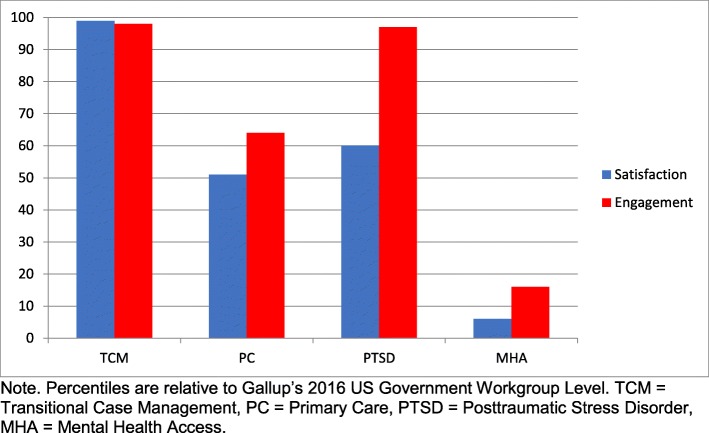
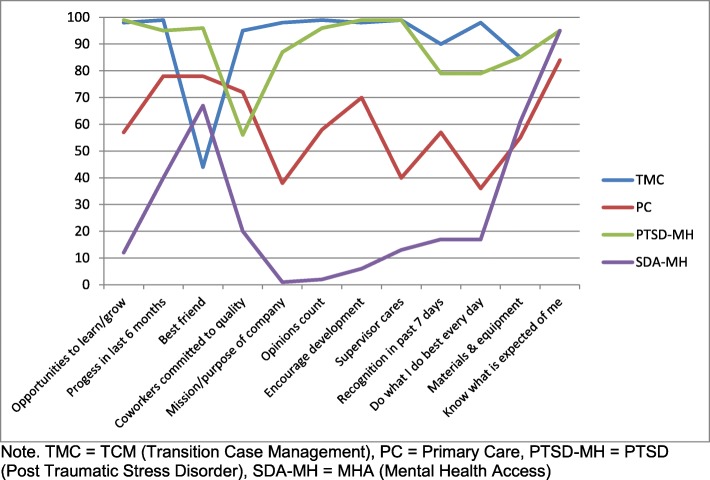
Overall, staff feedback about eScreening was positive. Knowledge about eScreening ranged widely between the clinics. Nearly all staff felt eScreening would fit well into their clinical setting at pre-implementation; however some felt it was a poor fit with emergent cases and older adults at post-implementation. Lack of adequate personnel support and perceived leadership support were barriers to implementation. Adequate training and technical assistance were cited as important facilitators. One clinic fully implemented eScreening, two partially implemented, and one clinic did not implement eScreening as part of normal practice after 6 months as measured by usage data and self-report. Organizational engagement survey scores were higher among clinics with full or partial implementation and low in the clinic that did not implement.
Despite some added work load for some staff and perceived lack of leadership support, eScreening was at least partially implemented in three clinics. The technology itself posed no barriers in any of the settings. An implementation strategy that accounts for increased work burden and includes accountability may help in future eScreening implementation efforts. Note. This abstract was previously published (e.g., Annals of Behavioral Medicine 53: S1-S842, 2019).
基于技术的自我评估(TB-SA)使患者和医疗服务提供者受益,并已显示出可行性、易用性、效率和成本节约。VA eScreening 项目是一种很有前景的 TB-SA,已显示出有效收集身心健康信息的效率和有效性。为了协助医疗服务提供者采用 eScreening,我们评估了可能影响四个不同 VA 诊所实施 eScreening 的与技术相关的以及个人和系统层面的因素。
这是一项混合方法、前后测、准实验研究,最初设计为一项质量改进项目。这些诊所是为了代表可能受益于 TB-SA 并利用各种 eScreening 功能的各种环境而选择的。由于资源有限,实施策略包括根据需要对员工进行教育、培训和技术支持。使用领导和临床工作人员的实施前和实施后的访谈或焦点小组、eScreening 使用数据以及实施后的调查收集数据。收集的数据包括:1)eScreening 的可用性;2)对 eScreening 的了解程度、接受程度和 3)成功实施 eScreening 的促进因素和障碍。
总体而言,员工对 eScreening 的反馈是积极的。诊所之间对 eScreening 的了解程度差异很大。在实施前,几乎所有的员工都觉得 eScreening 非常适合他们的临床环境;然而,一些人认为它与紧急情况和老年人不太匹配。缺乏足够的人员支持和感知到的领导支持是实施的障碍。充足的培训和技术援助被认为是重要的促进因素。一家诊所全面实施了 eScreening,两家诊所部分实施了 eScreening,一家诊所没有将其作为正常实践的一部分实施,这可以从使用数据和自我报告中看出。在完全或部分实施的诊所中,组织参与度调查的分数较高,而没有实施的诊所则较低。
尽管一些员工的工作量增加,并且感知到缺乏领导支持,但 eScreening 在三个诊所中至少部分实施。在任何环境中,该技术本身都没有造成障碍。未来的 eScreening 实施工作可能需要考虑增加工作负担并包括问责制的实施策略。注意。该摘要之前曾发表(例如,《行为医学年鉴》53:S1-S842,2019 年)。