Kalb Nadine, Randler Christoph
Department of Biology Eberhard Karls Universität Tübingen Tübingen Germany.
Ecol Evol. 2019 Jul 23;9(16):9207-9213. doi: 10.1002/ece3.5467. eCollection 2019 Aug.
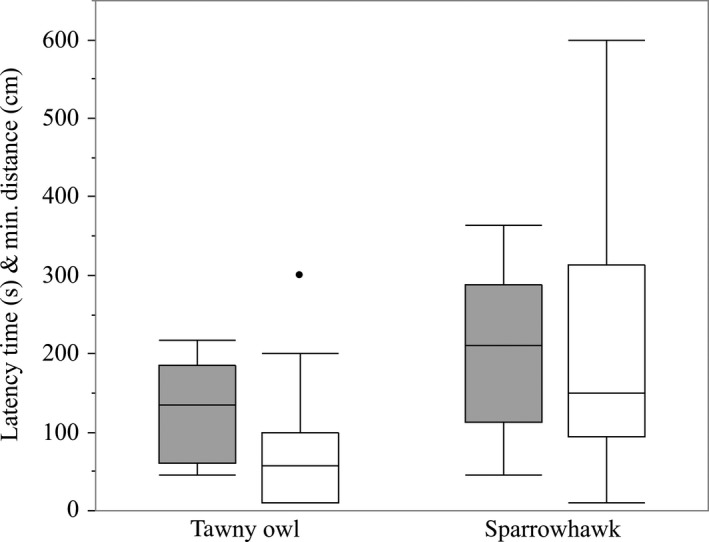
When facing a predator, animals need to perform an appropriate antipredator behavior such as escaping or mobbing to prevent predation. Many bird species exhibit distinct mobbing behaviors and vocalizations once a predator has been detected. In some species, mobbing calls transmit information about predator type, size, and threat, which can be assessed by conspecifics. We recently found that great tits () produce longer D calls with more elements and longer intervals between elements when confronted with a sparrowhawk, a high-threat predator, in comparison to calls produced in front of a less-threatening tawny owl. In the present study, we conducted a playback experiment to investigate if these differences in mobbing calls elicit different behavioral responses in adult great tits. We found tits to have a longer latency time and to keep a greater distance to the speaker when sparrowhawk mobbing calls were broadcast. This suggests that tits are capable of decoding information about predator threat in conspecific mobbing calls. We further found a tendency for males to approach faster and closer than females, which indicates that males are willing to take higher risks in a mobbing context than females.
面对捕食者时,动物需要采取适当的反捕食行为,如逃跑或围攻,以防止被捕食。一旦检测到捕食者,许多鸟类会表现出独特的围攻行为和叫声。在一些物种中,围攻叫声会传递有关捕食者类型、大小和威胁的信息,同种个体可以对这些信息进行评估。我们最近发现,与面对威胁较小的仓鸮时发出的叫声相比,大山雀在面对高威胁捕食者雀鹰时,会发出元素更多、元素之间间隔更长的D叫声。在本研究中,我们进行了一项回放实验,以调查围攻叫声的这些差异是否会在成年大山雀中引发不同的行为反应。我们发现,播放雀鹰围攻叫声时,大山雀的反应潜伏期更长,与扬声器的距离更远。这表明大山雀能够解读同种围攻叫声中有关捕食者威胁的信息。我们还进一步发现,雄性大山雀比雌性大山雀更倾向于更快、更靠近地接近扬声器,这表明在围攻情境中,雄性比雌性更愿意冒更高的风险。