Institute of Systematic Biology, University of Daugavpils, Daugavpils, Latvia.
Sci Rep. 2012;2:800. doi: 10.1038/srep00800. Epub 2012 Nov 12.
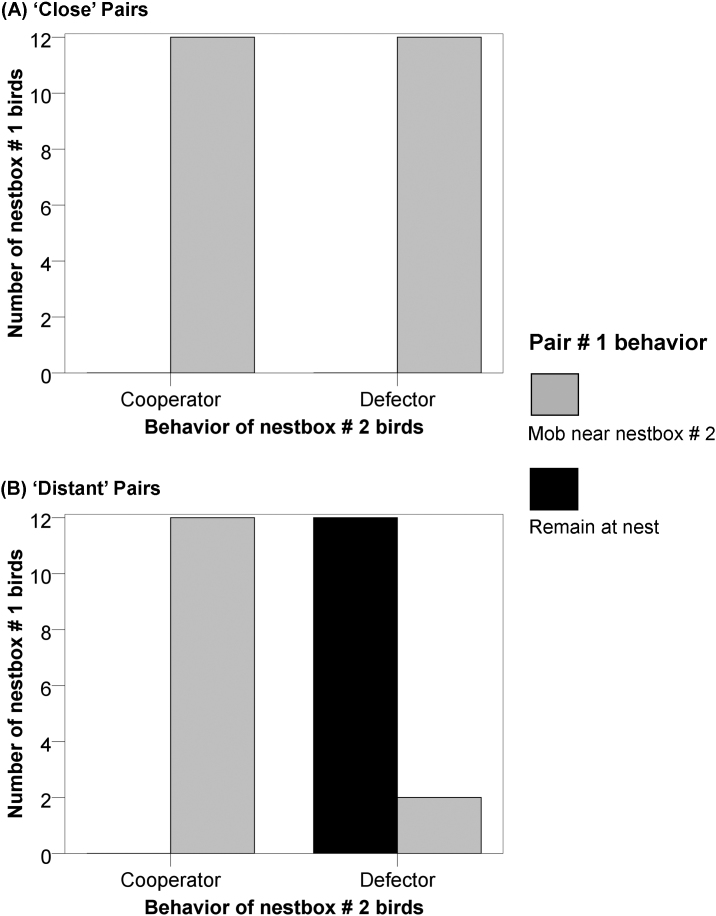
Reciprocity is fundamental to cooperative behaviour and has been verified in theoretical models. However, there is still limited experimental evidence for reciprocity in non-primate species. Our results more decisively clarify that reciprocity with a tit-for-tat enforcement strategy can occur among breeding pied flycatchers Ficedula hypoleuca separate from considerations of byproduct mutualism. Breeding pairs living in close proximity (20-24 m) did exhibit byproduct mutualism and always assisted in mobbing regardless of their neighbours' prior actions. However, breeding pairs with distant neighbours (69-84 m) either assisted or refused to assist in mobbing a predatory owl based on whether or not the distant pair had previously helped them in their own nest defense against the predator. Clearly, these birds are aware of their specific spatial security context, remember their neighbours' prior behaviour, and choose a situation-specific strategic course of action, which could promote their longer-term security, a capacity previously thought unique to primates.
互惠是合作行为的基础,在理论模型中已经得到验证。然而,在非灵长类物种中,互惠行为的实验证据仍然有限。我们的研究结果更明确地表明,具有针锋相对执行策略的互惠行为可以在繁殖期的白腰文鸟中发生,而无需考虑副产品互惠。生活在近距离(20-24 米)的繁殖对表现出副产品互惠,并且总是不顾邻居的先前行为而协助驱赶。然而,与远距离邻居(69-84 米)的繁殖对则根据远距离邻居是否在自己的巢穴防御捕食者方面帮助过他们,选择协助或拒绝协助驱赶捕食性猫头鹰。显然,这些鸟类了解自己特定的空间安全环境,记住邻居的先前行为,并选择特定情境下的策略行动,这可以促进它们的长期安全,这种能力以前被认为是灵长类动物所独有的。